

5 Experimental Fluid Mechanics
359
The method is a non-contact transient flow field measurement technique,
which is suitable for high-speed flow and large-speed gradient flow. In this
case, the Doppler velocity measurement method based on particle scattering
is no longer applicable because the particles cannot completely follow the
fluid, and the molecular luminescence-based LIF technology does not have
this limitation because LIF does not have particle followability problems.
(5) Optical tomography
Chromatography began in 1967, and began to be used for medical diagnostics and nondestructive testing of materials. CT was used for flow visualization in the mid-1980s. It is an advanced computer-aided flow visualization
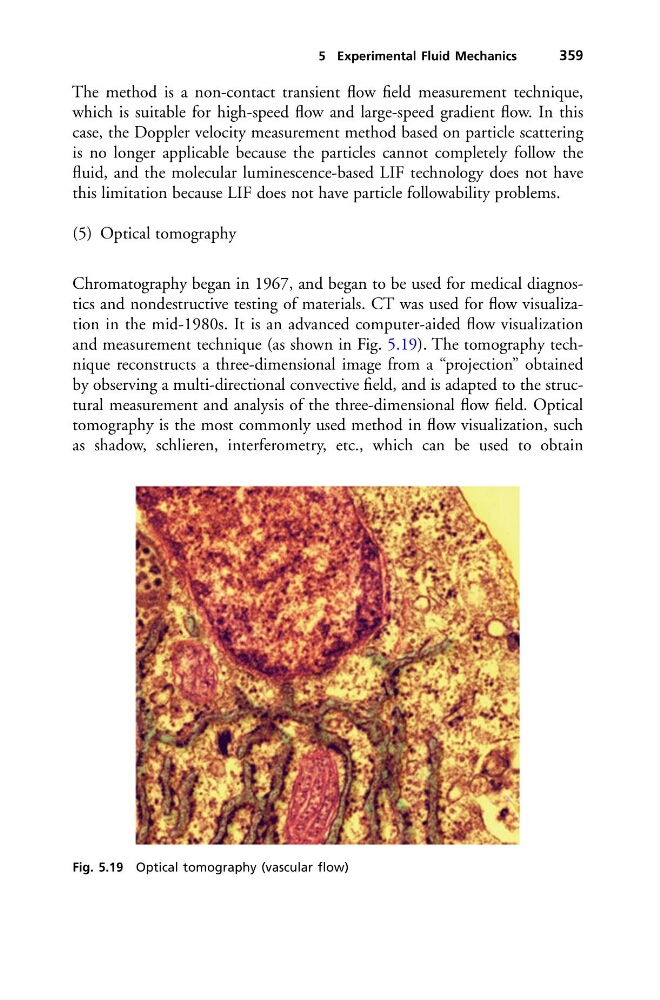
and measurement technique (as shown in Fig. 5.19). The tomography technique reconstructs a three-dimensional image from a “projection” obtained
by observing a multi-directional convective field, and is adapted to the structural measurement and analysis of the three-dimensional flow field. Optical
tomography is the most commonly used method in flow visualization, such
as shadow, schlieren, interferometry, etc., which can be used to obtain
Fig. 5.19 Optical tomography (vascular flow)
359
The method is a non-contact transient flow field measurement technique,
which is suitable for high-speed flow and large-speed gradient flow. In this
case, the Doppler velocity measurement method based on particle scattering
is no longer applicable because the particles cannot completely follow the
fluid, and the molecular luminescence-based LIF technology does not have
this limitation because LIF does not have particle followability problems.
(5) Optical tomography
Chromatography began in 1967, and began to be used for medical diagnostics and nondestructive testing of materials. CT was used for flow visualization in the mid-1980s. It is an advanced computer-aided flow visualization
and measurement technique (as shown in Fig. 5.19). The tomography technique reconstructs a three-dimensional image from a “projection” obtained
by observing a multi-directional convective field, and is adapted to the structural measurement and analysis of the three-dimensional flow field. Optical
tomography is the most commonly used method in flow visualization, such
as shadow, schlieren, interferometry, etc., which can be used to obtain
Fig. 5.19 Optical tomography (vascular flow)