

360
P. Liu
multi-directional “projection”, but it is more important to combine the interferometer with computer tomography technology to obtain quantitative 3D
flow visualization. The three-dimensional density field and concentration
field can be obtained by conventional interferometric tomography, and the
three-dimensional temperature field can also be obtained by holographic
interference tomography. Images of different sections can be obtained at
different instants or at the same instant using multi-directional interferometry. The former can only be used for constant flow, and the latter can also
be used for unsteady flow.
(6) Optical surface pressure measurement technique
The basic principle of optical surface pressure measurement is to apply a pressure sensitive paint (PSP) to the surface of the model. Under ultraviolet light
or other light of a given wavelength, the coating emits fluorescence of visible
wavelength. Its brightness is inversely proportional to the absolute pressure
of the air or any oxygen containing gas acting on the surface of the coating.
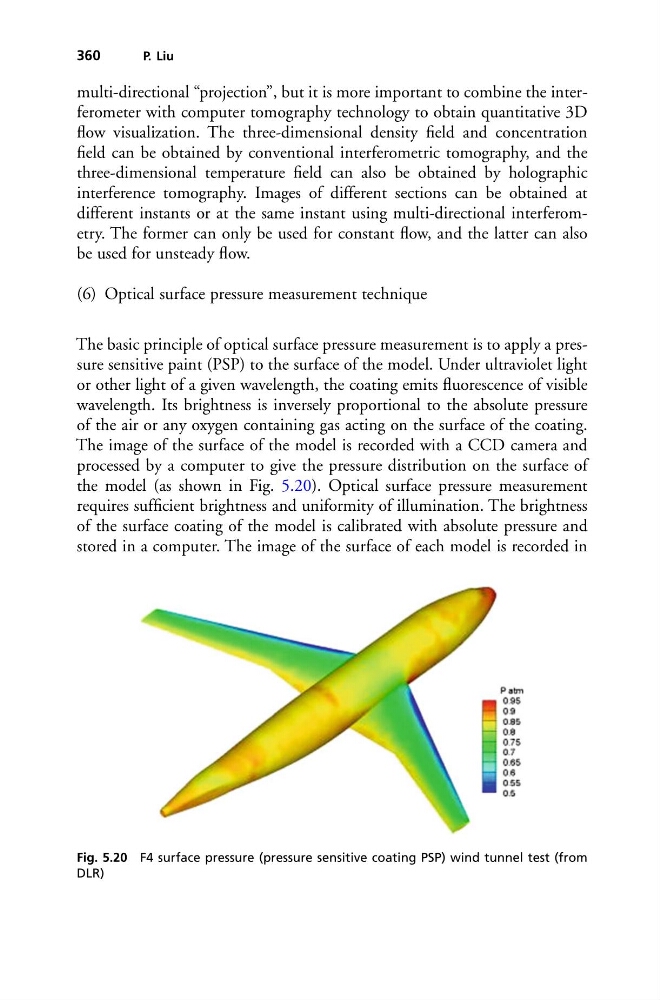
The image of the surface of the model is recorded with a CCD camera and
processed by a computer to give the pressure distribution on the surface of
the model (as shown in Fig. 5.20). Optical surface pressure measurement
requires sufficient brightness and uniformity of illumination. The brightness
of the surface coating of the model is calibrated with absolute pressure and
stored in a computer. The image of the surface of each model is recorded in
Fig. 5.20 F4 surface pressure (pressure sensitive coating PSP) wind tunnel test (from
DLR)
P. Liu
multi-directional “projection”, but it is more important to combine the interferometer with computer tomography technology to obtain quantitative 3D
flow visualization. The three-dimensional density field and concentration
field can be obtained by conventional interferometric tomography, and the
three-dimensional temperature field can also be obtained by holographic
interference tomography. Images of different sections can be obtained at
different instants or at the same instant using multi-directional interferometry. The former can only be used for constant flow, and the latter can also
be used for unsteady flow.
(6) Optical surface pressure measurement technique
The basic principle of optical surface pressure measurement is to apply a pressure sensitive paint (PSP) to the surface of the model. Under ultraviolet light
or other light of a given wavelength, the coating emits fluorescence of visible
wavelength. Its brightness is inversely proportional to the absolute pressure
of the air or any oxygen containing gas acting on the surface of the coating.
The image of the surface of the model is recorded with a CCD camera and
processed by a computer to give the pressure distribution on the surface of
the model (as shown in Fig. 5.20). Optical surface pressure measurement
requires sufficient brightness and uniformity of illumination. The brightness
of the surface coating of the model is calibrated with absolute pressure and
stored in a computer. The image of the surface of each model is recorded in
Fig. 5.20 F4 surface pressure (pressure sensitive coating PSP) wind tunnel test (from
DLR)