

266
P. Liu
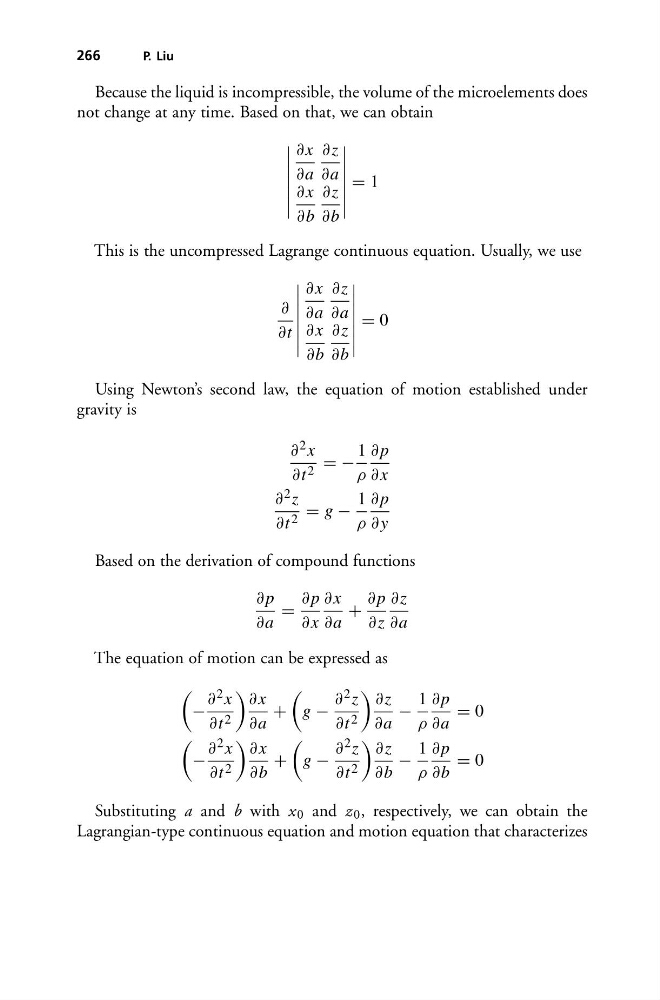
Because the liquid is incompressible, the volume of the microelements does
not change at any time. Based on that, we can obtain
∂ x
∂a
∂z
∂a
∂ x
∂b
∂z
∂b
= 1
This is the uncompressed Lagrange continuous equation. Usually, we use
∂
∂t
∂ x
∂a
∂z
∂a
∂ x
∂b
∂z
∂b
= 0
Using Newton’s second law, the equation of motion established under
gravity is
∂ 2 x
∂t 2 = −
1
ρ
∂ p
∂ x
∂ 2 z
∂t 2 = g −
1
ρ
∂ p
∂ y
Based on the derivation of compound functions
∂ p
∂a
=
∂ p
∂ x
∂ x
∂a
+
∂ p
∂z
∂z
∂a
The equation of motion can be expressed as
−
∂ 2 x
∂t 2
∂ x
∂a
+
g −
∂ 2 z
∂t 2
∂z
∂a
−
1
ρ
∂ p
∂a
= 0
−
∂ 2 x
∂t 2
∂ x
∂b
+
g −
∂ 2 z
∂t 2
∂z
∂b
−
1
ρ
∂ p
∂b
= 0
Substituting a and b with x 0 and z 0 , respectively, we can obtain the
Lagrangian-type continuous equation and motion equation that characterizes
P. Liu
Because the liquid is incompressible, the volume of the microelements does
not change at any time. Based on that, we can obtain
∂ x
∂a
∂z
∂a
∂ x
∂b
∂z
∂b
= 1
This is the uncompressed Lagrange continuous equation. Usually, we use
∂
∂t
∂ x
∂a
∂z
∂a
∂ x
∂b
∂z
∂b
= 0
Using Newton’s second law, the equation of motion established under
gravity is
∂ 2 x
∂t 2 = −
1
ρ
∂ p
∂ x
∂ 2 z
∂t 2 = g −
1
ρ
∂ p
∂ y
Based on the derivation of compound functions
∂ p
∂a
=
∂ p
∂ x
∂ x
∂a
+
∂ p
∂z
∂z
∂a
The equation of motion can be expressed as
−
∂ 2 x
∂t 2
∂ x
∂a
+
g −
∂ 2 z
∂t 2
∂z
∂a
−
1
ρ
∂ p
∂a
= 0
−
∂ 2 x
∂t 2
∂ x
∂b
+
g −
∂ 2 z
∂t 2
∂z
∂b
−
1
ρ
∂ p
∂b
= 0
Substituting a and b with x 0 and z 0 , respectively, we can obtain the
Lagrangian-type continuous equation and motion equation that characterizes