

3 Hydrodynamics
265
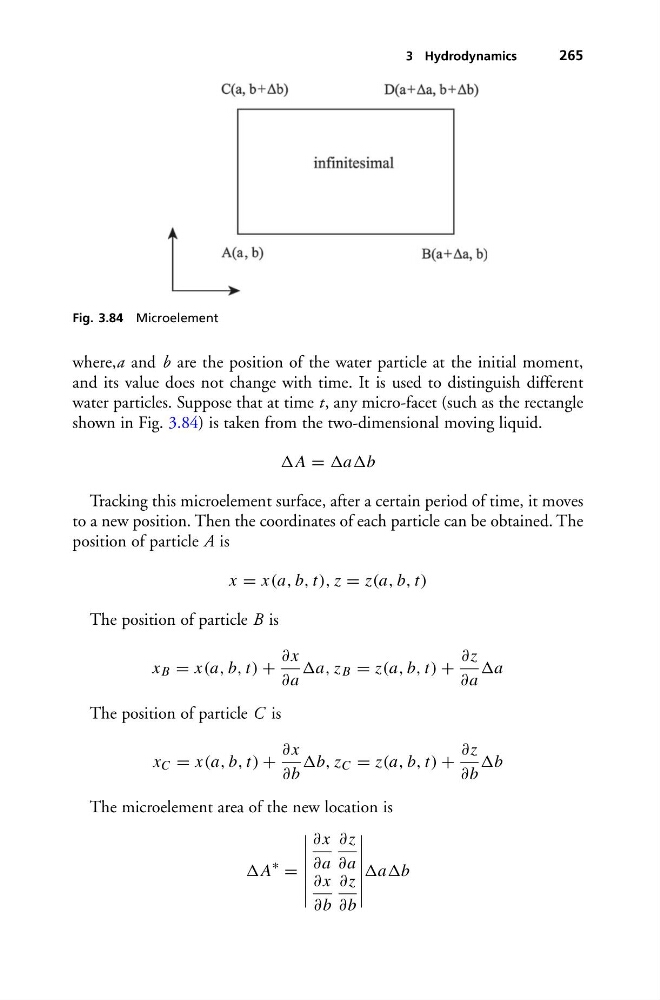
Fig. 3.84 Microelement
where,a and b are the position of the water particle at the initial moment,
and its value does not change with time. It is used to distinguish different
water particles. Suppose that at time t, any micro-facet (such as the rectangle
shown in Fig. 3.84) is taken from the two-dimensional moving liquid.
A = ab
Tracking this microelement surface, after a certain period of time, it moves
to a new position. Then the coordinates of each particle can be obtained. The
position of particle A is
x = x(a, b, t), z = z(a, b, t)
The position of particle B is
x B = x(a, b, t) +
∂ x
∂a
a, z B = z(a, b, t) +
∂z
∂a
a
The position of particle C is
x C = x(a, b, t) +
∂ x
∂b
b, z C = z(a, b, t) +
∂z
∂b
b
The microelement area of the new location is
A
∗
=
∂ x
∂a
∂z
∂a
∂ x
∂b
∂z
∂b
ab
265
Fig. 3.84 Microelement
where,a and b are the position of the water particle at the initial moment,
and its value does not change with time. It is used to distinguish different
water particles. Suppose that at time t, any micro-facet (such as the rectangle
shown in Fig. 3.84) is taken from the two-dimensional moving liquid.
A = ab
Tracking this microelement surface, after a certain period of time, it moves
to a new position. Then the coordinates of each particle can be obtained. The
position of particle A is
x = x(a, b, t), z = z(a, b, t)
The position of particle B is
x B = x(a, b, t) +
∂ x
∂a
a, z B = z(a, b, t) +
∂z
∂a
a
The position of particle C is
x C = x(a, b, t) +
∂ x
∂b
b, z C = z(a, b, t) +
∂z
∂b
b
The microelement area of the new location is
A
∗
=
∂ x
∂a
∂z
∂a
∂ x
∂b
∂z
∂b
ab