

3 Hydrodynamics
267
the motion of the particle as follows:
∂
∂t
∂ x
∂ x 0
∂z
∂ x 0
∂ x
∂z 0
∂z
∂z 0
= 0
−
∂ 2 x
∂t 2
∂ x
∂ x 0
+
g −
∂ 2 z
∂t 2
∂z
∂ x 0
−
1
ρ
∂ p
∂ x 0
= 0
−
∂ 2 x
∂t 2
∂ x
∂z 0
+
g −
∂ 2 z
∂t 2
∂z
∂z 0
−
1
ρ
∂ p
∂z 0
= 0
(1) Deepwater propulsion wave (circle trochoid theory)
For finite-amplitude deepwater propulsion waves, a commonly used approximation theory is the circle trochoid theory proposed by German physicist
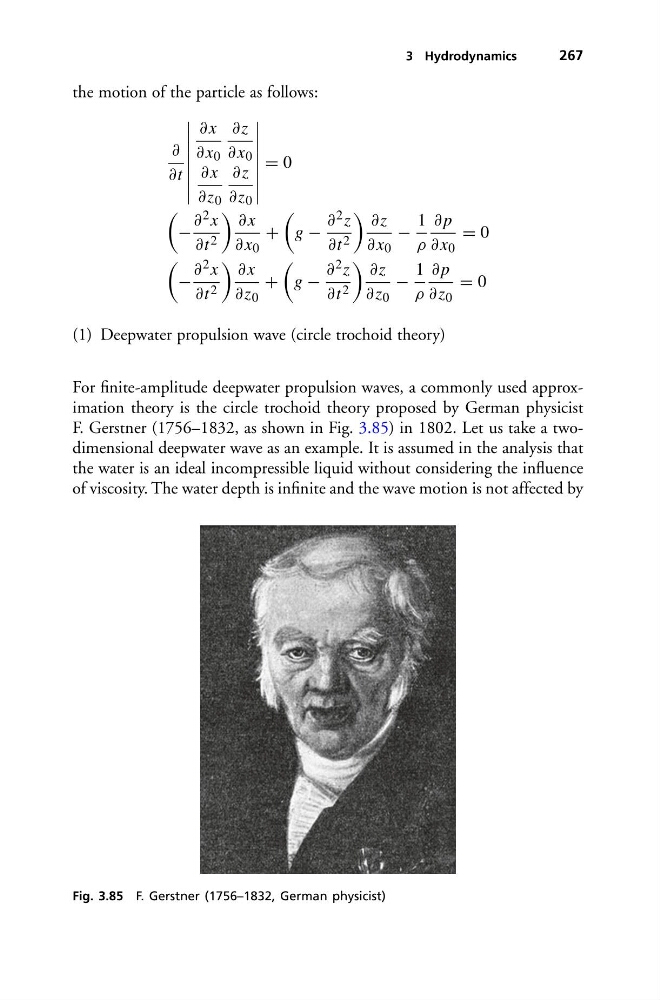
F. Gerstner (1756–1832, as shown in Fig. 3.85) in 1802. Let us take a twodimensional deepwater wave as an example. It is assumed in the analysis that
the water is an ideal incompressible liquid without considering the influence
of viscosity. The water depth is infinite and the wave motion is not affected by
Fig. 3.85 F. Gerstner (1756–1832, German physicist)
267
the motion of the particle as follows:
∂
∂t
∂ x
∂ x 0
∂z
∂ x 0
∂ x
∂z 0
∂z
∂z 0
= 0
−
∂ 2 x
∂t 2
∂ x
∂ x 0
+
g −
∂ 2 z
∂t 2
∂z
∂ x 0
−
1
ρ
∂ p
∂ x 0
= 0
−
∂ 2 x
∂t 2
∂ x
∂z 0
+
g −
∂ 2 z
∂t 2
∂z
∂z 0
−
1
ρ
∂ p
∂z 0
= 0
(1) Deepwater propulsion wave (circle trochoid theory)
For finite-amplitude deepwater propulsion waves, a commonly used approximation theory is the circle trochoid theory proposed by German physicist
F. Gerstner (1756–1832, as shown in Fig. 3.85) in 1802. Let us take a twodimensional deepwater wave as an example. It is assumed in the analysis that
the water is an ideal incompressible liquid without considering the influence
of viscosity. The water depth is infinite and the wave motion is not affected by
Fig. 3.85 F. Gerstner (1756–1832, German physicist)