

3 Hydrodynamics
257
At the free surface, the dynamic and kinematic conditions need to be
satisfied. Let the free surface equation be
z = η(x, y, t)
On the free surface, p = p a , the kinetic condition of the free surface is
obtained using the energy equation
∂ϕ(x, y, η, t)
∂t
+
1
2
V
2
+ gη = 0
Since the free surface is a flow surface, its kinematic condition is
w −
∂η
∂t
− u
∂η
∂ x
− v
∂μ
∂ y
= 0
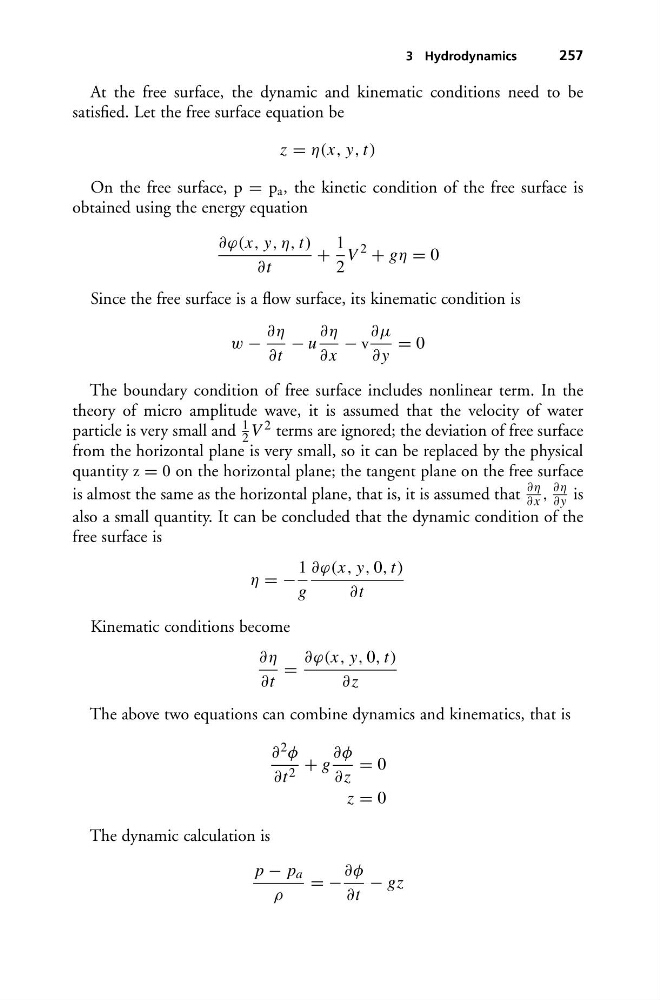
The boundary condition of free surface includes nonlinear term. In the
theory of micro amplitude wave, it is assumed that the velocity of water
particle is very small and
1
2 V 2 terms are ignored; the deviation of free surface
from the horizontal plane is very small, so it can be replaced by the physical
quantity z = 0 on the horizontal plane; the tangent plane on the free surface
is almost the same as the horizontal plane, that is, it is assumed that
∂η
∂ x ,
∂η
∂ y is
also a small quantity. It can be concluded that the dynamic condition of the
free surface is
η = −
1
g
∂ϕ(x, y, 0, t)
∂t
Kinematic conditions become
∂η
∂t
=
∂ϕ(x, y, 0, t)
∂z
The above two equations can combine dynamics and kinematics, that is
∂ 2 φ
∂t 2 + g
∂φ
∂z
= 0
z = 0
The dynamic calculation is
p − p a
ρ
= −
∂φ
∂t
− gz
257
At the free surface, the dynamic and kinematic conditions need to be
satisfied. Let the free surface equation be
z = η(x, y, t)
On the free surface, p = p a , the kinetic condition of the free surface is
obtained using the energy equation
∂ϕ(x, y, η, t)
∂t
+
1
2
V
2
+ gη = 0
Since the free surface is a flow surface, its kinematic condition is
w −
∂η
∂t
− u
∂η
∂ x
− v
∂μ
∂ y
= 0
The boundary condition of free surface includes nonlinear term. In the
theory of micro amplitude wave, it is assumed that the velocity of water
particle is very small and
1
2 V 2 terms are ignored; the deviation of free surface
from the horizontal plane is very small, so it can be replaced by the physical
quantity z = 0 on the horizontal plane; the tangent plane on the free surface
is almost the same as the horizontal plane, that is, it is assumed that
∂η
∂ x ,
∂η
∂ y is
also a small quantity. It can be concluded that the dynamic condition of the
free surface is
η = −
1
g
∂ϕ(x, y, 0, t)
∂t
Kinematic conditions become
∂η
∂t
=
∂ϕ(x, y, 0, t)
∂z
The above two equations can combine dynamics and kinematics, that is
∂ 2 φ
∂t 2 + g
∂φ
∂z
= 0
z = 0
The dynamic calculation is
p − p a
ρ
= −
∂φ
∂t
− gz