

256
P. Liu
∂v
∂t
+ u
∂v
∂ x
+ v
∂v
∂ y
+ w
∂v
∂z
= −
1
ρ
∂ p
∂ y
∂w
∂t
+ u
∂w
∂ x
+ v
∂w
∂ y
+ w
∂w
∂z
= −
1
ρ
∂ p
∂z
− g
∂u
∂ x
+
∂v
∂ y
+
∂w
∂z
= 0
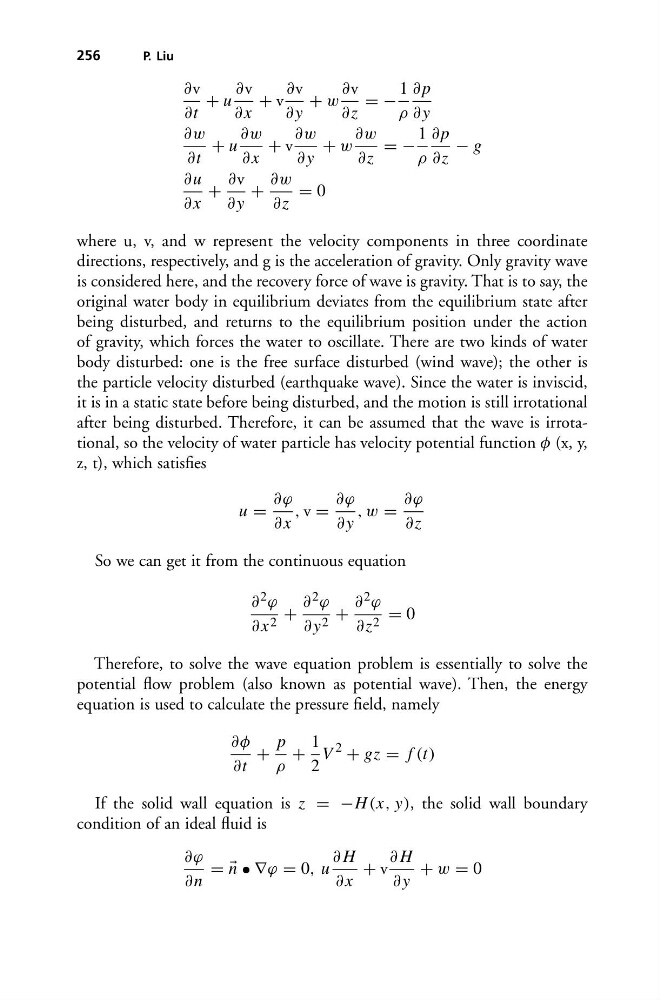
where u, v, and w represent the velocity components in three coordinate
directions, respectively, and g is the acceleration of gravity. Only gravity wave
is considered here, and the recovery force of wave is gravity. That is to say, the
original water body in equilibrium deviates from the equilibrium state after
being disturbed, and returns to the equilibrium position under the action
of gravity, which forces the water to oscillate. There are two kinds of water
body disturbed: one is the free surface disturbed (wind wave); the other is
the particle velocity disturbed (earthquake wave). Since the water is inviscid,
it is in a static state before being disturbed, and the motion is still irrotational
after being disturbed. Therefore, it can be assumed that the wave is irrotational, so the velocity of water particle has velocity potential function φ (x, y,
z, t), which satisfies
u =
∂ϕ
∂ x
, v =
∂ϕ
∂ y
, w =
∂ϕ
∂z
So we can get it from the continuous equation
∂ 2 ϕ
∂ x 2 +
∂ 2 ϕ
∂ y 2 +
∂ 2 ϕ
∂z 2 = 0
Therefore, to solve the wave equation problem is essentially to solve the
potential flow problem (also known as potential wave). Then, the energy
equation is used to calculate the pressure field, namely
∂φ
∂t
+
p
ρ
+
1
2
V
2
+ gz = f (t)
If the solid wall equation is z = −H (x, y), the solid wall boundary
condition of an ideal fluid is
∂ϕ
∂n
= =
n • ∇ϕ = 0, u
∂ H
∂ x
+ v
∂ H
∂ y
+ w = 0
P. Liu
∂v
∂t
+ u
∂v
∂ x
+ v
∂v
∂ y
+ w
∂v
∂z
= −
1
ρ
∂ p
∂ y
∂w
∂t
+ u
∂w
∂ x
+ v
∂w
∂ y
+ w
∂w
∂z
= −
1
ρ
∂ p
∂z
− g
∂u
∂ x
+
∂v
∂ y
+
∂w
∂z
= 0
where u, v, and w represent the velocity components in three coordinate
directions, respectively, and g is the acceleration of gravity. Only gravity wave
is considered here, and the recovery force of wave is gravity. That is to say, the
original water body in equilibrium deviates from the equilibrium state after
being disturbed, and returns to the equilibrium position under the action
of gravity, which forces the water to oscillate. There are two kinds of water
body disturbed: one is the free surface disturbed (wind wave); the other is
the particle velocity disturbed (earthquake wave). Since the water is inviscid,
it is in a static state before being disturbed, and the motion is still irrotational
after being disturbed. Therefore, it can be assumed that the wave is irrotational, so the velocity of water particle has velocity potential function φ (x, y,
z, t), which satisfies
u =
∂ϕ
∂ x
, v =
∂ϕ
∂ y
, w =
∂ϕ
∂z
So we can get it from the continuous equation
∂ 2 ϕ
∂ x 2 +
∂ 2 ϕ
∂ y 2 +
∂ 2 ϕ
∂z 2 = 0
Therefore, to solve the wave equation problem is essentially to solve the
potential flow problem (also known as potential wave). Then, the energy
equation is used to calculate the pressure field, namely
∂φ
∂t
+
p
ρ
+
1
2
V
2
+ gz = f (t)
If the solid wall equation is z = −H (x, y), the solid wall boundary
condition of an ideal fluid is
∂ϕ
∂n
= =
n • ∇ϕ = 0, u
∂ H
∂ x
+ v
∂ H
∂ y
+ w = 0