

258
P. Liu
(2) Basic solution
In the wave problem, we mainly study the shape of free surface, the propagation speed of wave, the velocity and trajectory of water particle, wave energy,
and so on. For two-dimensional problems, the Laplace equation is solved
by the method of separating variables. The general solution of its velocity
potential function is
ϕ(x, z) = cosh k(z + H )(A
∗ sin kx + B
∗ cos kx)
where k is the wave number and H is the water depth. The constants A * and
B * are determined by free surface conditions, which are functions of time in
wave problems. If the problem of surface tension is not considered, the free
surface condition is substituted and a basic solution is obtained
ϕ(x, z) = A cosh k(z + H ) sin(kx − ωt)
Among them, ω 2 = gk tanh k H. This is a typical velocity potential function of progressive wave. If the wave velocity is a = ω/k = λ f =
gλ
2π , the
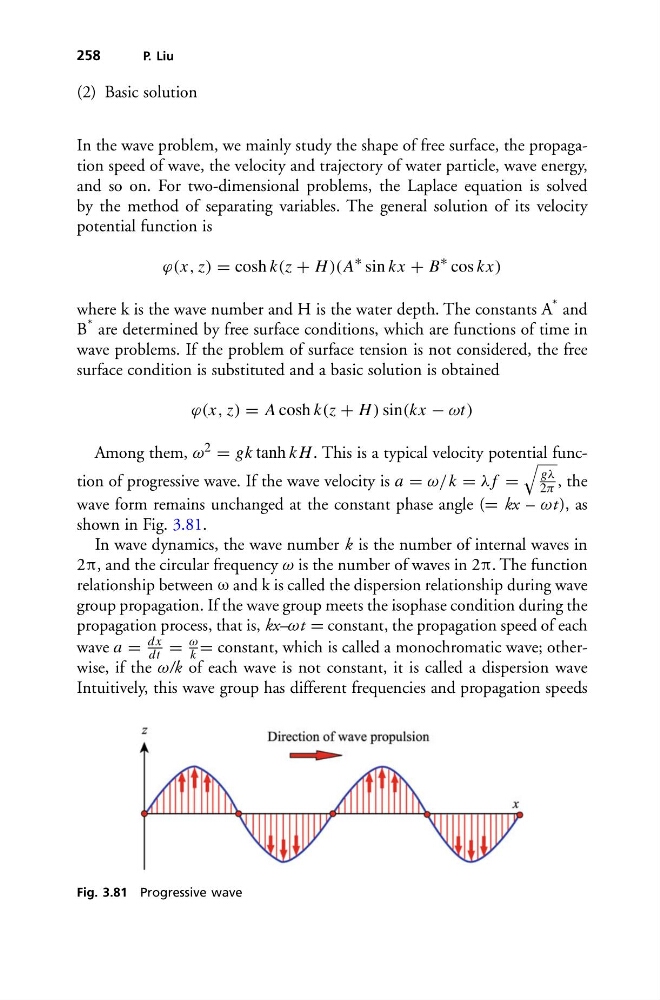
wave form remains unchanged at the constant phase angle (= kx – ωt ), as
shown in Fig. 3.81.
In wave dynamics, the wave number k is the number of internal waves in
2π, and the circular frequency ω is the number of waves in 2π. The function
relationship between ω and k is called the dispersion relationship during wave
group propagation. If the wave group meets the isophase condition during the
propagation process, that is, kx–ωt = constant, the propagation speed of each
wave a =
dx
dt =
ω
k = constant, which is called a monochromatic wave; otherwise, if the ω/k of each wave is not constant, it is called a dispersion wave
Intuitively, this wave group has different frequencies and propagation speeds
Fig. 3.81 Progressive wave
P. Liu
(2) Basic solution
In the wave problem, we mainly study the shape of free surface, the propagation speed of wave, the velocity and trajectory of water particle, wave energy,
and so on. For two-dimensional problems, the Laplace equation is solved
by the method of separating variables. The general solution of its velocity
potential function is
ϕ(x, z) = cosh k(z + H )(A
∗ sin kx + B
∗ cos kx)
where k is the wave number and H is the water depth. The constants A * and
B * are determined by free surface conditions, which are functions of time in
wave problems. If the problem of surface tension is not considered, the free
surface condition is substituted and a basic solution is obtained
ϕ(x, z) = A cosh k(z + H ) sin(kx − ωt)
Among them, ω 2 = gk tanh k H. This is a typical velocity potential function of progressive wave. If the wave velocity is a = ω/k = λ f =
gλ
2π , the
wave form remains unchanged at the constant phase angle (= kx – ωt ), as
shown in Fig. 3.81.
In wave dynamics, the wave number k is the number of internal waves in
2π, and the circular frequency ω is the number of waves in 2π. The function
relationship between ω and k is called the dispersion relationship during wave
group propagation. If the wave group meets the isophase condition during the
propagation process, that is, kx–ωt = constant, the propagation speed of each
wave a =
dx
dt =
ω
k = constant, which is called a monochromatic wave; otherwise, if the ω/k of each wave is not constant, it is called a dispersion wave
Intuitively, this wave group has different frequencies and propagation speeds
Fig. 3.81 Progressive wave