

244
P. Liu
two adjacent wave crests; wave steepness refers to the ratio of wave height and
wavelength.
The wave centerline is defined as the horizontal line of bisector wave
height. In fact, due to the sharp crest and flat trough, the distance from the
static water surface to the crest is greater than the distance from the static
water surface to the trough, so the middle line of the wave is often located
above the static water surface, and the height beyond it is called superelevation. The time that a complete wave process is repeated is called wave period
T. In the process of wave motion, the wave whose waveform moves forward
is called the progressive wave. In the progressive wave, the velocity of wave
crest moving along the horizontal direction is called wave velocity, a = λ/T .
Wave height, wavelength, wave steepness, wave velocity, and wave period are
called wave elements.
If the water particle moves in a circle with the wave height h as the diameter, the average speed is V m = πh/T , and the ratio between the water
particle and the wave speed can be expressed as
V m
a
=
π h/T
λ/T
= π
h
λ
Generally, the wave height is much smaller than the wavelength, usually
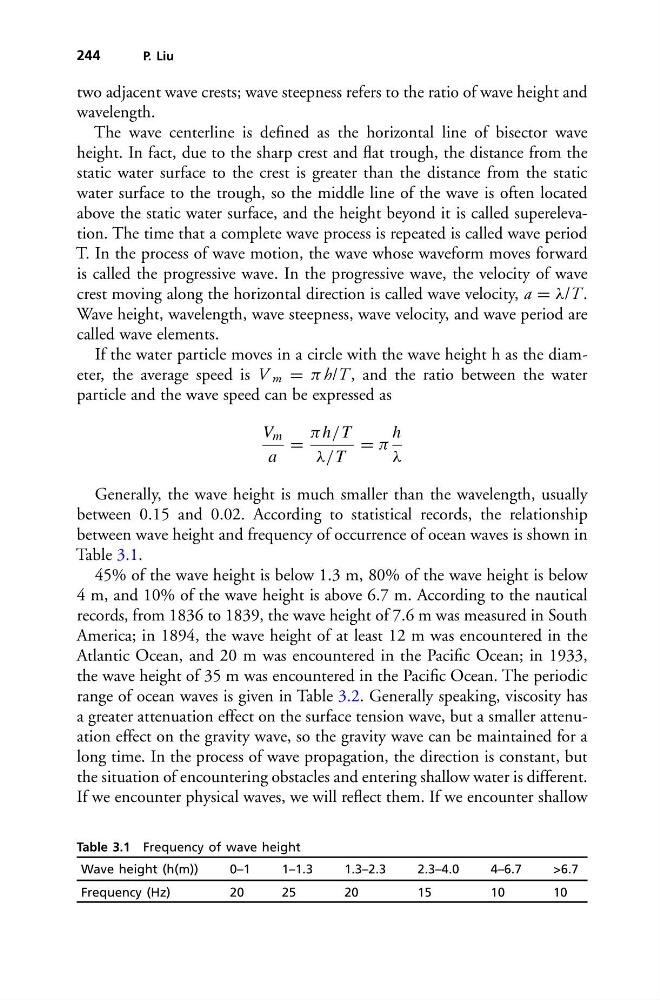
between 0.15 and 0.02. According to statistical records, the relationship
between wave height and frequency of occurrence of ocean waves is shown in
Table 3.1.
45% of the wave height is below 1.3 m, 80% of the wave height is below
4 m, and 10% of the wave height is above 6.7 m. According to the nautical
records, from 1836 to 1839, the wave height of 7.6 m was measured in South
America; in 1894, the wave height of at least 12 m was encountered in the
Atlantic Ocean, and 20 m was encountered in the Pacific Ocean; in 1933,
the wave height of 35 m was encountered in the Pacific Ocean. The periodic
range of ocean waves is given in Table 3.2. Generally speaking, viscosity has
a greater attenuation effect on the surface tension wave, but a smaller attenuation effect on the gravity wave, so the gravity wave can be maintained for a
long time. In the process of wave propagation, the direction is constant, but
the situation of encountering obstacles and entering shallow water is different.
If we encounter physical waves, we will reflect them. If we encounter shallow
Table 3.1 Frequency of wave height
Wave height (h(m))
0–1
1–1.3
1.3–2.3
2.3–4.0
4–6.7
>6.7
Frequency (Hz)
20
25
20
15
10
10
P. Liu
two adjacent wave crests; wave steepness refers to the ratio of wave height and
wavelength.
The wave centerline is defined as the horizontal line of bisector wave
height. In fact, due to the sharp crest and flat trough, the distance from the
static water surface to the crest is greater than the distance from the static
water surface to the trough, so the middle line of the wave is often located
above the static water surface, and the height beyond it is called superelevation. The time that a complete wave process is repeated is called wave period
T. In the process of wave motion, the wave whose waveform moves forward
is called the progressive wave. In the progressive wave, the velocity of wave
crest moving along the horizontal direction is called wave velocity, a = λ/T .
Wave height, wavelength, wave steepness, wave velocity, and wave period are
called wave elements.
If the water particle moves in a circle with the wave height h as the diameter, the average speed is V m = πh/T , and the ratio between the water
particle and the wave speed can be expressed as
V m
a
=
π h/T
λ/T
= π
h
λ
Generally, the wave height is much smaller than the wavelength, usually
between 0.15 and 0.02. According to statistical records, the relationship
between wave height and frequency of occurrence of ocean waves is shown in
Table 3.1.
45% of the wave height is below 1.3 m, 80% of the wave height is below
4 m, and 10% of the wave height is above 6.7 m. According to the nautical
records, from 1836 to 1839, the wave height of 7.6 m was measured in South
America; in 1894, the wave height of at least 12 m was encountered in the
Atlantic Ocean, and 20 m was encountered in the Pacific Ocean; in 1933,
the wave height of 35 m was encountered in the Pacific Ocean. The periodic
range of ocean waves is given in Table 3.2. Generally speaking, viscosity has
a greater attenuation effect on the surface tension wave, but a smaller attenuation effect on the gravity wave, so the gravity wave can be maintained for a
long time. In the process of wave propagation, the direction is constant, but
the situation of encountering obstacles and entering shallow water is different.
If we encounter physical waves, we will reflect them. If we encounter shallow
Table 3.1 Frequency of wave height
Wave height (h(m))
0–1
1–1.3
1.3–2.3
2.3–4.0
4–6.7
>6.7
Frequency (Hz)
20
25
20
15
10
10