

3 Hydrodynamics
245
Table 3.2 Ocean wave period
Wind velocity (m/s)
5
10
20
Average period (s)
2.86
5.0
11.4
Cycle upper limit (s)
1.0
3.0
6.5
Lower period limit (s)
6.0
11.1
21.7
water waves, we will refract them. The influence of wave on depth is attenuated exponentially. In deepwater, a wave with a height of 5 m and a length of
150 m can only cause a movement with a diameter of 60 cm at 50 m below
the water surface, and the water particle velocity is reduced from 1.6 m/s to
0.2 m/s. Under 15 m, 2–3 m waves have little effect.
3.8.2 Basic Characteristics of Wave Motion
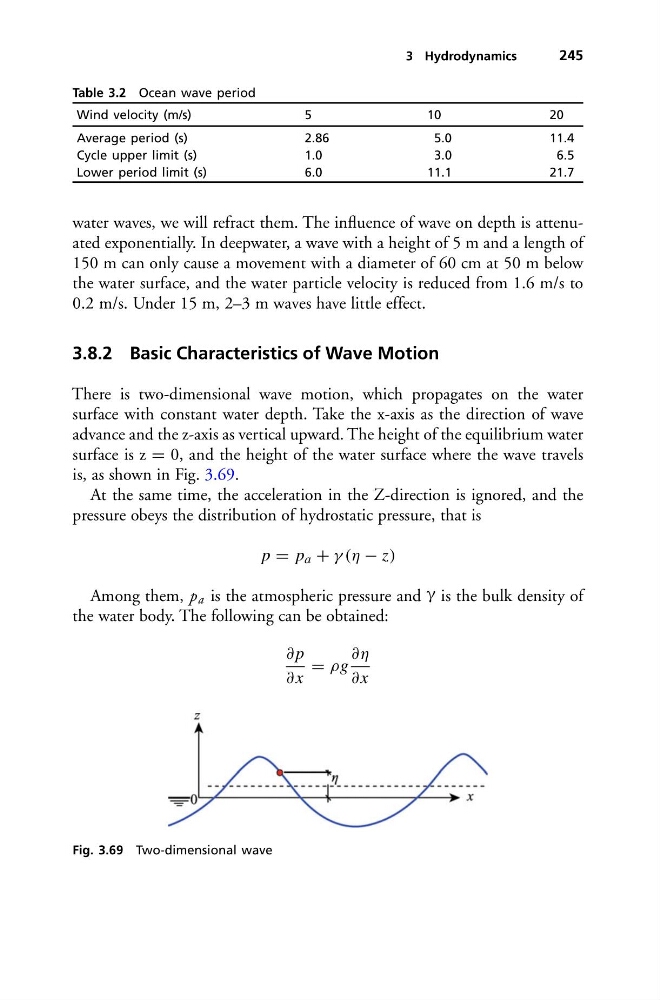
There is two-dimensional wave motion, which propagates on the water
surface with constant water depth. Take the x-axis as the direction of wave
advance and the z-axis as vertical upward. The height of the equilibrium water
surface is z = 0, and the height of the water surface where the wave travels
is, as shown in Fig. 3.69.
At the same time, the acceleration in the Z-direction is ignored, and the
pressure obeys the distribution of hydrostatic pressure, that is
p = p a + γ (η − z)
Among them, p a is the atmospheric pressure and γ is the bulk density of
the water body. The following can be obtained:
∂ p
∂ x
= ρg
∂η
∂ x
Fig. 3.69 Two-dimensional wave
245
Table 3.2 Ocean wave period
Wind velocity (m/s)
5
10
20
Average period (s)
2.86
5.0
11.4
Cycle upper limit (s)
1.0
3.0
6.5
Lower period limit (s)
6.0
11.1
21.7
water waves, we will refract them. The influence of wave on depth is attenuated exponentially. In deepwater, a wave with a height of 5 m and a length of
150 m can only cause a movement with a diameter of 60 cm at 50 m below
the water surface, and the water particle velocity is reduced from 1.6 m/s to
0.2 m/s. Under 15 m, 2–3 m waves have little effect.
3.8.2 Basic Characteristics of Wave Motion
There is two-dimensional wave motion, which propagates on the water
surface with constant water depth. Take the x-axis as the direction of wave
advance and the z-axis as vertical upward. The height of the equilibrium water
surface is z = 0, and the height of the water surface where the wave travels
is, as shown in Fig. 3.69.
At the same time, the acceleration in the Z-direction is ignored, and the
pressure obeys the distribution of hydrostatic pressure, that is
p = p a + γ (η − z)
Among them, p a is the atmospheric pressure and γ is the bulk density of
the water body. The following can be obtained:
∂ p
∂ x
= ρg
∂η
∂ x
Fig. 3.69 Two-dimensional wave