

3 Hydrodynamics
215
where ϕ is the velocity coefficient. The discharge through the gate is
Q = bh 1 V 1 = ϕbh 1
2g(H 0 − h 1 )
For the water depth h 1 of the contraction section, it can be expressed by
the product of gate opening and vertical shrinkage coefficient. That is, h 1 =
εe, and take μ 0 = εϕ as the discharge coefficient of sluice hole. Finally, the
discharge formula of the free outflow of the gate hole is as follows:
Q = μ 0 be
2g(H 0 − εe)
The formula shows that the discharge of the sluice outlet is directly
proportional to the power of 0.5 of the head in front of the sluice.
(3) Hydraulic jump
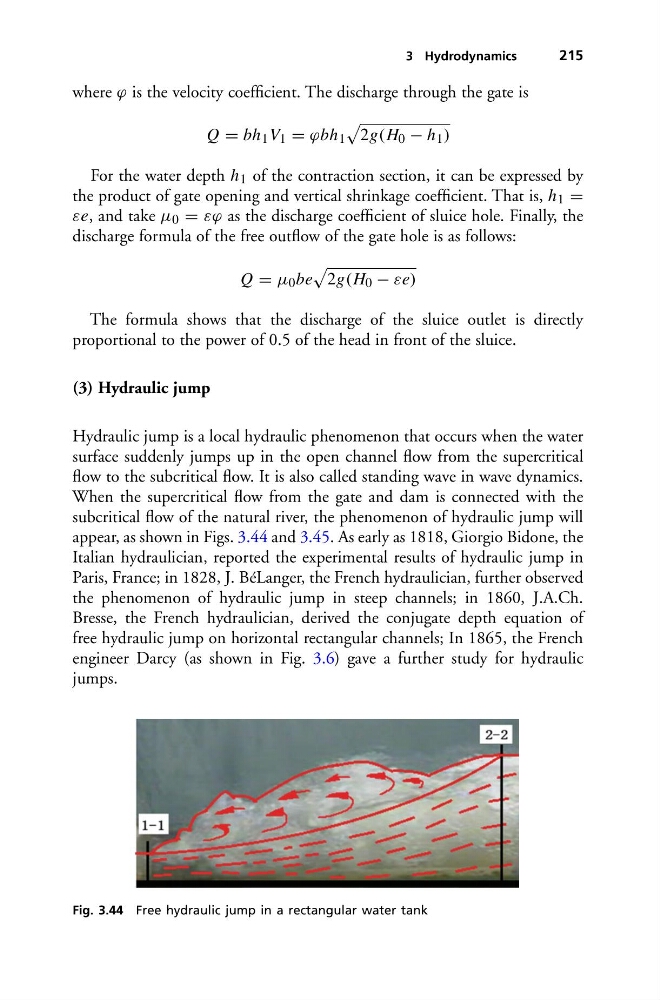
Hydraulic jump is a local hydraulic phenomenon that occurs when the water
surface suddenly jumps up in the open channel flow from the supercritical
flow to the subcritical flow. It is also called standing wave in wave dynamics.
When the supercritical flow from the gate and dam is connected with the
subcritical flow of the natural river, the phenomenon of hydraulic jump will
appear, as shown in Figs. 3.44 and 3.45. As early as 1818, Giorgio Bidone, the
Italian hydraulician, reported the experimental results of hydraulic jump in
Paris, France; in 1828, J. BéLanger, the French hydraulician, further observed
the phenomenon of hydraulic jump in steep channels; in 1860, J.A.Ch.
Bresse, the French hydraulician, derived the conjugate depth equation of
free hydraulic jump on horizontal rectangular channels; In 1865, the French
engineer Darcy (as shown in Fig. 3.6) gave a further study for hydraulic
jumps.
Fig. 3.44 Free hydraulic jump in a rectangular water tank
215
where ϕ is the velocity coefficient. The discharge through the gate is
Q = bh 1 V 1 = ϕbh 1
2g(H 0 − h 1 )
For the water depth h 1 of the contraction section, it can be expressed by
the product of gate opening and vertical shrinkage coefficient. That is, h 1 =
εe, and take μ 0 = εϕ as the discharge coefficient of sluice hole. Finally, the
discharge formula of the free outflow of the gate hole is as follows:
Q = μ 0 be
2g(H 0 − εe)
The formula shows that the discharge of the sluice outlet is directly
proportional to the power of 0.5 of the head in front of the sluice.
(3) Hydraulic jump
Hydraulic jump is a local hydraulic phenomenon that occurs when the water
surface suddenly jumps up in the open channel flow from the supercritical
flow to the subcritical flow. It is also called standing wave in wave dynamics.
When the supercritical flow from the gate and dam is connected with the
subcritical flow of the natural river, the phenomenon of hydraulic jump will
appear, as shown in Figs. 3.44 and 3.45. As early as 1818, Giorgio Bidone, the
Italian hydraulician, reported the experimental results of hydraulic jump in
Paris, France; in 1828, J. BéLanger, the French hydraulician, further observed
the phenomenon of hydraulic jump in steep channels; in 1860, J.A.Ch.
Bresse, the French hydraulician, derived the conjugate depth equation of
free hydraulic jump on horizontal rectangular channels; In 1865, the French
engineer Darcy (as shown in Fig. 3.6) gave a further study for hydraulic
jumps.
Fig. 3.44 Free hydraulic jump in a rectangular water tank