

3 Hydrodynamics
211
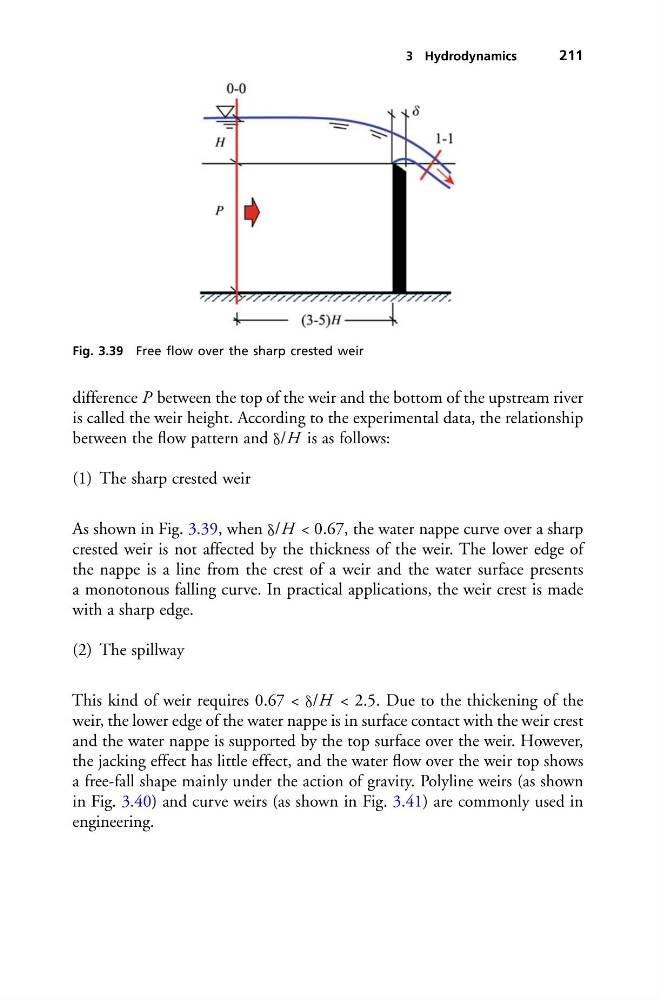
Fig. 3.39 Free flow over the sharp crested weir
difference P between the top of the weir and the bottom of the upstream river
is called the weir height. According to the experimental data, the relationship
between the flow pattern and δ/H is as follows:
(1) The sharp crested weir
As shown in Fig. 3.39, when δ/H < 0.67, the water nappe curve over a sharp
crested weir is not affected by the thickness of the weir. The lower edge of
the nappe is a line from the crest of a weir and the water surface presents
a monotonous falling curve. In practical applications, the weir crest is made
with a sharp edge.
(2) The spillway
This kind of weir requires 0.67 < δ/H < 2.5. Due to the thickening of the
weir, the lower edge of the water nappe is in surface contact with the weir crest
and the water nappe is supported by the top surface over the weir. However,
the jacking effect has little effect, and the water flow over the weir top shows
a free-fall shape mainly under the action of gravity. Polyline weirs (as shown
in Fig. 3.40) and curve weirs (as shown in Fig. 3.41) are commonly used in
engineering.
211
Fig. 3.39 Free flow over the sharp crested weir
difference P between the top of the weir and the bottom of the upstream river
is called the weir height. According to the experimental data, the relationship
between the flow pattern and δ/H is as follows:
(1) The sharp crested weir
As shown in Fig. 3.39, when δ/H < 0.67, the water nappe curve over a sharp
crested weir is not affected by the thickness of the weir. The lower edge of
the nappe is a line from the crest of a weir and the water surface presents
a monotonous falling curve. In practical applications, the weir crest is made
with a sharp edge.
(2) The spillway
This kind of weir requires 0.67 < δ/H < 2.5. Due to the thickening of the
weir, the lower edge of the water nappe is in surface contact with the weir crest
and the water nappe is supported by the top surface over the weir. However,
the jacking effect has little effect, and the water flow over the weir top shows
a free-fall shape mainly under the action of gravity. Polyline weirs (as shown
in Fig. 3.40) and curve weirs (as shown in Fig. 3.41) are commonly used in
engineering.