

210
P. Liu
S 1
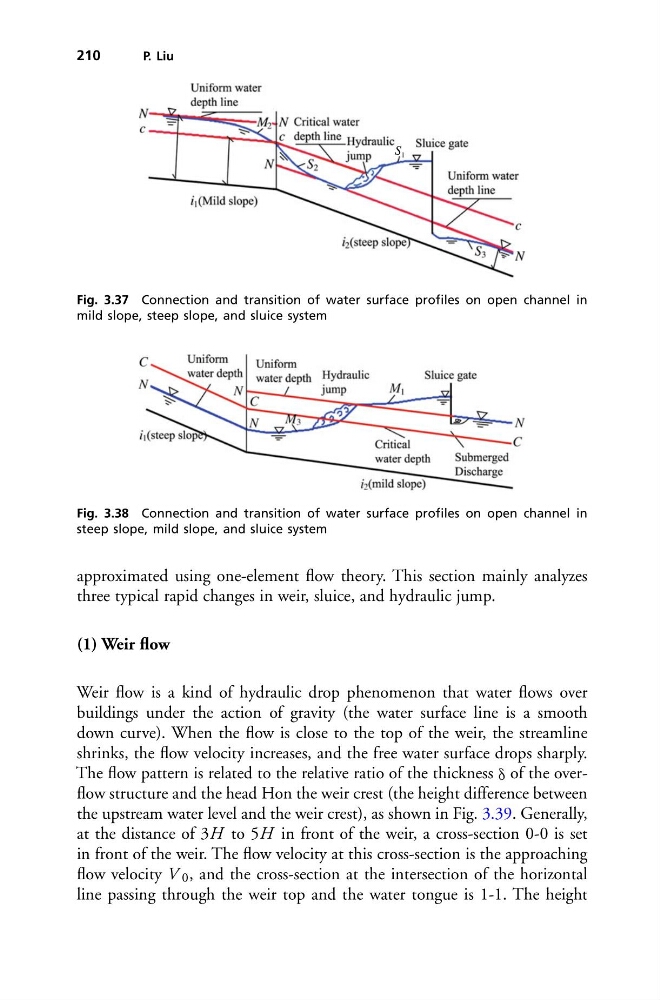
Fig. 3.37 Connection and transition of water surface profiles on open channel in
mild slope, steep slope, and sluice system
Fig. 3.38 Connection and transition of water surface profiles on open channel in
steep slope, mild slope, and sluice system
approximated using one-element flow theory. This section mainly analyzes
three typical rapid changes in weir, sluice, and hydraulic jump.
(1) Weir flow
Weir flow is a kind of hydraulic drop phenomenon that water flows over
buildings under the action of gravity (the water surface line is a smooth
down curve). When the flow is close to the top of the weir, the streamline
shrinks, the flow velocity increases, and the free water surface drops sharply.
The flow pattern is related to the relative ratio of the thickness δ of the overflow structure and the head Hon the weir crest (the height difference between
the upstream water level and the weir crest), as shown in Fig. 3.39. Generally,
at the distance of 3H to 5H in front of the weir, a cross-section 0-0 is set
in front of the weir. The flow velocity at this cross-section is the approaching
flow velocity V 0 , and the cross-section at the intersection of the horizontal
line passing through the weir top and the water tongue is 1-1. The height
P. Liu
S 1
Fig. 3.37 Connection and transition of water surface profiles on open channel in
mild slope, steep slope, and sluice system
Fig. 3.38 Connection and transition of water surface profiles on open channel in
steep slope, mild slope, and sluice system
approximated using one-element flow theory. This section mainly analyzes
three typical rapid changes in weir, sluice, and hydraulic jump.
(1) Weir flow
Weir flow is a kind of hydraulic drop phenomenon that water flows over
buildings under the action of gravity (the water surface line is a smooth
down curve). When the flow is close to the top of the weir, the streamline
shrinks, the flow velocity increases, and the free water surface drops sharply.
The flow pattern is related to the relative ratio of the thickness δ of the overflow structure and the head Hon the weir crest (the height difference between
the upstream water level and the weir crest), as shown in Fig. 3.39. Generally,
at the distance of 3H to 5H in front of the weir, a cross-section 0-0 is set
in front of the weir. The flow velocity at this cross-section is the approaching
flow velocity V 0 , and the cross-section at the intersection of the horizontal
line passing through the weir top and the water tongue is 1-1. The height