

190
P. Liu
shear stress be proportional to the square of the velocity, take
τ w =
1
2
ρV
2 C f =
1
2
ρV
2
(
λ
4
)
Among them, C f is the wall friction resistance coefficient, and λ is the
resistance coefficient along the pipeline. Take the former
h f = λ
L
4R
V 2
2g
= λ
L
d
V 2
2g
, λ = f(Re,
d
)
In the formula, λ is a dimensionless coefficient, which is related to
Reynolds number Re of liquid flow and relative roughness of pipe wall. This
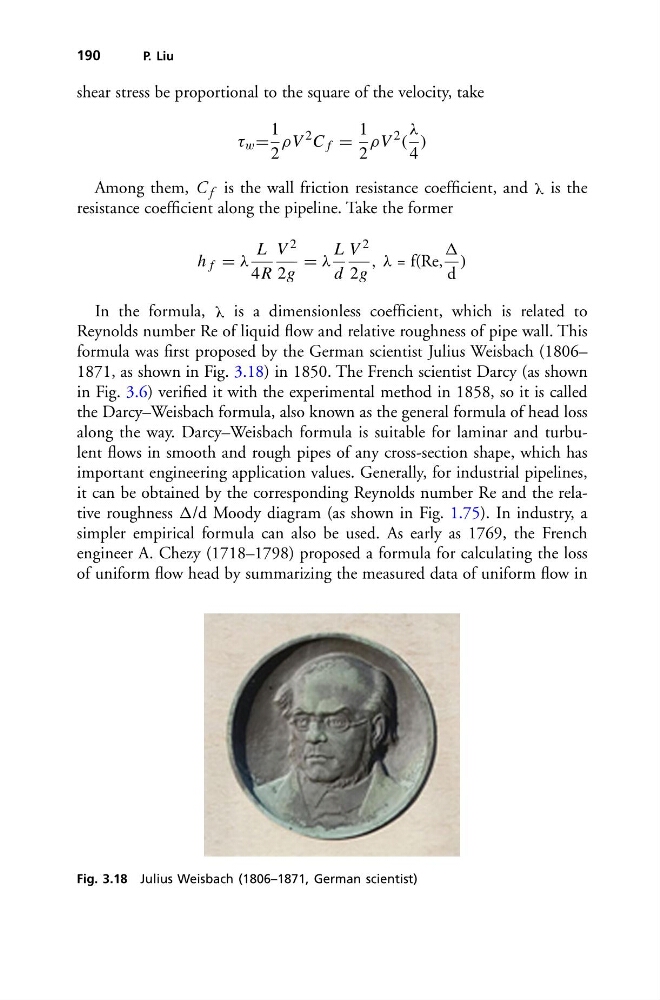
formula was first proposed by the German scientist Julius Weisbach (1806–
1871, as shown in Fig. 3.18) in 1850. The French scientist Darcy (as shown
in Fig. 3.6) verified it with the experimental method in 1858, so it is called
the Darcy–Weisbach formula, also known as the general formula of head loss
along the way. Darcy–Weisbach formula is suitable for laminar and turbulent flows in smooth and rough pipes of any cross-section shape, which has
important engineering application values. Generally, for industrial pipelines,
it can be obtained by the corresponding Reynolds number Re and the relative roughness /d Moody diagram (as shown in Fig. 1.75). In industry, a
simpler empirical formula can also be used. As early as 1769, the French
engineer A. Chezy (1718–1798) proposed a formula for calculating the loss
of uniform flow head by summarizing the measured data of uniform flow in
Fig. 3.18 Julius Weisbach (1806–1871, German scientist)
P. Liu
shear stress be proportional to the square of the velocity, take
τ w =
1
2
ρV
2 C f =
1
2
ρV
2
(
λ
4
)
Among them, C f is the wall friction resistance coefficient, and λ is the
resistance coefficient along the pipeline. Take the former
h f = λ
L
4R
V 2
2g
= λ
L
d
V 2
2g
, λ = f(Re,
d
)
In the formula, λ is a dimensionless coefficient, which is related to
Reynolds number Re of liquid flow and relative roughness of pipe wall. This
formula was first proposed by the German scientist Julius Weisbach (1806–
1871, as shown in Fig. 3.18) in 1850. The French scientist Darcy (as shown
in Fig. 3.6) verified it with the experimental method in 1858, so it is called
the Darcy–Weisbach formula, also known as the general formula of head loss
along the way. Darcy–Weisbach formula is suitable for laminar and turbulent flows in smooth and rough pipes of any cross-section shape, which has
important engineering application values. Generally, for industrial pipelines,
it can be obtained by the corresponding Reynolds number Re and the relative roughness /d Moody diagram (as shown in Fig. 1.75). In industry, a
simpler empirical formula can also be used. As early as 1769, the French
engineer A. Chezy (1718–1798) proposed a formula for calculating the loss
of uniform flow head by summarizing the measured data of uniform flow in
Fig. 3.18 Julius Weisbach (1806–1871, German scientist)