

3 Hydrodynamics
191
open channels, namely.
V = C
√
R J
where C is The Chezy coefficient. Substituting J = h f /L,R = A/P into the
above formula, we can get
h f =
8g
C 2
L
4R
V 2
2g
, λ=
8g
C 2 , C =
8g
λ
Chezy coefficient C is a dimensionally empirical coefficient in m 1/2 /s.
Later, in 1889, Robert Manning gave a simpler formula for coefficient C .
Namely
C =
1
n
R
1/6
where n is the roughness coefficient of the pipeline, which is called roughness
for short. In practical application, the value of n can be found in the table.
For the local loss h j , which involves the size and degree of the separation
zone of the liquid flow in the pipeline, it is generally determined by the experiment according to the specific situation, and an empirical formula is usually
used
h j = ξ
V 2
2g
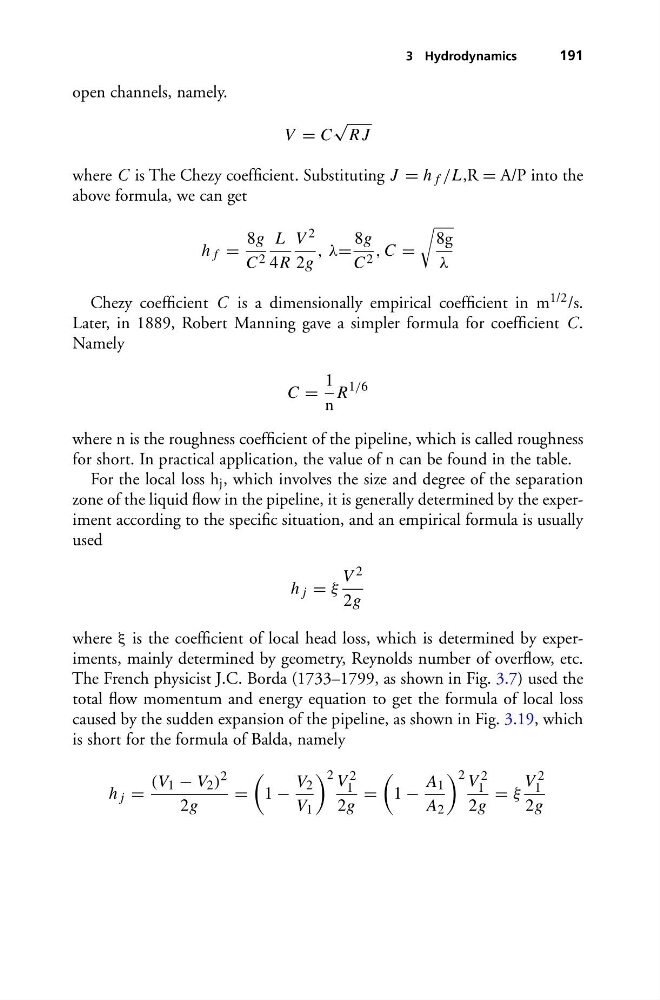
where ξ is the coefficient of local head loss, which is determined by experiments, mainly determined by geometry, Reynolds number of overflow, etc.
The French physicist J.C. Borda (1733–1799, as shown in Fig. 3.7) used the
total flow momentum and energy equation to get the formula of local loss
caused by the sudden expansion of the pipeline, as shown in Fig. 3.19, which
is short for the formula of Balda, namely
h j =
(V 1 − V 2 )
2
2g
=
1 −
V 2
V 1
2 V 2
1
2g
=
1 −
A 1
A 2
2 V 2
1
2g
= ξ
V 2
1
2g
191
open channels, namely.
V = C
√
R J
where C is The Chezy coefficient. Substituting J = h f /L,R = A/P into the
above formula, we can get
h f =
8g
C 2
L
4R
V 2
2g
, λ=
8g
C 2 , C =
8g
λ
Chezy coefficient C is a dimensionally empirical coefficient in m 1/2 /s.
Later, in 1889, Robert Manning gave a simpler formula for coefficient C .
Namely
C =
1
n
R
1/6
where n is the roughness coefficient of the pipeline, which is called roughness
for short. In practical application, the value of n can be found in the table.
For the local loss h j , which involves the size and degree of the separation
zone of the liquid flow in the pipeline, it is generally determined by the experiment according to the specific situation, and an empirical formula is usually
used
h j = ξ
V 2
2g
where ξ is the coefficient of local head loss, which is determined by experiments, mainly determined by geometry, Reynolds number of overflow, etc.
The French physicist J.C. Borda (1733–1799, as shown in Fig. 3.7) used the
total flow momentum and energy equation to get the formula of local loss
caused by the sudden expansion of the pipeline, as shown in Fig. 3.19, which
is short for the formula of Balda, namely
h j =
(V 1 − V 2 )
2
2g
=
1 −
V 2
V 1
2 V 2
1
2g
=
1 −
A 1
A 2
2 V 2
1
2g
= ξ
V 2
1
2g