

3 Hydrodynamics
177
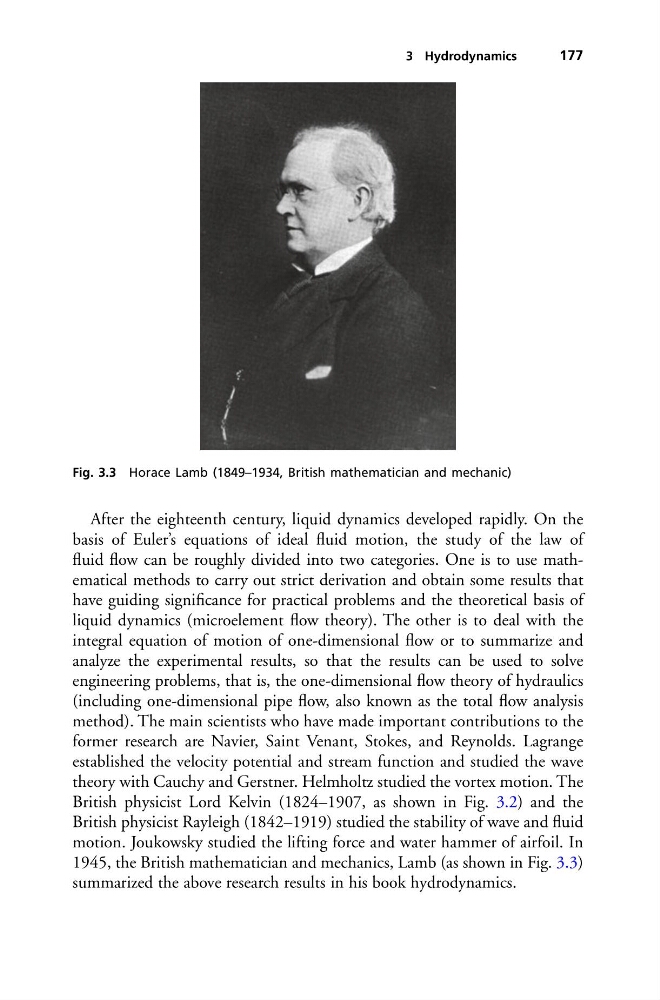
Fig. 3.3 Horace Lamb (1849–1934, British mathematician and mechanic)
After the eighteenth century, liquid dynamics developed rapidly. On the
basis of Euler’s equations of ideal fluid motion, the study of the law of
fluid flow can be roughly divided into two categories. One is to use mathematical methods to carry out strict derivation and obtain some results that
have guiding significance for practical problems and the theoretical basis of
liquid dynamics (microelement flow theory). The other is to deal with the
integral equation of motion of one-dimensional flow or to summarize and
analyze the experimental results, so that the results can be used to solve
engineering problems, that is, the one-dimensional flow theory of hydraulics
(including one-dimensional pipe flow, also known as the total flow analysis
method). The main scientists who have made important contributions to the
former research are Navier, Saint Venant, Stokes, and Reynolds. Lagrange
established the velocity potential and stream function and studied the wave
theory with Cauchy and Gerstner. Helmholtz studied the vortex motion. The
British physicist Lord Kelvin (1824–1907, as shown in Fig. 3.2) and the
British physicist Rayleigh (1842–1919) studied the stability of wave and fluid
motion. Joukowsky studied the lifting force and water hammer of airfoil. In
1945, the British mathematician and mechanics, Lamb (as shown in Fig. 3.3)
summarized the above research results in his book hydrodynamics.
177
Fig. 3.3 Horace Lamb (1849–1934, British mathematician and mechanic)
After the eighteenth century, liquid dynamics developed rapidly. On the
basis of Euler’s equations of ideal fluid motion, the study of the law of
fluid flow can be roughly divided into two categories. One is to use mathematical methods to carry out strict derivation and obtain some results that
have guiding significance for practical problems and the theoretical basis of
liquid dynamics (microelement flow theory). The other is to deal with the
integral equation of motion of one-dimensional flow or to summarize and
analyze the experimental results, so that the results can be used to solve
engineering problems, that is, the one-dimensional flow theory of hydraulics
(including one-dimensional pipe flow, also known as the total flow analysis
method). The main scientists who have made important contributions to the
former research are Navier, Saint Venant, Stokes, and Reynolds. Lagrange
established the velocity potential and stream function and studied the wave
theory with Cauchy and Gerstner. Helmholtz studied the vortex motion. The
British physicist Lord Kelvin (1824–1907, as shown in Fig. 3.2) and the
British physicist Rayleigh (1842–1919) studied the stability of wave and fluid
motion. Joukowsky studied the lifting force and water hammer of airfoil. In
1945, the British mathematician and mechanics, Lamb (as shown in Fig. 3.3)
summarized the above research results in his book hydrodynamics.