

2 Aerodynamics
87
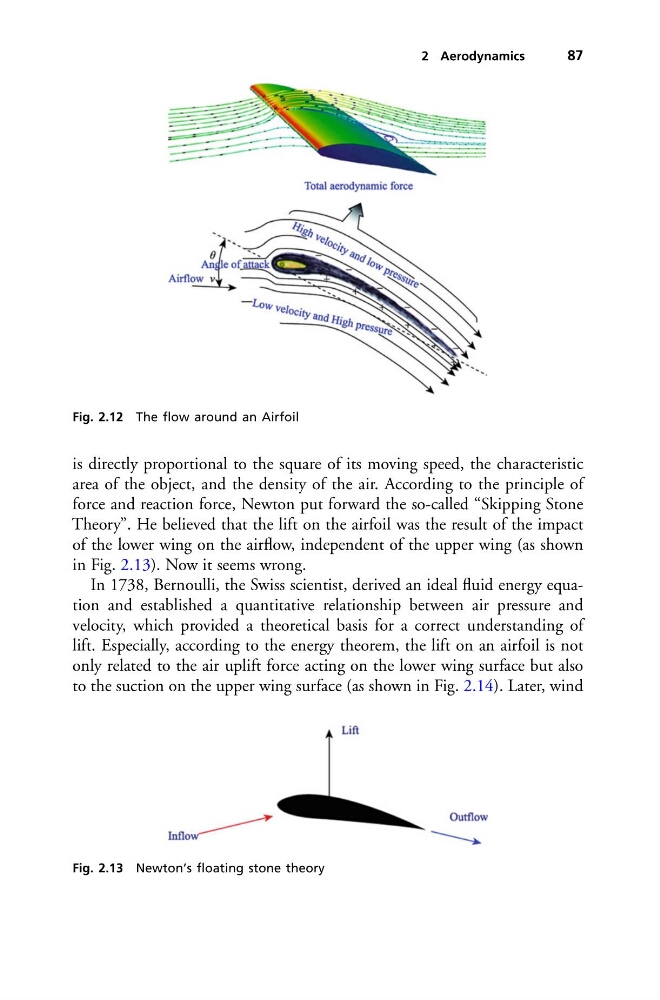
Fig. 2.12 The flow around an Airfoil
is directly proportional to the square of its moving speed, the characteristic
area of the object, and the density of the air. According to the principle of
force and reaction force, Newton put forward the so-called “Skipping Stone
Theory”. He believed that the lift on the airfoil was the result of the impact
of the lower wing on the airflow, independent of the upper wing (as shown
in Fig. 2.13). Now it seems wrong.
In 1738, Bernoulli, the Swiss scientist, derived an ideal fluid energy equation and established a quantitative relationship between air pressure and
velocity, which provided a theoretical basis for a correct understanding of
lift. Especially, according to the energy theorem, the lift on an airfoil is not
only related to the air uplift force acting on the lower wing surface but also
to the suction on the upper wing surface (as shown in Fig. 2.14). Later, wind
Fig. 2.13 Newton’s floating stone theory
87
Fig. 2.12 The flow around an Airfoil
is directly proportional to the square of its moving speed, the characteristic
area of the object, and the density of the air. According to the principle of
force and reaction force, Newton put forward the so-called “Skipping Stone
Theory”. He believed that the lift on the airfoil was the result of the impact
of the lower wing on the airflow, independent of the upper wing (as shown
in Fig. 2.13). Now it seems wrong.
In 1738, Bernoulli, the Swiss scientist, derived an ideal fluid energy equation and established a quantitative relationship between air pressure and
velocity, which provided a theoretical basis for a correct understanding of
lift. Especially, according to the energy theorem, the lift on an airfoil is not
only related to the air uplift force acting on the lower wing surface but also
to the suction on the upper wing surface (as shown in Fig. 2.14). Later, wind
Fig. 2.13 Newton’s floating stone theory