

86
P. Liu
the emergence of the aircraft makes the distance between people’s living place
appear much shorter.
How a real aircraft can fly depends on the understanding of birds. In terms
of flight, it can be said that birds are the ancestors of human beings. No
matter what kind of aircraft they build, they need to learn from birds. Because
birds have enough flight experience in the air, they have evolved over a long
period of time. Next, we analyze the flight principle of birds to explore the
mystery of the lift generated by airfoils.
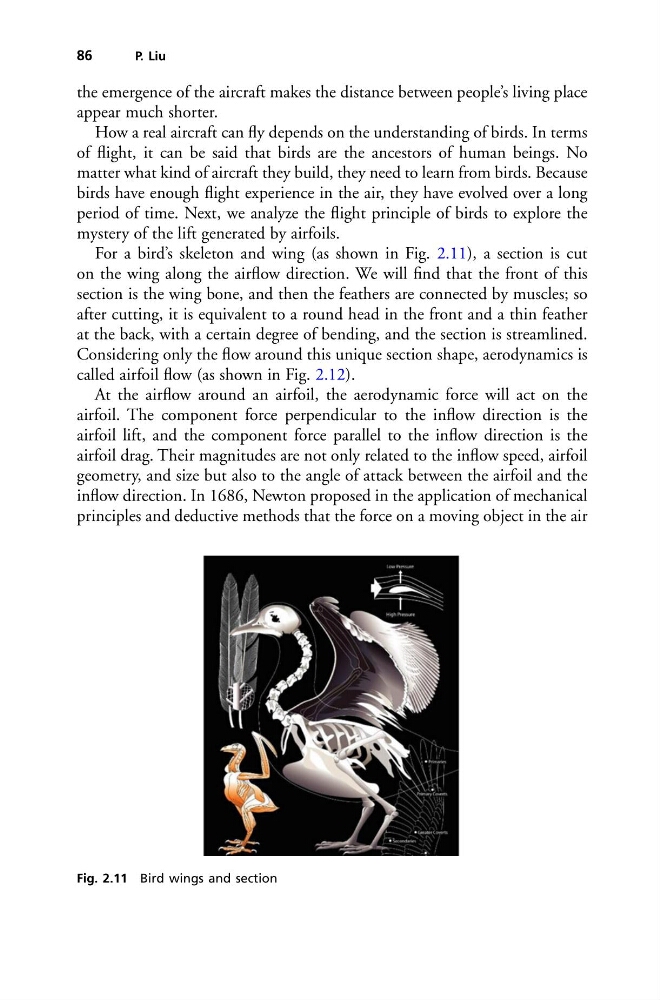
For a bird’s skeleton and wing (as shown in Fig. 2.11), a section is cut
on the wing along the airflow direction. We will find that the front of this
section is the wing bone, and then the feathers are connected by muscles; so
after cutting, it is equivalent to a round head in the front and a thin feather
at the back, with a certain degree of bending, and the section is streamlined.
Considering only the flow around this unique section shape, aerodynamics is
called airfoil flow (as shown in Fig. 2.12).
At the airflow around an airfoil, the aerodynamic force will act on the
airfoil. The component force perpendicular to the inflow direction is the
airfoil lift, and the component force parallel to the inflow direction is the
airfoil drag. Their magnitudes are not only related to the inflow speed, airfoil
geometry, and size but also to the angle of attack between the airfoil and the
inflow direction. In 1686, Newton proposed in the application of mechanical
principles and deductive methods that the force on a moving object in the air
Fig. 2.11 Bird wings and section
P. Liu
the emergence of the aircraft makes the distance between people’s living place
appear much shorter.
How a real aircraft can fly depends on the understanding of birds. In terms
of flight, it can be said that birds are the ancestors of human beings. No
matter what kind of aircraft they build, they need to learn from birds. Because
birds have enough flight experience in the air, they have evolved over a long
period of time. Next, we analyze the flight principle of birds to explore the
mystery of the lift generated by airfoils.
For a bird’s skeleton and wing (as shown in Fig. 2.11), a section is cut
on the wing along the airflow direction. We will find that the front of this
section is the wing bone, and then the feathers are connected by muscles; so
after cutting, it is equivalent to a round head in the front and a thin feather
at the back, with a certain degree of bending, and the section is streamlined.
Considering only the flow around this unique section shape, aerodynamics is
called airfoil flow (as shown in Fig. 2.12).
At the airflow around an airfoil, the aerodynamic force will act on the
airfoil. The component force perpendicular to the inflow direction is the
airfoil lift, and the component force parallel to the inflow direction is the
airfoil drag. Their magnitudes are not only related to the inflow speed, airfoil
geometry, and size but also to the angle of attack between the airfoil and the
inflow direction. In 1686, Newton proposed in the application of mechanical
principles and deductive methods that the force on a moving object in the air
Fig. 2.11 Bird wings and section