

detection limit of 74 ppb were observed for zinc-doped nickel oxide nanoparticles at
optimal operating temperature of 200
C and 10% humidity (Fomekong et al. 2018).
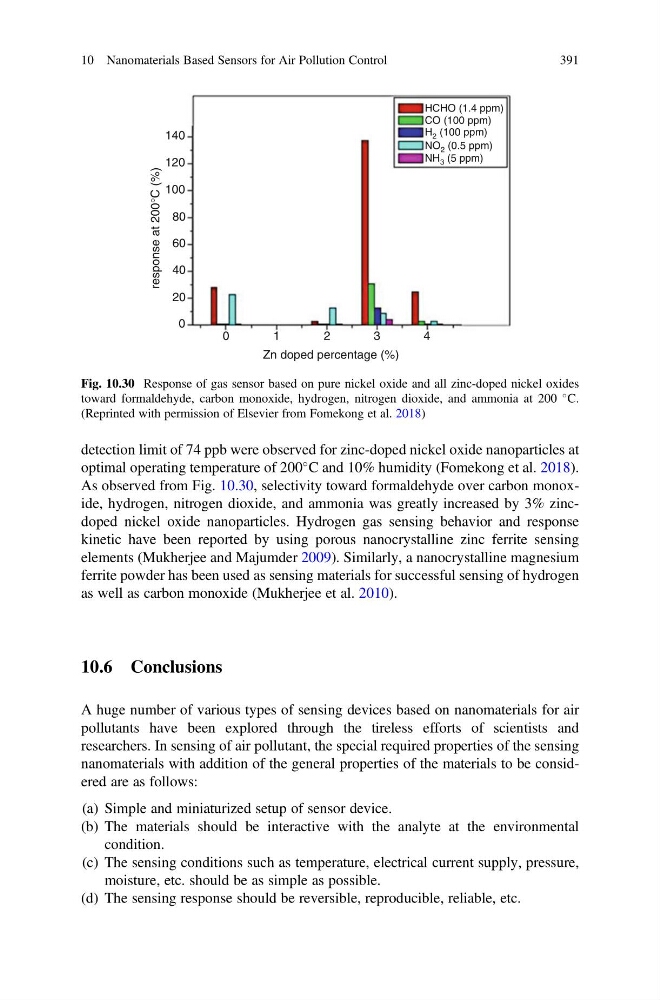
As observed from Fig. 10.30, selectivity toward formaldehyde over carbon monoxide, hydrogen, nitrogen dioxide, and ammonia was greatly increased by 3% zincdoped nickel oxide nanoparticles. Hydrogen gas sensing behavior and response
kinetic have been reported by using porous nanocrystalline zinc ferrite sensing
elements (Mukherjee and Majumder 2009). Similarly, a nanocrystalline magnesium
ferrite powder has been used as sensing materials for successful sensing of hydrogen
as well as carbon monoxide (Mukherjee et al. 2010).
10.6 Conclusions
A huge number of various types of sensing devices based on nanomaterials for air
pollutants have been explored through the tireless efforts of scientists and
researchers. In sensing of air pollutant, the special required properties of the sensing
nanomaterials with addition of the general properties of the materials to be considered are as follows:
(a) Simple and miniaturized setup of sensor device.
(b) The materials should be interactive with the analyte at the environmental
condition.
(c) The sensing conditions such as temperature, electrical current supply, pressure,
moisture, etc. should be as simple as possible.
(d) The sensing response should be reversible, reproducible, reliable, etc.
140
120
100
80
60
40
20
0
0
1
2
3
4
Zn doped percentage (%)
HCHO (1.4 ppm)
CO (100 ppm)
H 2 (100 ppm)
NO 2 (0.5 ppm)
NH 3 (5 ppm)
response at 200°C (%)
Fig. 10.30 Response of gas sensor based on pure nickel oxide and all zinc-doped nickel oxides
toward formaldehyde, carbon monoxide, hydrogen, nitrogen dioxide, and ammonia at 200
C.
(Reprinted with permission of Elsevier from Fomekong et al. 2018)
10 Nanomaterials Based Sensors for Air Pollution Control
391
optimal operating temperature of 200
C and 10% humidity (Fomekong et al. 2018).
As observed from Fig. 10.30, selectivity toward formaldehyde over carbon monoxide, hydrogen, nitrogen dioxide, and ammonia was greatly increased by 3% zincdoped nickel oxide nanoparticles. Hydrogen gas sensing behavior and response
kinetic have been reported by using porous nanocrystalline zinc ferrite sensing
elements (Mukherjee and Majumder 2009). Similarly, a nanocrystalline magnesium
ferrite powder has been used as sensing materials for successful sensing of hydrogen
as well as carbon monoxide (Mukherjee et al. 2010).
10.6 Conclusions
A huge number of various types of sensing devices based on nanomaterials for air
pollutants have been explored through the tireless efforts of scientists and
researchers. In sensing of air pollutant, the special required properties of the sensing
nanomaterials with addition of the general properties of the materials to be considered are as follows:
(a) Simple and miniaturized setup of sensor device.
(b) The materials should be interactive with the analyte at the environmental
condition.
(c) The sensing conditions such as temperature, electrical current supply, pressure,
moisture, etc. should be as simple as possible.
(d) The sensing response should be reversible, reproducible, reliable, etc.
140
120
100
80
60
40
20
0
0
1
2
3
4
Zn doped percentage (%)
HCHO (1.4 ppm)
CO (100 ppm)
H 2 (100 ppm)
NO 2 (0.5 ppm)
NH 3 (5 ppm)
response at 200°C (%)
Fig. 10.30 Response of gas sensor based on pure nickel oxide and all zinc-doped nickel oxides
toward formaldehyde, carbon monoxide, hydrogen, nitrogen dioxide, and ammonia at 200
C.
(Reprinted with permission of Elsevier from Fomekong et al. 2018)
10 Nanomaterials Based Sensors for Air Pollution Control
391