

nanomaterials were developed on the basic operating principle of heterojunction gas
sensor barrier (Dhawale et al. 2008, 2010a, b). For p-type polyaniline
nanocomposite with n-type zinc oxide heterojunction has been successfully sense
the LPG at room temperature by increasing the barrier height at the interface of
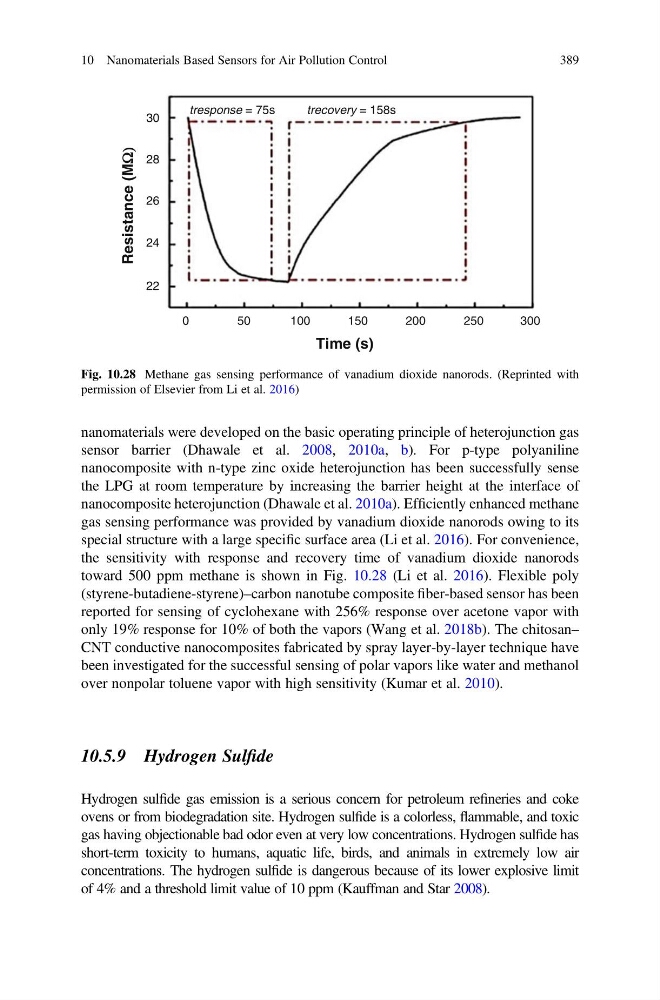
nanocomposite heterojunction (Dhawale et al. 2010a). Efficiently enhanced methane
gas sensing performance was provided by vanadium dioxide nanorods owing to its
special structure with a large specific surface area (Li et al. 2016). For convenience,
the sensitivity with response and recovery time of vanadium dioxide nanorods
toward 500 ppm methane is shown in Fig. 10.28 (Li et al. 2016). Flexible poly
(styrene-butadiene-styrene)–carbon nanotube composite fiber-based sensor has been
reported for sensing of cyclohexane with 256% response over acetone vapor with
only 19% response for 10% of both the vapors (Wang et al. 2018b). The chitosan–
CNT conductive nanocomposites fabricated by spray layer-by-layer technique have
been investigated for the successful sensing of polar vapors like water and methanol
over nonpolar toluene vapor with high sensitivity (Kumar et al. 2010).
10.5.9 Hydrogen Sulfide
Hydrogen sulfide gas emission is a serious concern for petroleum refineries and coke
ovens or from biodegradation site. Hydrogen sulfide is a colorless, flammable, and toxic
gas having objectionable bad odor even at very low concentrations. Hydrogen sulfide has
short-term toxicity to humans, aquatic life, birds, and animals in extremely low air
concentrations. The hydrogen sulfide is dangerous because of its lower explosive limit
of 4% and a threshold limit value of 10 ppm (Kauffman and Star 2008).
30
28
26
24
22
0
50
100
150
200
250
300
Time (s)
Resistance (MW)
tresponse = 75s
trecovery = 158s
Fig. 10.28 Methane gas sensing performance of vanadium dioxide nanorods. (Reprinted with
permission of Elsevier from Li et al. 2016)
10 Nanomaterials Based Sensors for Air Pollution Control
389
sensor barrier (Dhawale et al. 2008, 2010a, b). For p-type polyaniline
nanocomposite with n-type zinc oxide heterojunction has been successfully sense
the LPG at room temperature by increasing the barrier height at the interface of
nanocomposite heterojunction (Dhawale et al. 2010a). Efficiently enhanced methane
gas sensing performance was provided by vanadium dioxide nanorods owing to its
special structure with a large specific surface area (Li et al. 2016). For convenience,
the sensitivity with response and recovery time of vanadium dioxide nanorods
toward 500 ppm methane is shown in Fig. 10.28 (Li et al. 2016). Flexible poly
(styrene-butadiene-styrene)–carbon nanotube composite fiber-based sensor has been
reported for sensing of cyclohexane with 256% response over acetone vapor with
only 19% response for 10% of both the vapors (Wang et al. 2018b). The chitosan–
CNT conductive nanocomposites fabricated by spray layer-by-layer technique have
been investigated for the successful sensing of polar vapors like water and methanol
over nonpolar toluene vapor with high sensitivity (Kumar et al. 2010).
10.5.9 Hydrogen Sulfide
Hydrogen sulfide gas emission is a serious concern for petroleum refineries and coke
ovens or from biodegradation site. Hydrogen sulfide is a colorless, flammable, and toxic
gas having objectionable bad odor even at very low concentrations. Hydrogen sulfide has
short-term toxicity to humans, aquatic life, birds, and animals in extremely low air
concentrations. The hydrogen sulfide is dangerous because of its lower explosive limit
of 4% and a threshold limit value of 10 ppm (Kauffman and Star 2008).
30
28
26
24
22
0
50
100
150
200
250
300
Time (s)
Resistance (MW)
tresponse = 75s
trecovery = 158s
Fig. 10.28 Methane gas sensing performance of vanadium dioxide nanorods. (Reprinted with
permission of Elsevier from Li et al. 2016)
10 Nanomaterials Based Sensors for Air Pollution Control
389