

of hybrid nanomaterials having mixture of more than two materials are very rare.
The hybrid nanomaterials are broadly classified into two categories: nanocomposites
and nanoblends. Nanocomposites are combinations of two materials in which the
nanomaterial called reinforcing phase is embedded in the other material called the
matrix phase. Typically vast varieties of available nanomaterials have been introduced for the development of nanocomposite into (1) metal matrix nanocomposites,
(2) ceramic matrix nanocomposites, and (3) polymer matrix nanocomposites.
Nanoblends are the mixture of two materials having either of the components with
nano-dimensional morphology. In addition, the basic difference between blends and
composites is that the two materials in the composites remain in separate phase,
while these are miscible in blend.
Preparative methods of hybrid nanocomposites can be broadly classified as ex
situ and in situ techniques through physical, chemical, or electrochemical routes
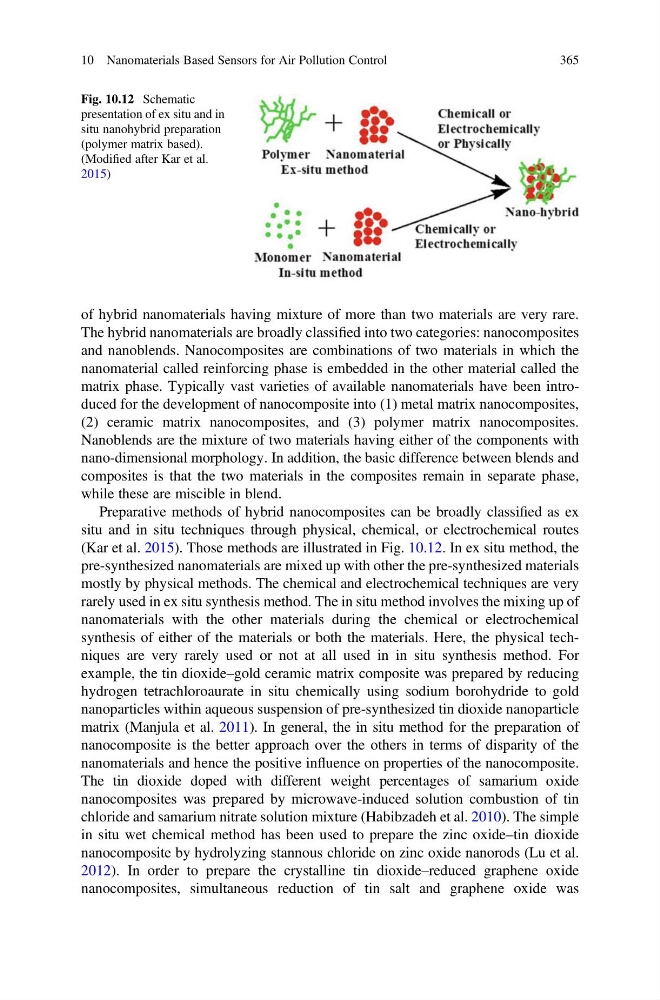
(Kar et al. 2015). Those methods are illustrated in Fig. 10.12. In ex situ method, the
pre-synthesized nanomaterials are mixed up with other the pre-synthesized materials
mostly by physical methods. The chemical and electrochemical techniques are very
rarely used in ex situ synthesis method. The in situ method involves the mixing up of
nanomaterials with the other materials during the chemical or electrochemical
synthesis of either of the materials or both the materials. Here, the physical techniques are very rarely used or not at all used in in situ synthesis method. For
example, the tin dioxide–gold ceramic matrix composite was prepared by reducing
hydrogen tetrachloroaurate in situ chemically using sodium borohydride to gold
nanoparticles within aqueous suspension of pre-synthesized tin dioxide nanoparticle
matrix (Manjula et al. 2011). In general, the in situ method for the preparation of
nanocomposite is the better approach over the others in terms of disparity of the
nanomaterials and hence the positive influence on properties of the nanocomposite.
The tin dioxide doped with different weight percentages of samarium oxide
nanocomposites was prepared by microwave-induced solution combustion of tin
chloride and samarium nitrate solution mixture (Habibzadeh et al. 2010). The simple
in situ wet chemical method has been used to prepare the zinc oxide–tin dioxide
nanocomposite by hydrolyzing stannous chloride on zinc oxide nanorods (Lu et al.
2012). In order to prepare the crystalline tin dioxide–reduced graphene oxide
nanocomposites, simultaneous reduction of tin salt and graphene oxide was
Fig. 10.12 Schematic
presentation of ex situ and in
situ nanohybrid preparation
(polymer matrix based).
(Modified after Kar et al.
2015)
10 Nanomaterials Based Sensors for Air Pollution Control
365
The hybrid nanomaterials are broadly classified into two categories: nanocomposites
and nanoblends. Nanocomposites are combinations of two materials in which the
nanomaterial called reinforcing phase is embedded in the other material called the
matrix phase. Typically vast varieties of available nanomaterials have been introduced for the development of nanocomposite into (1) metal matrix nanocomposites,
(2) ceramic matrix nanocomposites, and (3) polymer matrix nanocomposites.
Nanoblends are the mixture of two materials having either of the components with
nano-dimensional morphology. In addition, the basic difference between blends and
composites is that the two materials in the composites remain in separate phase,
while these are miscible in blend.
Preparative methods of hybrid nanocomposites can be broadly classified as ex
situ and in situ techniques through physical, chemical, or electrochemical routes
(Kar et al. 2015). Those methods are illustrated in Fig. 10.12. In ex situ method, the
pre-synthesized nanomaterials are mixed up with other the pre-synthesized materials
mostly by physical methods. The chemical and electrochemical techniques are very
rarely used in ex situ synthesis method. The in situ method involves the mixing up of
nanomaterials with the other materials during the chemical or electrochemical
synthesis of either of the materials or both the materials. Here, the physical techniques are very rarely used or not at all used in in situ synthesis method. For
example, the tin dioxide–gold ceramic matrix composite was prepared by reducing
hydrogen tetrachloroaurate in situ chemically using sodium borohydride to gold
nanoparticles within aqueous suspension of pre-synthesized tin dioxide nanoparticle
matrix (Manjula et al. 2011). In general, the in situ method for the preparation of
nanocomposite is the better approach over the others in terms of disparity of the
nanomaterials and hence the positive influence on properties of the nanocomposite.
The tin dioxide doped with different weight percentages of samarium oxide
nanocomposites was prepared by microwave-induced solution combustion of tin
chloride and samarium nitrate solution mixture (Habibzadeh et al. 2010). The simple
in situ wet chemical method has been used to prepare the zinc oxide–tin dioxide
nanocomposite by hydrolyzing stannous chloride on zinc oxide nanorods (Lu et al.
2012). In order to prepare the crystalline tin dioxide–reduced graphene oxide
nanocomposites, simultaneous reduction of tin salt and graphene oxide was
Fig. 10.12 Schematic
presentation of ex situ and in
situ nanohybrid preparation
(polymer matrix based).
(Modified after Kar et al.
2015)
10 Nanomaterials Based Sensors for Air Pollution Control
365