

template method, interfacial polymerization, controlled/living radical polymerization, etc. (Rao and Geckeler 2011). The third type of mixed technique, which is the
combinations of top–down and bottom–up, is also introduced for the nanofabrication
of polymers. After the synthesis of polythiophene and its block copolymers with
different second blocks, polystyrene, poly(methylacrylate), and poly
(n-butylacrylate), the polymers were fabricated to nanofibers by standard photolithography processes (Li et al. 2006a). The ex situ nanolayer fabrication by layer-bylayer deposition nano-assembly method was used for conjugated polymers with
suitable electrolytes such as poly(styrene sulfonate)–polypyrrole or poly(styrene
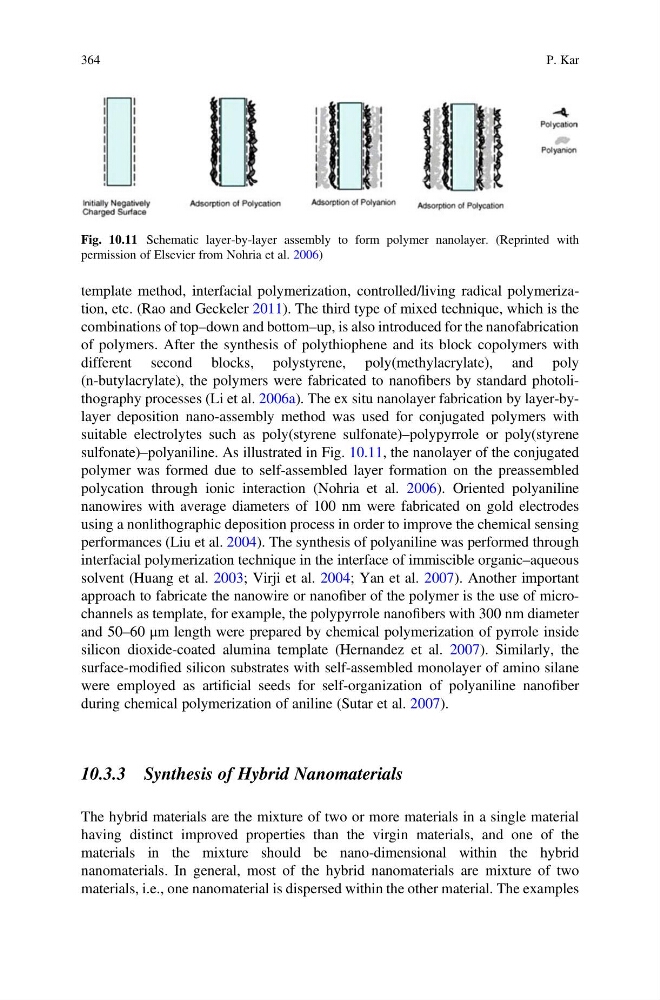
sulfonate)–polyaniline. As illustrated in Fig. 10.11, the nanolayer of the conjugated
polymer was formed due to self-assembled layer formation on the preassembled
polycation through ionic interaction (Nohria et al. 2006). Oriented polyaniline
nanowires with average diameters of 100 nm were fabricated on gold electrodes
using a nonlithographic deposition process in order to improve the chemical sensing
performances (Liu et al. 2004). The synthesis of polyaniline was performed through
interfacial polymerization technique in the interface of immiscible organic–aqueous
solvent (Huang et al. 2003; Virji et al. 2004; Yan et al. 2007). Another important
approach to fabricate the nanowire or nanofiber of the polymer is the use of microchannels as template, for example, the polypyrrole nanofibers with 300 nm diameter
and 50–60 μm length were prepared by chemical polymerization of pyrrole inside
silicon dioxide-coated alumina template (Hernandez et al. 2007). Similarly, the
surface-modified silicon substrates with self-assembled monolayer of amino silane
were employed as artificial seeds for self-organization of polyaniline nanofiber
during chemical polymerization of aniline (Sutar et al. 2007).
10.3.3 Synthesis of Hybrid Nanomaterials
The hybrid materials are the mixture of two or more materials in a single material
having distinct improved properties than the virgin materials, and one of the
materials in the mixture should be nano-dimensional within the hybrid
nanomaterials. In general, most of the hybrid nanomaterials are mixture of two
materials, i.e., one nanomaterial is dispersed within the other material. The examples
Fig. 10.11 Schematic layer-by-layer assembly to form polymer nanolayer. (Reprinted with
permission of Elsevier from Nohria et al. 2006)
364
P. Kar
combinations of top–down and bottom–up, is also introduced for the nanofabrication
of polymers. After the synthesis of polythiophene and its block copolymers with
different second blocks, polystyrene, poly(methylacrylate), and poly
(n-butylacrylate), the polymers were fabricated to nanofibers by standard photolithography processes (Li et al. 2006a). The ex situ nanolayer fabrication by layer-bylayer deposition nano-assembly method was used for conjugated polymers with
suitable electrolytes such as poly(styrene sulfonate)–polypyrrole or poly(styrene
sulfonate)–polyaniline. As illustrated in Fig. 10.11, the nanolayer of the conjugated
polymer was formed due to self-assembled layer formation on the preassembled
polycation through ionic interaction (Nohria et al. 2006). Oriented polyaniline
nanowires with average diameters of 100 nm were fabricated on gold electrodes
using a nonlithographic deposition process in order to improve the chemical sensing
performances (Liu et al. 2004). The synthesis of polyaniline was performed through
interfacial polymerization technique in the interface of immiscible organic–aqueous
solvent (Huang et al. 2003; Virji et al. 2004; Yan et al. 2007). Another important
approach to fabricate the nanowire or nanofiber of the polymer is the use of microchannels as template, for example, the polypyrrole nanofibers with 300 nm diameter
and 50–60 μm length were prepared by chemical polymerization of pyrrole inside
silicon dioxide-coated alumina template (Hernandez et al. 2007). Similarly, the
surface-modified silicon substrates with self-assembled monolayer of amino silane
were employed as artificial seeds for self-organization of polyaniline nanofiber
during chemical polymerization of aniline (Sutar et al. 2007).
10.3.3 Synthesis of Hybrid Nanomaterials
The hybrid materials are the mixture of two or more materials in a single material
having distinct improved properties than the virgin materials, and one of the
materials in the mixture should be nano-dimensional within the hybrid
nanomaterials. In general, most of the hybrid nanomaterials are mixture of two
materials, i.e., one nanomaterial is dispersed within the other material. The examples
Fig. 10.11 Schematic layer-by-layer assembly to form polymer nanolayer. (Reprinted with
permission of Elsevier from Nohria et al. 2006)
364
P. Kar