

filtration, and annealing (Peter and Harris 1999) etc. for the purification of the CNT.
The CNT was synthesized on iron-coated low-cost alumina substrates using radiofrequency plasma-enhanced chemical vapor deposition technology (Penza et al.
2010). The surface functionalization of CNTs by breaking the covalent linkage of
functional entities onto carbon scaffold was employed by various chemical reactions
such as fluorination followed by amino, alkyl, and hydroxyl group modification or
carbene and nitrene addition, chlorination, bromination, hydrogenation, azomethine
ylides, carboxylation, amination, sulfonation, etc. (Yang et al. 2007).
10.3.2 Synthesis of Organic Nanomaterials
Like the preparation of other nanomaterials, the fabrication of polymer nanomaterial
approaches either assembling of monomers together to polymer nanomaterials in
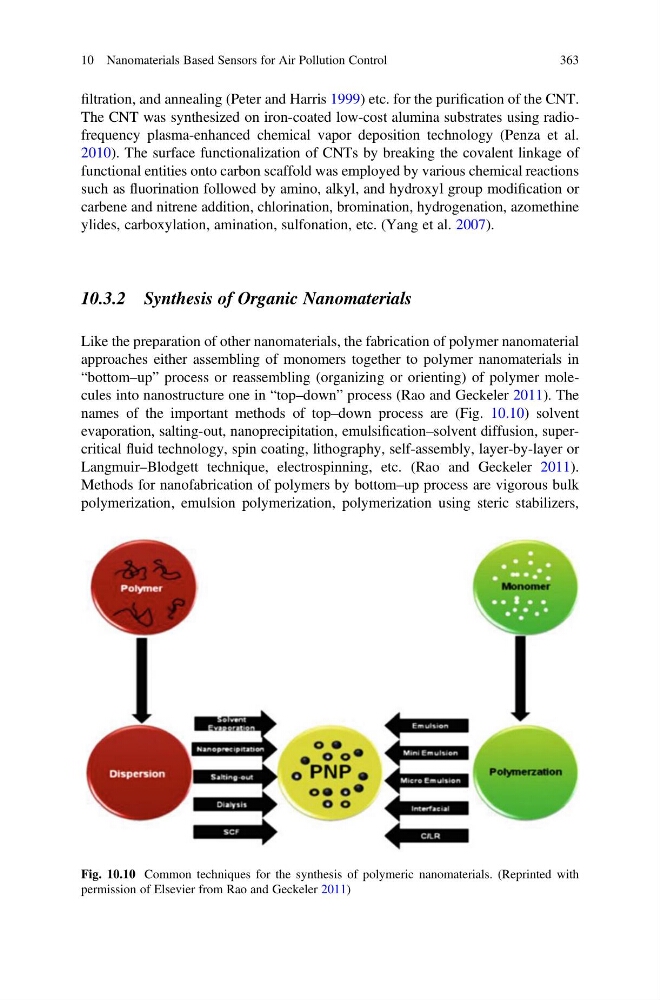
“bottom–up” process or reassembling (organizing or orienting) of polymer molecules into nanostructure one in “top–down” process (Rao and Geckeler 2011). The
names of the important methods of top–down process are (Fig. 10.10) solvent
evaporation, salting-out, nanoprecipitation, emulsification–solvent diffusion, supercritical fluid technology, spin coating, lithography, self-assembly, layer-by-layer or
Langmuir–Blodgett technique, electrospinning, etc. (Rao and Geckeler 2011).
Methods for nanofabrication of polymers by bottom–up process are vigorous bulk
polymerization, emulsion polymerization, polymerization using steric stabilizers,
Fig. 10.10 Common techniques for the synthesis of polymeric nanomaterials. (Reprinted with
permission of Elsevier from Rao and Geckeler 2011)
10 Nanomaterials Based Sensors for Air Pollution Control
363
The CNT was synthesized on iron-coated low-cost alumina substrates using radiofrequency plasma-enhanced chemical vapor deposition technology (Penza et al.
2010). The surface functionalization of CNTs by breaking the covalent linkage of
functional entities onto carbon scaffold was employed by various chemical reactions
such as fluorination followed by amino, alkyl, and hydroxyl group modification or
carbene and nitrene addition, chlorination, bromination, hydrogenation, azomethine
ylides, carboxylation, amination, sulfonation, etc. (Yang et al. 2007).
10.3.2 Synthesis of Organic Nanomaterials
Like the preparation of other nanomaterials, the fabrication of polymer nanomaterial
approaches either assembling of monomers together to polymer nanomaterials in
“bottom–up” process or reassembling (organizing or orienting) of polymer molecules into nanostructure one in “top–down” process (Rao and Geckeler 2011). The
names of the important methods of top–down process are (Fig. 10.10) solvent
evaporation, salting-out, nanoprecipitation, emulsification–solvent diffusion, supercritical fluid technology, spin coating, lithography, self-assembly, layer-by-layer or
Langmuir–Blodgett technique, electrospinning, etc. (Rao and Geckeler 2011).
Methods for nanofabrication of polymers by bottom–up process are vigorous bulk
polymerization, emulsion polymerization, polymerization using steric stabilizers,
Fig. 10.10 Common techniques for the synthesis of polymeric nanomaterials. (Reprinted with
permission of Elsevier from Rao and Geckeler 2011)
10 Nanomaterials Based Sensors for Air Pollution Control
363