

agent (Manjula et al. 2011). The nanocrystalline metal oxides such as tin dioxide,
indium oxide, and tungsten trioxide were prepared by laser-ablated method (Starke
et al. 2002). Microemulsion-based solvothermal method has been used to synthesize
both the hierarchical flower-like and one-dimensional tube-like zinc oxide nanoarchitectures (Chen et al. 2011). The carbothermal reduction method was used to
prepare the indium oxide nanowires by reaction between indium oxide and active
carbon at 1000
C under flowing nitrogen atmosphere (Xiangfeng et al. 2004). The
synthesis of nanostructured zinc oxide was performed by two different synthetic
routes: traditional sol–gel route and a combination of vapor transport process and
controlled oxidation methods (Carotta et al. 2009). Even the zinc oxide
nanostructures were deposited on glass substrates by the simple aqueous chemical
growth technique at low temperature as low as 95
C (Kenanakis et al. 2007). The
simple electrospinning process was also adopted to fabricate the tin dioxide
nanofibers by electrospinning the poly(vinyl alcohol)–tin chloride pentahydrate
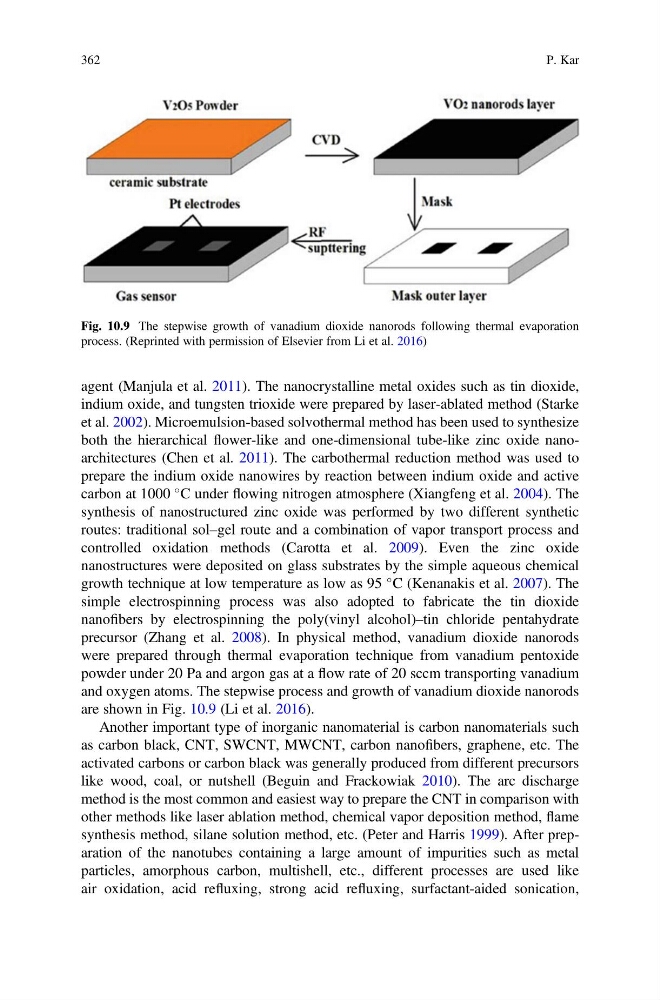
precursor (Zhang et al. 2008). In physical method, vanadium dioxide nanorods
were prepared through thermal evaporation technique from vanadium pentoxide
powder under 20 Pa and argon gas at a flow rate of 20 sccm transporting vanadium
and oxygen atoms. The stepwise process and growth of vanadium dioxide nanorods
are shown in Fig. 10.9 (Li et al. 2016).
Another important type of inorganic nanomaterial is carbon nanomaterials such
as carbon black, CNT, SWCNT, MWCNT, carbon nanofibers, graphene, etc. The
activated carbons or carbon black was generally produced from different precursors
like wood, coal, or nutshell (Beguin and Frackowiak 2010). The arc discharge
method is the most common and easiest way to prepare the CNT in comparison with
other methods like laser ablation method, chemical vapor deposition method, flame
synthesis method, silane solution method, etc. (Peter and Harris 1999). After preparation of the nanotubes containing a large amount of impurities such as metal
particles, amorphous carbon, multishell, etc., different processes are used like
air oxidation, acid refluxing, strong acid refluxing, surfactant-aided sonication,
Fig. 10.9 The stepwise growth of vanadium dioxide nanorods following thermal evaporation
process. (Reprinted with permission of Elsevier from Li et al. 2016)
362
P. Kar
indium oxide, and tungsten trioxide were prepared by laser-ablated method (Starke
et al. 2002). Microemulsion-based solvothermal method has been used to synthesize
both the hierarchical flower-like and one-dimensional tube-like zinc oxide nanoarchitectures (Chen et al. 2011). The carbothermal reduction method was used to
prepare the indium oxide nanowires by reaction between indium oxide and active
carbon at 1000
C under flowing nitrogen atmosphere (Xiangfeng et al. 2004). The
synthesis of nanostructured zinc oxide was performed by two different synthetic
routes: traditional sol–gel route and a combination of vapor transport process and
controlled oxidation methods (Carotta et al. 2009). Even the zinc oxide
nanostructures were deposited on glass substrates by the simple aqueous chemical
growth technique at low temperature as low as 95
C (Kenanakis et al. 2007). The
simple electrospinning process was also adopted to fabricate the tin dioxide
nanofibers by electrospinning the poly(vinyl alcohol)–tin chloride pentahydrate
precursor (Zhang et al. 2008). In physical method, vanadium dioxide nanorods
were prepared through thermal evaporation technique from vanadium pentoxide
powder under 20 Pa and argon gas at a flow rate of 20 sccm transporting vanadium
and oxygen atoms. The stepwise process and growth of vanadium dioxide nanorods
are shown in Fig. 10.9 (Li et al. 2016).
Another important type of inorganic nanomaterial is carbon nanomaterials such
as carbon black, CNT, SWCNT, MWCNT, carbon nanofibers, graphene, etc. The
activated carbons or carbon black was generally produced from different precursors
like wood, coal, or nutshell (Beguin and Frackowiak 2010). The arc discharge
method is the most common and easiest way to prepare the CNT in comparison with
other methods like laser ablation method, chemical vapor deposition method, flame
synthesis method, silane solution method, etc. (Peter and Harris 1999). After preparation of the nanotubes containing a large amount of impurities such as metal
particles, amorphous carbon, multishell, etc., different processes are used like
air oxidation, acid refluxing, strong acid refluxing, surfactant-aided sonication,
Fig. 10.9 The stepwise growth of vanadium dioxide nanorods following thermal evaporation
process. (Reprinted with permission of Elsevier from Li et al. 2016)
362
P. Kar