

muscovite, etc. The routes used to modify the surface of nanoclays are adsorption,
ion exchange, binding with inorganic and organic anions, grafting, reaction with
acids, pillaring by different types of poly(hydroxo metal) cations, intraparticle and
interparticle polymerization, dehydroxylation and calcination, delamination and
reaggregation of smectites, lyophilisation, ultrasound, and plasma (Bergaya and
Lagaly 2001; dePaiva et al. 2008). The inorganic metal, metal oxide, and metal
compound nanomaterials can be made using different approaches in both top–down
and bottom–up techniques like homogeneous nucleation from liquid or gas phase,
heterogeneous nucleation on a substrate, phase separation through annealing of
certain solids or micelle synthesis, thermodynamic equilibrium approach, kinetic
approach, etc. In general, the synthesis methods for nanostructured metal oxides or
metal compounds can be classified broadly into solution-based and vapor-phase
synthesis methods. Important solution phase methods include hydrothermal, sol–gel,
electrochemical deposition, precipitation methods, thermolysis, flame spray pyrolysis, etc., and vapor-phase methods are physical vapor deposition, chemical vapor
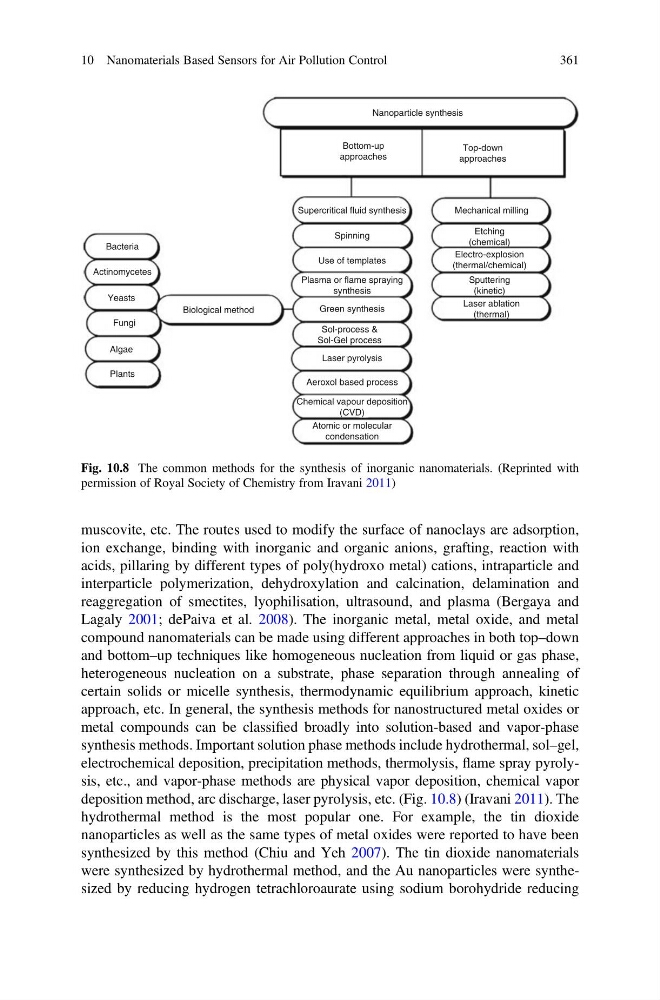
deposition method, arc discharge, laser pyrolysis, etc. (Fig. 10.8) (Iravani 2011). The
hydrothermal method is the most popular one. For example, the tin dioxide
nanoparticles as well as the same types of metal oxides were reported to have been
synthesized by this method (Chiu and Yeh 2007). The tin dioxide nanomaterials
were synthesized by hydrothermal method, and the Au nanoparticles were synthesized by reducing hydrogen tetrachloroaurate using sodium borohydride reducing
Nanoparticle synthesis
Bottom-up
approaches
Top-down
approaches
Supercritical fluid synthesis
Spinning
Mechanical milling
Use of templates
Etching
(chemical)
Electro-explosion
(thermal/chemical)
Sputtering
(kinetic)
Laser ablation
(thermal)
Plasma or flame spraying
synthesis
Green synthesis
Sol-process &
Sol-Gel process
Laser pyrolysis
Aeroxol based process
Chemical vapour deposition
(CVD)
Atomic or molecular
condensation
Bacteria
Actinomycetes
Yeasts
Fungi
Algae
Plants
Biological method
Fig. 10.8 The common methods for the synthesis of inorganic nanomaterials. (Reprinted with
permission of Royal Society of Chemistry from Iravani 2011)
10 Nanomaterials Based Sensors for Air Pollution Control
361
ion exchange, binding with inorganic and organic anions, grafting, reaction with
acids, pillaring by different types of poly(hydroxo metal) cations, intraparticle and
interparticle polymerization, dehydroxylation and calcination, delamination and
reaggregation of smectites, lyophilisation, ultrasound, and plasma (Bergaya and
Lagaly 2001; dePaiva et al. 2008). The inorganic metal, metal oxide, and metal
compound nanomaterials can be made using different approaches in both top–down
and bottom–up techniques like homogeneous nucleation from liquid or gas phase,
heterogeneous nucleation on a substrate, phase separation through annealing of
certain solids or micelle synthesis, thermodynamic equilibrium approach, kinetic
approach, etc. In general, the synthesis methods for nanostructured metal oxides or
metal compounds can be classified broadly into solution-based and vapor-phase
synthesis methods. Important solution phase methods include hydrothermal, sol–gel,
electrochemical deposition, precipitation methods, thermolysis, flame spray pyrolysis, etc., and vapor-phase methods are physical vapor deposition, chemical vapor
deposition method, arc discharge, laser pyrolysis, etc. (Fig. 10.8) (Iravani 2011). The
hydrothermal method is the most popular one. For example, the tin dioxide
nanoparticles as well as the same types of metal oxides were reported to have been
synthesized by this method (Chiu and Yeh 2007). The tin dioxide nanomaterials
were synthesized by hydrothermal method, and the Au nanoparticles were synthesized by reducing hydrogen tetrachloroaurate using sodium borohydride reducing
Nanoparticle synthesis
Bottom-up
approaches
Top-down
approaches
Supercritical fluid synthesis
Spinning
Mechanical milling
Use of templates
Etching
(chemical)
Electro-explosion
(thermal/chemical)
Sputtering
(kinetic)
Laser ablation
(thermal)
Plasma or flame spraying
synthesis
Green synthesis
Sol-process &
Sol-Gel process
Laser pyrolysis
Aeroxol based process
Chemical vapour deposition
(CVD)
Atomic or molecular
condensation
Bacteria
Actinomycetes
Yeasts
Fungi
Algae
Plants
Biological method
Fig. 10.8 The common methods for the synthesis of inorganic nanomaterials. (Reprinted with
permission of Royal Society of Chemistry from Iravani 2011)
10 Nanomaterials Based Sensors for Air Pollution Control
361