

performed by a one-pot microwave-assisted nonaqueous sol–gel method (Neri et al.
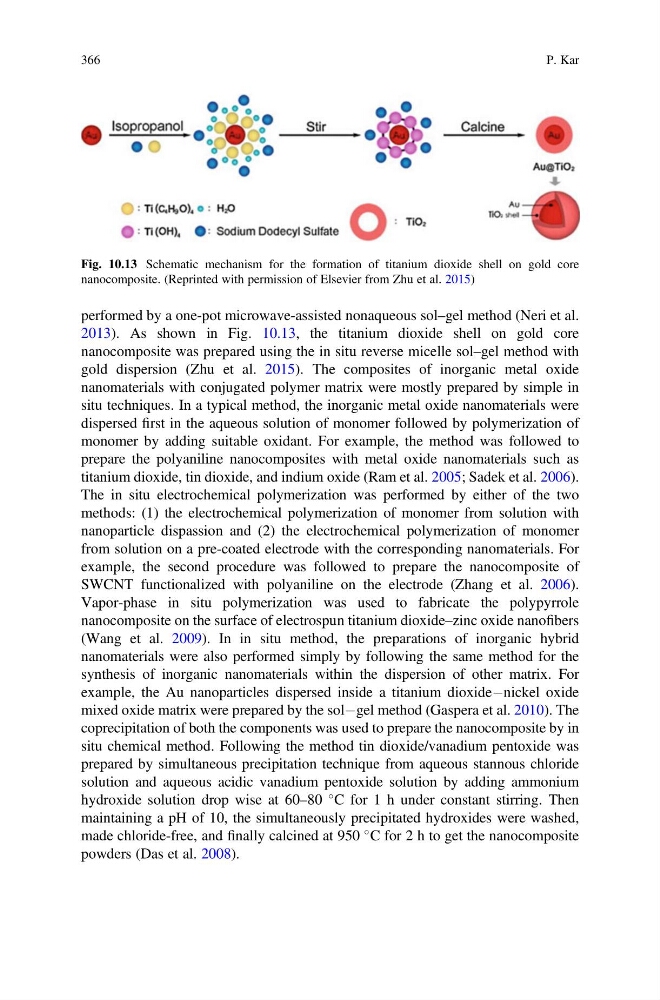
2013). As shown in Fig. 10.13, the titanium dioxide shell on gold core
nanocomposite was prepared using the in situ reverse micelle sol–gel method with
gold dispersion (Zhu et al. 2015). The composites of inorganic metal oxide
nanomaterials with conjugated polymer matrix were mostly prepared by simple in
situ techniques. In a typical method, the inorganic metal oxide nanomaterials were
dispersed first in the aqueous solution of monomer followed by polymerization of
monomer by adding suitable oxidant. For example, the method was followed to
prepare the polyaniline nanocomposites with metal oxide nanomaterials such as
titanium dioxide, tin dioxide, and indium oxide (Ram et al. 2005; Sadek et al. 2006).
The in situ electrochemical polymerization was performed by either of the two
methods: (1) the electrochemical polymerization of monomer from solution with
nanoparticle dispassion and (2) the electrochemical polymerization of monomer
from solution on a pre-coated electrode with the corresponding nanomaterials. For
example, the second procedure was followed to prepare the nanocomposite of
SWCNT functionalized with polyaniline on the electrode (Zhang et al. 2006).
Vapor-phase in situ polymerization was used to fabricate the polypyrrole
nanocomposite on the surface of electrospun titanium dioxide–zinc oxide nanofibers
(Wang et al. 2009). In in situ method, the preparations of inorganic hybrid
nanomaterials were also performed simply by following the same method for the
synthesis of inorganic nanomaterials within the dispersion of other matrix. For
example, the Au nanoparticles dispersed inside a titanium dioxideÀnickel oxide
mixed oxide matrix were prepared by the solÀgel method (Gaspera et al. 2010). The
coprecipitation of both the components was used to prepare the nanocomposite by in
situ chemical method. Following the method tin dioxide/vanadium pentoxide was
prepared by simultaneous precipitation technique from aqueous stannous chloride
solution and aqueous acidic vanadium pentoxide solution by adding ammonium
hydroxide solution drop wise at 60–80
C for 1 h under constant stirring. Then
maintaining a pH of 10, the simultaneously precipitated hydroxides were washed,
made chloride-free, and finally calcined at 950
C for 2 h to get the nanocomposite
powders (Das et al. 2008).
Fig. 10.13 Schematic mechanism for the formation of titanium dioxide shell on gold core
nanocomposite. (Reprinted with permission of Elsevier from Zhu et al. 2015)
366
P. Kar
2013). As shown in Fig. 10.13, the titanium dioxide shell on gold core
nanocomposite was prepared using the in situ reverse micelle sol–gel method with
gold dispersion (Zhu et al. 2015). The composites of inorganic metal oxide
nanomaterials with conjugated polymer matrix were mostly prepared by simple in
situ techniques. In a typical method, the inorganic metal oxide nanomaterials were
dispersed first in the aqueous solution of monomer followed by polymerization of
monomer by adding suitable oxidant. For example, the method was followed to
prepare the polyaniline nanocomposites with metal oxide nanomaterials such as
titanium dioxide, tin dioxide, and indium oxide (Ram et al. 2005; Sadek et al. 2006).
The in situ electrochemical polymerization was performed by either of the two
methods: (1) the electrochemical polymerization of monomer from solution with
nanoparticle dispassion and (2) the electrochemical polymerization of monomer
from solution on a pre-coated electrode with the corresponding nanomaterials. For
example, the second procedure was followed to prepare the nanocomposite of
SWCNT functionalized with polyaniline on the electrode (Zhang et al. 2006).
Vapor-phase in situ polymerization was used to fabricate the polypyrrole
nanocomposite on the surface of electrospun titanium dioxide–zinc oxide nanofibers
(Wang et al. 2009). In in situ method, the preparations of inorganic hybrid
nanomaterials were also performed simply by following the same method for the
synthesis of inorganic nanomaterials within the dispersion of other matrix. For
example, the Au nanoparticles dispersed inside a titanium dioxideÀnickel oxide
mixed oxide matrix were prepared by the solÀgel method (Gaspera et al. 2010). The
coprecipitation of both the components was used to prepare the nanocomposite by in
situ chemical method. Following the method tin dioxide/vanadium pentoxide was
prepared by simultaneous precipitation technique from aqueous stannous chloride
solution and aqueous acidic vanadium pentoxide solution by adding ammonium
hydroxide solution drop wise at 60–80
C for 1 h under constant stirring. Then
maintaining a pH of 10, the simultaneously precipitated hydroxides were washed,
made chloride-free, and finally calcined at 950
C for 2 h to get the nanocomposite
powders (Das et al. 2008).
Fig. 10.13 Schematic mechanism for the formation of titanium dioxide shell on gold core
nanocomposite. (Reprinted with permission of Elsevier from Zhu et al. 2015)
366
P. Kar