

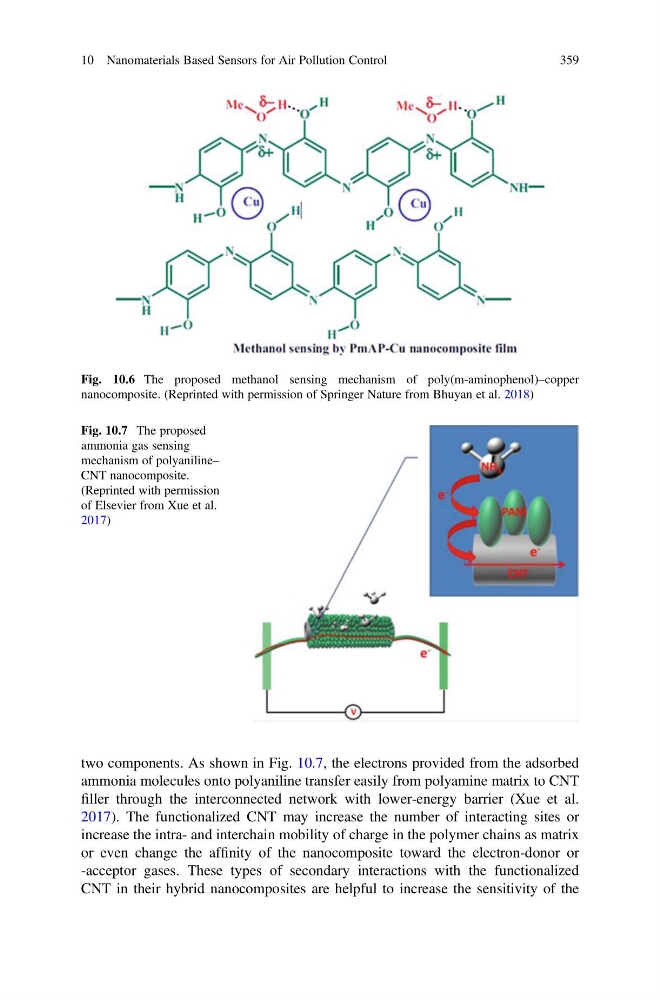
two components. As shown in Fig. 10.7, the electrons provided from the adsorbed
ammonia molecules onto polyaniline transfer easily from polyamine matrix to CNT
filler through the interconnected network with lower-energy barrier (Xue et al.
2017). The functionalized CNT may increase the number of interacting sites or
increase the intra- and interchain mobility of charge in the polymer chains as matrix
or even change the affinity of the nanocomposite toward the electron-donor or
-acceptor gases. These types of secondary interactions with the functionalized
CNT in their hybrid nanocomposites are helpful to increase the sensitivity of the
Fig. 10.6 The proposed methanol sensing mechanism of poly(m-aminophenol)–copper
nanocomposite. (Reprinted with permission of Springer Nature from Bhuyan et al. 2018)
Fig. 10.7 The proposed
ammonia gas sensing
mechanism of polyaniline–
CNT nanocomposite.
(Reprinted with permission
of Elsevier from Xue et al.
2017)
10 Nanomaterials Based Sensors for Air Pollution Control
359
ammonia molecules onto polyaniline transfer easily from polyamine matrix to CNT
filler through the interconnected network with lower-energy barrier (Xue et al.
2017). The functionalized CNT may increase the number of interacting sites or
increase the intra- and interchain mobility of charge in the polymer chains as matrix
or even change the affinity of the nanocomposite toward the electron-donor or
-acceptor gases. These types of secondary interactions with the functionalized
CNT in their hybrid nanocomposites are helpful to increase the sensitivity of the
Fig. 10.6 The proposed methanol sensing mechanism of poly(m-aminophenol)–copper
nanocomposite. (Reprinted with permission of Springer Nature from Bhuyan et al. 2018)
Fig. 10.7 The proposed
ammonia gas sensing
mechanism of polyaniline–
CNT nanocomposite.
(Reprinted with permission
of Elsevier from Xue et al.
2017)
10 Nanomaterials Based Sensors for Air Pollution Control
359