

with zinc ferrite toward (Mukherjee and Majumder 2010) a variety of reducing gases
including carbon monoxide, hydrogen, methane, and nitrous oxide. The analytes can
interact with the hybrid layer by electron donation or electron withdrawing or some
type of weak interaction or even small amount of charge induction (Kar et al. 2015).
As described earlier, hole conductivity increases for a p-type nanocomposite by
donating electrons to the chemical analyte, and conductivity decreases for n-type
nanocomposite by accepting electron from chemical analyte. For example, the
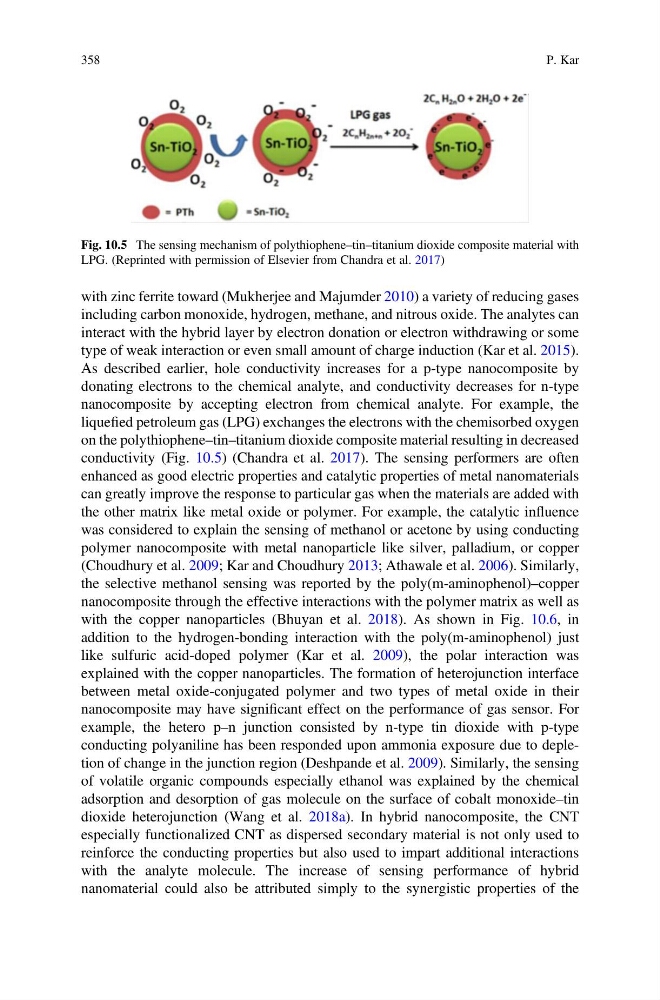
liquefied petroleum gas (LPG) exchanges the electrons with the chemisorbed oxygen
on the polythiophene–tin–titanium dioxide composite material resulting in decreased
conductivity (Fig. 10.5) (Chandra et al. 2017). The sensing performers are often
enhanced as good electric properties and catalytic properties of metal nanomaterials
can greatly improve the response to particular gas when the materials are added with
the other matrix like metal oxide or polymer. For example, the catalytic influence
was considered to explain the sensing of methanol or acetone by using conducting
polymer nanocomposite with metal nanoparticle like silver, palladium, or copper
(Choudhury et al. 2009; Kar and Choudhury 2013; Athawale et al. 2006). Similarly,
the selective methanol sensing was reported by the poly(m-aminophenol)–copper
nanocomposite through the effective interactions with the polymer matrix as well as
with the copper nanoparticles (Bhuyan et al. 2018). As shown in Fig. 10.6, in
addition to the hydrogen-bonding interaction with the poly(m-aminophenol) just
like sulfuric acid-doped polymer (Kar et al. 2009), the polar interaction was
explained with the copper nanoparticles. The formation of heterojunction interface
between metal oxide-conjugated polymer and two types of metal oxide in their
nanocomposite may have significant effect on the performance of gas sensor. For
example, the hetero p–n junction consisted by n-type tin dioxide with p-type
conducting polyaniline has been responded upon ammonia exposure due to depletion of change in the junction region (Deshpande et al. 2009). Similarly, the sensing
of volatile organic compounds especially ethanol was explained by the chemical
adsorption and desorption of gas molecule on the surface of cobalt monoxide–tin
dioxide heterojunction (Wang et al. 2018a). In hybrid nanocomposite, the CNT
especially functionalized CNT as dispersed secondary material is not only used to
reinforce the conducting properties but also used to impart additional interactions
with the analyte molecule. The increase of sensing performance of hybrid
nanomaterial could also be attributed simply to the synergistic properties of the
Fig. 10.5 The sensing mechanism of polythiophene–tin–titanium dioxide composite material with
LPG. (Reprinted with permission of Elsevier from Chandra et al. 2017)
358
P. Kar
including carbon monoxide, hydrogen, methane, and nitrous oxide. The analytes can
interact with the hybrid layer by electron donation or electron withdrawing or some
type of weak interaction or even small amount of charge induction (Kar et al. 2015).
As described earlier, hole conductivity increases for a p-type nanocomposite by
donating electrons to the chemical analyte, and conductivity decreases for n-type
nanocomposite by accepting electron from chemical analyte. For example, the
liquefied petroleum gas (LPG) exchanges the electrons with the chemisorbed oxygen
on the polythiophene–tin–titanium dioxide composite material resulting in decreased
conductivity (Fig. 10.5) (Chandra et al. 2017). The sensing performers are often
enhanced as good electric properties and catalytic properties of metal nanomaterials
can greatly improve the response to particular gas when the materials are added with
the other matrix like metal oxide or polymer. For example, the catalytic influence
was considered to explain the sensing of methanol or acetone by using conducting
polymer nanocomposite with metal nanoparticle like silver, palladium, or copper
(Choudhury et al. 2009; Kar and Choudhury 2013; Athawale et al. 2006). Similarly,
the selective methanol sensing was reported by the poly(m-aminophenol)–copper
nanocomposite through the effective interactions with the polymer matrix as well as
with the copper nanoparticles (Bhuyan et al. 2018). As shown in Fig. 10.6, in
addition to the hydrogen-bonding interaction with the poly(m-aminophenol) just
like sulfuric acid-doped polymer (Kar et al. 2009), the polar interaction was
explained with the copper nanoparticles. The formation of heterojunction interface
between metal oxide-conjugated polymer and two types of metal oxide in their
nanocomposite may have significant effect on the performance of gas sensor. For
example, the hetero p–n junction consisted by n-type tin dioxide with p-type
conducting polyaniline has been responded upon ammonia exposure due to depletion of change in the junction region (Deshpande et al. 2009). Similarly, the sensing
of volatile organic compounds especially ethanol was explained by the chemical
adsorption and desorption of gas molecule on the surface of cobalt monoxide–tin
dioxide heterojunction (Wang et al. 2018a). In hybrid nanocomposite, the CNT
especially functionalized CNT as dispersed secondary material is not only used to
reinforce the conducting properties but also used to impart additional interactions
with the analyte molecule. The increase of sensing performance of hybrid
nanomaterial could also be attributed simply to the synergistic properties of the
Fig. 10.5 The sensing mechanism of polythiophene–tin–titanium dioxide composite material with
LPG. (Reprinted with permission of Elsevier from Chandra et al. 2017)
358
P. Kar