

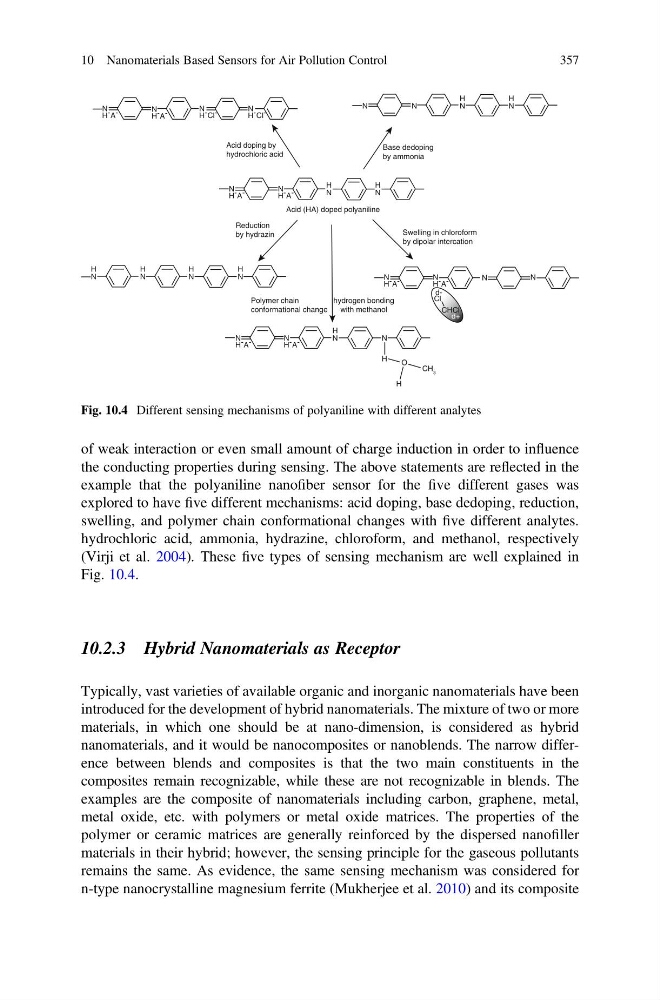
of weak interaction or even small amount of charge induction in order to influence
the conducting properties during sensing. The above statements are reflected in the
example that the polyaniline nanofiber sensor for the five different gases was
explored to have five different mechanisms: acid doping, base dedoping, reduction,
swelling, and polymer chain conformational changes with five different analytes.
hydrochloric acid, ammonia, hydrazine, chloroform, and methanol, respectively
(Virji et al. 2004). These five types of sensing mechanism are well explained in
Fig. 10.4.
10.2.3 Hybrid Nanomaterials as Receptor
Typically, vast varieties of available organic and inorganic nanomaterials have been
introduced for the development of hybrid nanomaterials. The mixture of two or more
materials, in which one should be at nano-dimension, is considered as hybrid
nanomaterials, and it would be nanocomposites or nanoblends. The narrow difference between blends and composites is that the two main constituents in the
composites remain recognizable, while these are not recognizable in blends. The
examples are the composite of nanomaterials including carbon, graphene, metal,
metal oxide, etc. with polymers or metal oxide matrices. The properties of the
polymer or ceramic matrices are generally reinforced by the dispersed nanofiller
materials in their hybrid; however, the sensing principle for the gaseous pollutants
remains the same. As evidence, the same sensing mechanism was considered for
n-type nanocrystalline magnesium ferrite (Mukherjee et al. 2010) and its composite
N
H - A -
N
H - A -
N
H - A -
N
H - A -
N
H - A -
N
H - A -
N
H - A -
dd+
N
N
N
N
N
N
H
N
H
N
H
N
H
N
H
N
H
N
N
H
H
CH 3
H
O
N
H
N
H
H - A -
N
Acid doping by
hydrochloric acid
Acid (HA) doped polyaniline
Reduction
by hydrazin
Swelling in chloroform
by dipolar intercation
Polymer chain
conformational change
hydrogen bonding
with methanol
Base dedoping
by ammonia
H - Cl -
N
H - Cl -
Cl
CHCl
Fig. 10.4 Different sensing mechanisms of polyaniline with different analytes
10 Nanomaterials Based Sensors for Air Pollution Control
357
the conducting properties during sensing. The above statements are reflected in the
example that the polyaniline nanofiber sensor for the five different gases was
explored to have five different mechanisms: acid doping, base dedoping, reduction,
swelling, and polymer chain conformational changes with five different analytes.
hydrochloric acid, ammonia, hydrazine, chloroform, and methanol, respectively
(Virji et al. 2004). These five types of sensing mechanism are well explained in
Fig. 10.4.
10.2.3 Hybrid Nanomaterials as Receptor
Typically, vast varieties of available organic and inorganic nanomaterials have been
introduced for the development of hybrid nanomaterials. The mixture of two or more
materials, in which one should be at nano-dimension, is considered as hybrid
nanomaterials, and it would be nanocomposites or nanoblends. The narrow difference between blends and composites is that the two main constituents in the
composites remain recognizable, while these are not recognizable in blends. The
examples are the composite of nanomaterials including carbon, graphene, metal,
metal oxide, etc. with polymers or metal oxide matrices. The properties of the
polymer or ceramic matrices are generally reinforced by the dispersed nanofiller
materials in their hybrid; however, the sensing principle for the gaseous pollutants
remains the same. As evidence, the same sensing mechanism was considered for
n-type nanocrystalline magnesium ferrite (Mukherjee et al. 2010) and its composite
N
H - A -
N
H - A -
N
H - A -
N
H - A -
N
H - A -
N
H - A -
N
H - A -
dd+
N
N
N
N
N
N
H
N
H
N
H
N
H
N
H
N
H
N
N
H
H
CH 3
H
O
N
H
N
H
H - A -
N
Acid doping by
hydrochloric acid
Acid (HA) doped polyaniline
Reduction
by hydrazin
Swelling in chloroform
by dipolar intercation
Polymer chain
conformational change
hydrogen bonding
with methanol
Base dedoping
by ammonia
H - Cl -
N
H - Cl -
Cl
CHCl
Fig. 10.4 Different sensing mechanisms of polyaniline with different analytes
10 Nanomaterials Based Sensors for Air Pollution Control
357