

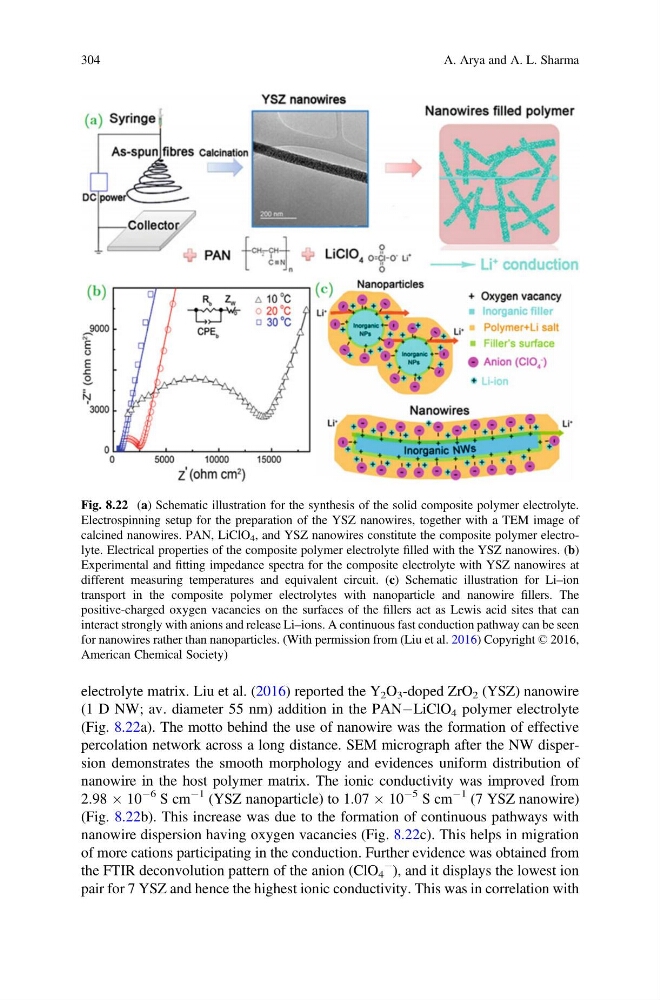
electrolyte matrix. Liu et al. (2016) reported the Y 2 O 3 -doped ZrO 2 (YSZ) nanowire
(1 D NW; av. diameter 55 nm) addition in the PANÀLiClO 4 polymer electrolyte
(Fig. 8.22a). The motto behind the use of nanowire was the formation of effective
percolation network across a long distance. SEM micrograph after the NW dispersion demonstrates the smooth morphology and evidences uniform distribution of
nanowire in the host polymer matrix. The ionic conductivity was improved from
2.98 Â 10
À6 S cm
À1 (YSZ nanoparticle) to 1.07 Â 10
À5 S cm
À1 (7 YSZ nanowire)
(Fig. 8.22b). This increase was due to the formation of continuous pathways with
nanowire dispersion having oxygen vacancies (Fig. 8.22c). This helps in migration
of more cations participating in the conduction. Further evidence was obtained from
the FTIR deconvolution pattern of the anion (ClO 4
À ), and it displays the lowest ion
pair for 7 YSZ and hence the highest ionic conductivity. This was in correlation with
Fig. 8.22 (a) Schematic illustration for the synthesis of the solid composite polymer electrolyte.
Electrospinning setup for the preparation of the YSZ nanowires, together with a TEM image of
calcined nanowires. PAN, LiClO 4 , and YSZ nanowires constitute the composite polymer electrolyte. Electrical properties of the composite polymer electrolyte filled with the YSZ nanowires. (b)
Experimental and fitting impedance spectra for the composite electrolyte with YSZ nanowires at
different measuring temperatures and equivalent circuit. (c) Schematic illustration for Li–ion
transport in the composite polymer electrolytes with nanoparticle and nanowire fillers. The
positive-charged oxygen vacancies on the surfaces of the fillers act as Lewis acid sites that can
interact strongly with anions and release Li–ions. A continuous fast conduction pathway can be seen
for nanowires rather than nanoparticles. (With permission from (Liu et al. 2016) Copyright © 2016,
American Chemical Society)
304
A. Arya and A. L. Sharma
(1 D NW; av. diameter 55 nm) addition in the PANÀLiClO 4 polymer electrolyte
(Fig. 8.22a). The motto behind the use of nanowire was the formation of effective
percolation network across a long distance. SEM micrograph after the NW dispersion demonstrates the smooth morphology and evidences uniform distribution of
nanowire in the host polymer matrix. The ionic conductivity was improved from
2.98 Â 10
À6 S cm
À1 (YSZ nanoparticle) to 1.07 Â 10
À5 S cm
À1 (7 YSZ nanowire)
(Fig. 8.22b). This increase was due to the formation of continuous pathways with
nanowire dispersion having oxygen vacancies (Fig. 8.22c). This helps in migration
of more cations participating in the conduction. Further evidence was obtained from
the FTIR deconvolution pattern of the anion (ClO 4
À ), and it displays the lowest ion
pair for 7 YSZ and hence the highest ionic conductivity. This was in correlation with
Fig. 8.22 (a) Schematic illustration for the synthesis of the solid composite polymer electrolyte.
Electrospinning setup for the preparation of the YSZ nanowires, together with a TEM image of
calcined nanowires. PAN, LiClO 4 , and YSZ nanowires constitute the composite polymer electrolyte. Electrical properties of the composite polymer electrolyte filled with the YSZ nanowires. (b)
Experimental and fitting impedance spectra for the composite electrolyte with YSZ nanowires at
different measuring temperatures and equivalent circuit. (c) Schematic illustration for Li–ion
transport in the composite polymer electrolytes with nanoparticle and nanowire fillers. The
positive-charged oxygen vacancies on the surfaces of the fillers act as Lewis acid sites that can
interact strongly with anions and release Li–ions. A continuous fast conduction pathway can be seen
for nanowires rather than nanoparticles. (With permission from (Liu et al. 2016) Copyright © 2016,
American Chemical Society)
304
A. Arya and A. L. Sharma