

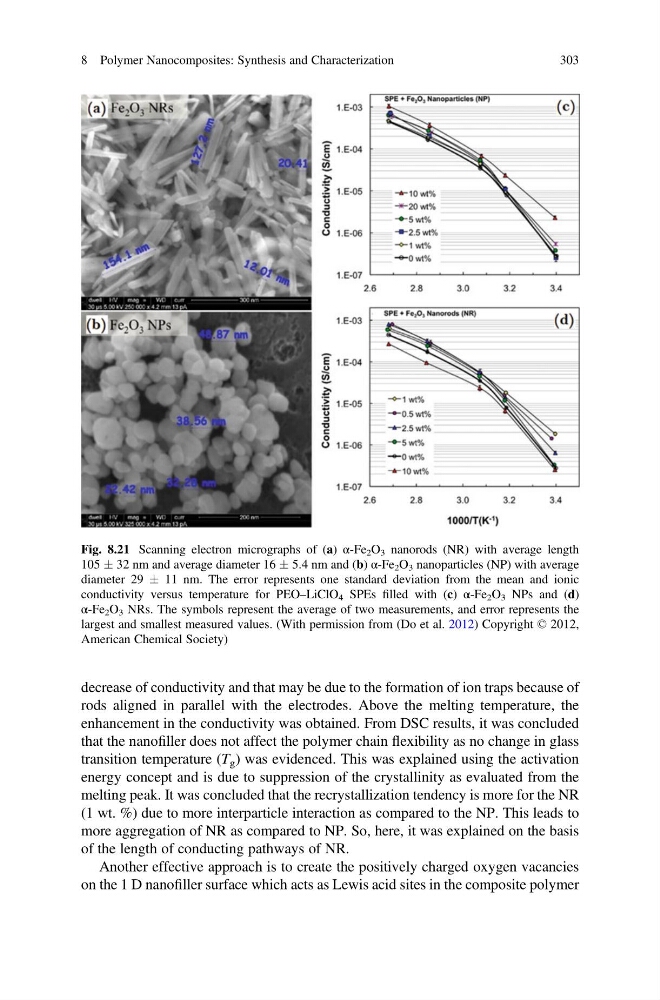
decrease of conductivity and that may be due to the formation of ion traps because of
rods aligned in parallel with the electrodes. Above the melting temperature, the
enhancement in the conductivity was obtained. From DSC results, it was concluded
that the nanofiller does not affect the polymer chain flexibility as no change in glass
transition temperature (T g ) was evidenced. This was explained using the activation
energy concept and is due to suppression of the crystallinity as evaluated from the
melting peak. It was concluded that the recrystallization tendency is more for the NR
(1 wt. %) due to more interparticle interaction as compared to the NP. This leads to
more aggregation of NR as compared to NP. So, here, it was explained on the basis
of the length of conducting pathways of NR.
Another effective approach is to create the positively charged oxygen vacancies
on the 1 D nanofiller surface which acts as Lewis acid sites in the composite polymer
Fig. 8.21 Scanning electron micrographs of (a) α-Fe 2 O 3 nanorods (NR) with average length
105 Æ 32 nm and average diameter 16 Æ 5.4 nm and (b) α-Fe 2 O 3 nanoparticles (NP) with average
diameter 29 Æ 11 nm. The error represents one standard deviation from the mean and ionic
conductivity versus temperature for PEO–LiClO 4 SPEs filled with (c) α-Fe 2 O 3 NPs and (d)
α-Fe 2 O 3 NRs. The symbols represent the average of two measurements, and error represents the
largest and smallest measured values. (With permission from (Do et al. 2012) Copyright © 2012,
American Chemical Society)
8 Polymer Nanocomposites: Synthesis and Characterization
303
rods aligned in parallel with the electrodes. Above the melting temperature, the
enhancement in the conductivity was obtained. From DSC results, it was concluded
that the nanofiller does not affect the polymer chain flexibility as no change in glass
transition temperature (T g ) was evidenced. This was explained using the activation
energy concept and is due to suppression of the crystallinity as evaluated from the
melting peak. It was concluded that the recrystallization tendency is more for the NR
(1 wt. %) due to more interparticle interaction as compared to the NP. This leads to
more aggregation of NR as compared to NP. So, here, it was explained on the basis
of the length of conducting pathways of NR.
Another effective approach is to create the positively charged oxygen vacancies
on the 1 D nanofiller surface which acts as Lewis acid sites in the composite polymer
Fig. 8.21 Scanning electron micrographs of (a) α-Fe 2 O 3 nanorods (NR) with average length
105 Æ 32 nm and average diameter 16 Æ 5.4 nm and (b) α-Fe 2 O 3 nanoparticles (NP) with average
diameter 29 Æ 11 nm. The error represents one standard deviation from the mean and ionic
conductivity versus temperature for PEO–LiClO 4 SPEs filled with (c) α-Fe 2 O 3 NPs and (d)
α-Fe 2 O 3 NRs. The symbols represent the average of two measurements, and error represents the
largest and smallest measured values. (With permission from (Do et al. 2012) Copyright © 2012,
American Chemical Society)
8 Polymer Nanocomposites: Synthesis and Characterization
303