

the increased Li
+ ion transference number from 0.27 to 0.56. From TGA analysis, a
correlation of ionic conductivity was built with dehydration temperature, and the
lower the dehydration temperature, the higher will be the conductivity and lower
crystallinity. The voltage stability window was increased as compared to the
polymer–salt matrix.
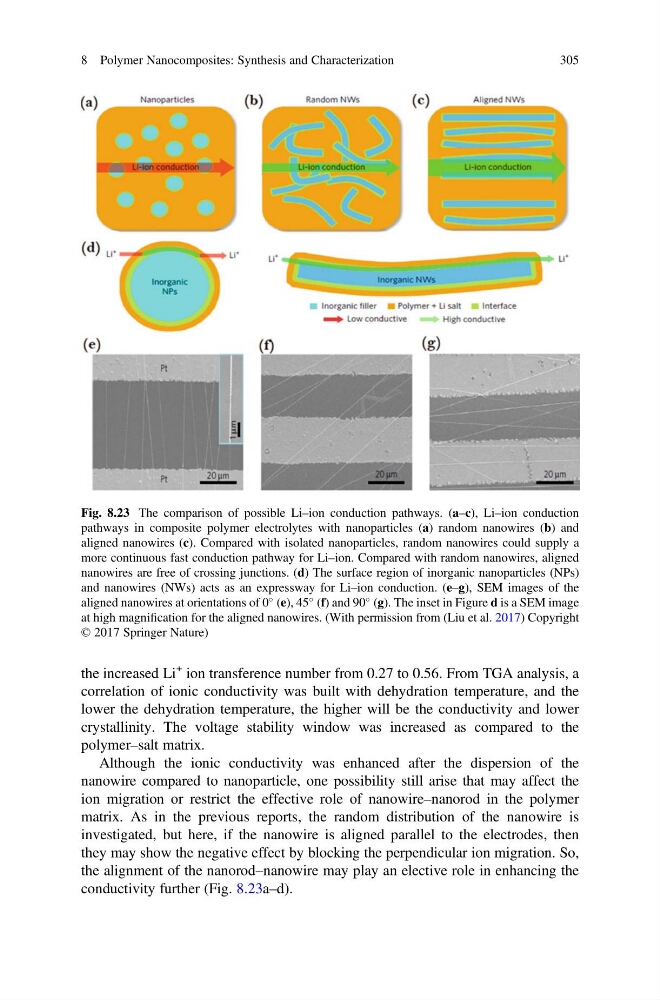
Although the ionic conductivity was enhanced after the dispersion of the
nanowire compared to nanoparticle, one possibility still arise that may affect the
ion migration or restrict the effective role of nanowire–nanorod in the polymer
matrix. As in the previous reports, the random distribution of the nanowire is
investigated, but here, if the nanowire is aligned parallel to the electrodes, then
they may show the negative effect by blocking the perpendicular ion migration. So,
the alignment of the nanorod–nanowire may play an elective role in enhancing the
conductivity further (Fig. 8.23a–d).
Fig. 8.23 The comparison of possible Li–ion conduction pathways. (a–c), Li–ion conduction
pathways in composite polymer electrolytes with nanoparticles (a) random nanowires (b) and
aligned nanowires (c). Compared with isolated nanoparticles, random nanowires could supply a
more continuous fast conduction pathway for Li–ion. Compared with random nanowires, aligned
nanowires are free of crossing junctions. (d) The surface region of inorganic nanoparticles (NPs)
and nanowires (NWs) acts as an expressway for Li–ion conduction. (e–g), SEM images of the
aligned nanowires at orientations of 0
(e), 45
(f) and 90
(g). The inset in Figure d is a SEM image
at high magnification for the aligned nanowires. (With permission from (Liu et al. 2017) Copyright
© 2017 Springer Nature)
8 Polymer Nanocomposites: Synthesis and Characterization
305
+ ion transference number from 0.27 to 0.56. From TGA analysis, a
correlation of ionic conductivity was built with dehydration temperature, and the
lower the dehydration temperature, the higher will be the conductivity and lower
crystallinity. The voltage stability window was increased as compared to the
polymer–salt matrix.
Although the ionic conductivity was enhanced after the dispersion of the
nanowire compared to nanoparticle, one possibility still arise that may affect the
ion migration or restrict the effective role of nanowire–nanorod in the polymer
matrix. As in the previous reports, the random distribution of the nanowire is
investigated, but here, if the nanowire is aligned parallel to the electrodes, then
they may show the negative effect by blocking the perpendicular ion migration. So,
the alignment of the nanorod–nanowire may play an elective role in enhancing the
conductivity further (Fig. 8.23a–d).
Fig. 8.23 The comparison of possible Li–ion conduction pathways. (a–c), Li–ion conduction
pathways in composite polymer electrolytes with nanoparticles (a) random nanowires (b) and
aligned nanowires (c). Compared with isolated nanoparticles, random nanowires could supply a
more continuous fast conduction pathway for Li–ion. Compared with random nanowires, aligned
nanowires are free of crossing junctions. (d) The surface region of inorganic nanoparticles (NPs)
and nanowires (NWs) acts as an expressway for Li–ion conduction. (e–g), SEM images of the
aligned nanowires at orientations of 0
(e), 45
(f) and 90
(g). The inset in Figure d is a SEM image
at high magnification for the aligned nanowires. (With permission from (Liu et al. 2017) Copyright
© 2017 Springer Nature)
8 Polymer Nanocomposites: Synthesis and Characterization
305