

electrolytes with value about 10
À5 S cm
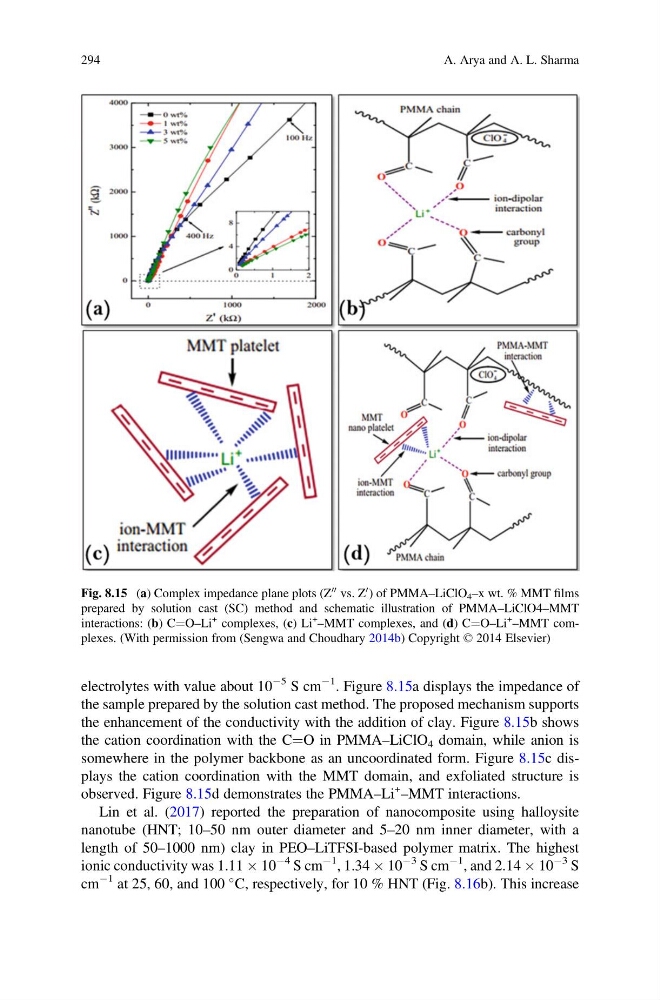
À1 . Figure 8.15a displays the impedance of
the sample prepared by the solution cast method. The proposed mechanism supports
the enhancement of the conductivity with the addition of clay. Figure 8.15b shows
the cation coordination with the C¼O in PMMA–LiClO 4 domain, while anion is
somewhere in the polymer backbone as an uncoordinated form. Figure 8.15c displays the cation coordination with the MMT domain, and exfoliated structure is
observed. Figure 8.15d demonstrates the PMMA–Li
+
–MMT interactions.
Lin et al. (2017) reported the preparation of nanocomposite using halloysite
nanotube (HNT; 10–50 nm outer diameter and 5–20 nm inner diameter, with a
length of 50–1000 nm) clay in PEO–LiTFSI-based polymer matrix. The highest
ionic conductivity was 1.11 Â 10
À4 S cm
À1
, 1.34 Â 10
À3 S cm
À1 , and 2.14 Â 10
À3 S
cm
À1 at 25, 60, and 100
C, respectively, for 10 % HNT (Fig. 8.16b). This increase
Fig. 8.15 (a) Complex impedance plane plots (Z
00 vs. Z
0 ) of PMMA–LiClO 4 –x wt. % MMT films
prepared by solution cast (SC) method and schematic illustration of PMMA–LiClO4–MMT
interactions: (b) C¼O–Li
+ complexes, (c) Li
+ –MMT complexes, and (d) C¼O–Li
+ –MMT complexes. (With permission from (Sengwa and Choudhary 2014b) Copyright © 2014 Elsevier)
294
A. Arya and A. L. Sharma
À5 S cm
À1 . Figure 8.15a displays the impedance of
the sample prepared by the solution cast method. The proposed mechanism supports
the enhancement of the conductivity with the addition of clay. Figure 8.15b shows
the cation coordination with the C¼O in PMMA–LiClO 4 domain, while anion is
somewhere in the polymer backbone as an uncoordinated form. Figure 8.15c displays the cation coordination with the MMT domain, and exfoliated structure is
observed. Figure 8.15d demonstrates the PMMA–Li
+
–MMT interactions.
Lin et al. (2017) reported the preparation of nanocomposite using halloysite
nanotube (HNT; 10–50 nm outer diameter and 5–20 nm inner diameter, with a
length of 50–1000 nm) clay in PEO–LiTFSI-based polymer matrix. The highest
ionic conductivity was 1.11 Â 10
À4 S cm
À1
, 1.34 Â 10
À3 S cm
À1 , and 2.14 Â 10
À3 S
cm
À1 at 25, 60, and 100
C, respectively, for 10 % HNT (Fig. 8.16b). This increase
Fig. 8.15 (a) Complex impedance plane plots (Z
00 vs. Z
0 ) of PMMA–LiClO 4 –x wt. % MMT films
prepared by solution cast (SC) method and schematic illustration of PMMA–LiClO4–MMT
interactions: (b) C¼O–Li
+ complexes, (c) Li
+ –MMT complexes, and (d) C¼O–Li
+ –MMT complexes. (With permission from (Sengwa and Choudhary 2014b) Copyright © 2014 Elsevier)
294
A. Arya and A. L. Sharma