

faster ion migration as compared to the exfoliated-type PNC, and hopping mechanism seems to be followed as indicated by the value of n. So, the preparation
methods influence the ion mobility, and intercalated type is more beneficial as
compared to the exfoliated type which hinders the ion migration.
Erceg et al. (2014) prepared the composite polymer electrolyte based on poly
(ethylene oxide)–lithium montmorillonite (PEO–LiMMT) by melt intercalation
technique. The small-angle X-ray scattering (SAXS) evidenced the increase of the
interlayer spacing due to polymer chain intercalation inside the clay galleries with a
maximum of about 1.88 nm, while the interlayer distance was 0.93 nm (maximum).
DSC analysis displays the powering of the melting temperature and indicates the
disruption of the crystallinity after addition of clay (76.1% to 37.1%). FTIR spectrum evidences the broadening in the spectrum in region 3000 and 2750 cm
À1 and
1500 cm
À1 to 2000 cm
À1 , while some new peaks were observed after clay addition.
It confirms the existence of a crystalline phase and gets broadened with clay addition
indicating the change of the crystallinity. The highest ionic conductivity was
2.8 Â 10
À6 S cm
À1 for 40 wt. % clay content and may be due to the proper dispersion
of nanoclay, while at higher content, self-aggregation of clay layers traps the cation
and hence the lowering of the ion mobility.
Sengwa et al. (Sengwa and Choudhary 2014b) prepared the solid polymer
nanocomposite electrolytes (SPNEs) based on poly(methyl methacrylate) (PMMA)
and lithium perchlorate (LiClO 4 ) with varying concentrations of montmorillonite
(MMT) clay by solution casting and high-intensity ultrasonic-assisted solution
casting methods. XRD analysis evidences the complete dissociation of the salt,
and the exfoliation of clay was attributed to the interactions of polymer–salt complex
(C¼O–Li
+
) with the MMT nanosheet surfaces. Impedance analysis suggested that
the current carriers are ions which govern the total electrical conductivity of these
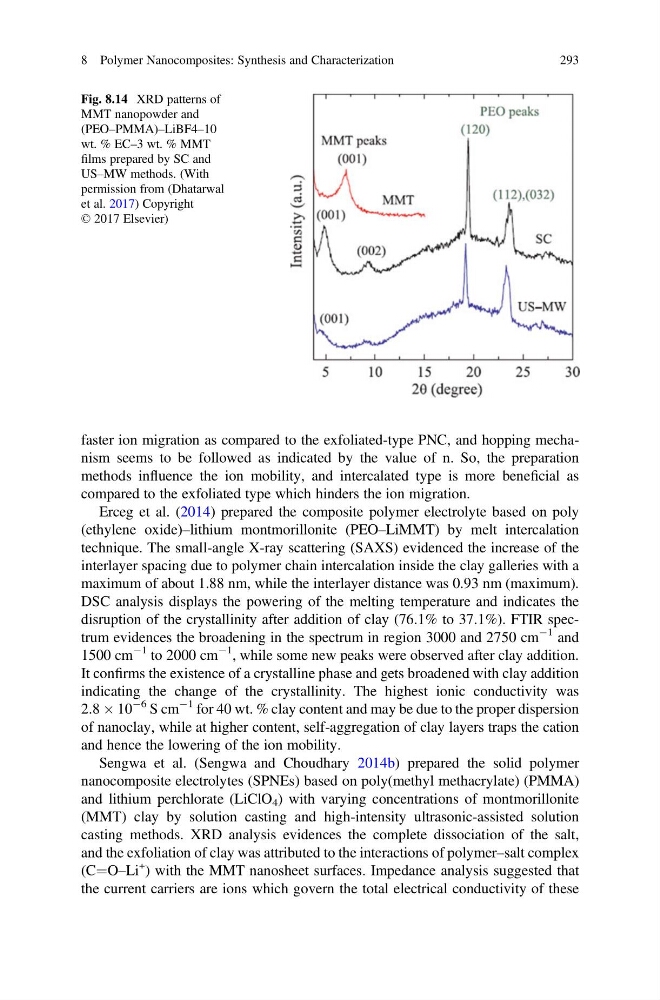
Fig. 8.14 XRD patterns of
MMT nanopowder and
(PEO–PMMA)–LiBF4–10
wt. % EC–3 wt. % MMT
films prepared by SC and
US–MW methods. (With
permission from (Dhatarwal
et al. 2017) Copyright
© 2017 Elsevier)
8 Polymer Nanocomposites: Synthesis and Characterization
293
methods influence the ion mobility, and intercalated type is more beneficial as
compared to the exfoliated type which hinders the ion migration.
Erceg et al. (2014) prepared the composite polymer electrolyte based on poly
(ethylene oxide)–lithium montmorillonite (PEO–LiMMT) by melt intercalation
technique. The small-angle X-ray scattering (SAXS) evidenced the increase of the
interlayer spacing due to polymer chain intercalation inside the clay galleries with a
maximum of about 1.88 nm, while the interlayer distance was 0.93 nm (maximum).
DSC analysis displays the powering of the melting temperature and indicates the
disruption of the crystallinity after addition of clay (76.1% to 37.1%). FTIR spectrum evidences the broadening in the spectrum in region 3000 and 2750 cm
À1 and
1500 cm
À1 to 2000 cm
À1 , while some new peaks were observed after clay addition.
It confirms the existence of a crystalline phase and gets broadened with clay addition
indicating the change of the crystallinity. The highest ionic conductivity was
2.8 Â 10
À6 S cm
À1 for 40 wt. % clay content and may be due to the proper dispersion
of nanoclay, while at higher content, self-aggregation of clay layers traps the cation
and hence the lowering of the ion mobility.
Sengwa et al. (Sengwa and Choudhary 2014b) prepared the solid polymer
nanocomposite electrolytes (SPNEs) based on poly(methyl methacrylate) (PMMA)
and lithium perchlorate (LiClO 4 ) with varying concentrations of montmorillonite
(MMT) clay by solution casting and high-intensity ultrasonic-assisted solution
casting methods. XRD analysis evidences the complete dissociation of the salt,
and the exfoliation of clay was attributed to the interactions of polymer–salt complex
(C¼O–Li
+
) with the MMT nanosheet surfaces. Impedance analysis suggested that
the current carriers are ions which govern the total electrical conductivity of these
Fig. 8.14 XRD patterns of
MMT nanopowder and
(PEO–PMMA)–LiBF4–10
wt. % EC–3 wt. % MMT
films prepared by SC and
US–MW methods. (With
permission from (Dhatarwal
et al. 2017) Copyright
© 2017 Elsevier)
8 Polymer Nanocomposites: Synthesis and Characterization
293