

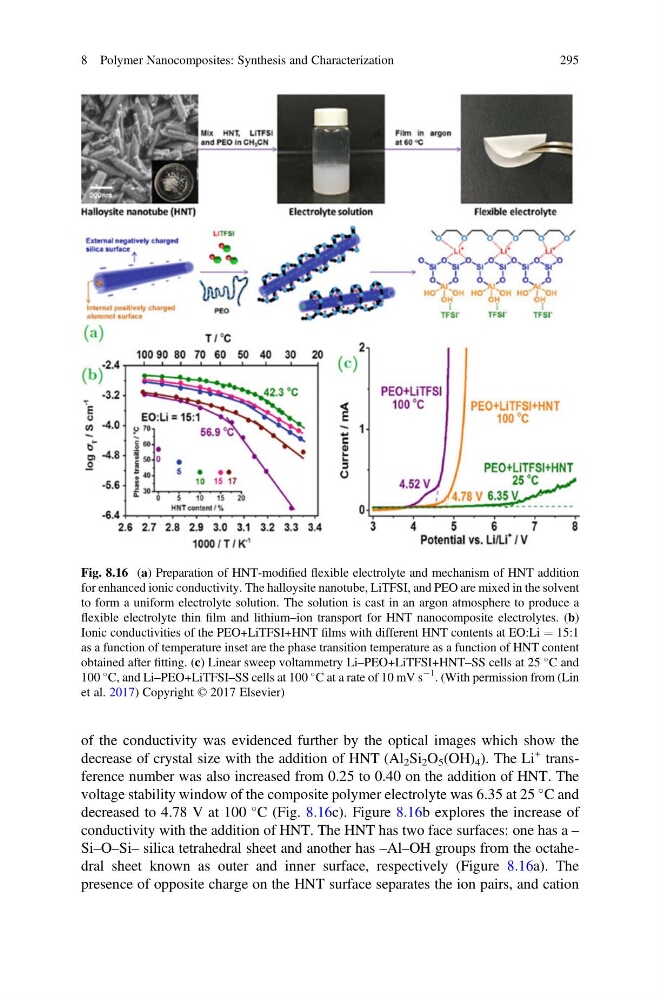
of the conductivity was evidenced further by the optical images which show the
decrease of crystal size with the addition of HNT (Al 2 Si 2 O 5 (OH) 4 ). The Li
+ transference number was also increased from 0.25 to 0.40 on the addition of HNT. The
voltage stability window of the composite polymer electrolyte was 6.35 at 25
C and
decreased to 4.78 V at 100
C (Fig. 8.16c). Figure 8.16b explores the increase of
conductivity with the addition of HNT. The HNT has two face surfaces: one has a –
Si–O–Si– silica tetrahedral sheet and another has –Al–OH groups from the octahedral sheet known as outer and inner surface, respectively (Figure 8.16a). The
presence of opposite charge on the HNT surface separates the ion pairs, and cation
Fig. 8.16 (a) Preparation of HNT-modified flexible electrolyte and mechanism of HNT addition
for enhanced ionic conductivity. The halloysite nanotube, LiTFSI, and PEO are mixed in the solvent
to form a uniform electrolyte solution. The solution is cast in an argon atmosphere to produce a
flexible electrolyte thin film and lithium–ion transport for HNT nanocomposite electrolytes. (b)
Ionic conductivities of the PEO+LiTFSI+HNT films with different HNT contents at EO:Li ¼ 15:1
as a function of temperature inset are the phase transition temperature as a function of HNT content
obtained after fitting. (c) Linear sweep voltammetry Li–PEO+LiTFSI+HNT–SS cells at 25
C and
100
C, and Li–PEO+LiTFSI–SS cells at 100
C at a rate of 10 mV s
À1
. (With permission from (Lin
et al. 2017) Copyright © 2017 Elsevier)
8 Polymer Nanocomposites: Synthesis and Characterization
295
decrease of crystal size with the addition of HNT (Al 2 Si 2 O 5 (OH) 4 ). The Li
+ transference number was also increased from 0.25 to 0.40 on the addition of HNT. The
voltage stability window of the composite polymer electrolyte was 6.35 at 25
C and
decreased to 4.78 V at 100
C (Fig. 8.16c). Figure 8.16b explores the increase of
conductivity with the addition of HNT. The HNT has two face surfaces: one has a –
Si–O–Si– silica tetrahedral sheet and another has –Al–OH groups from the octahedral sheet known as outer and inner surface, respectively (Figure 8.16a). The
presence of opposite charge on the HNT surface separates the ion pairs, and cation
Fig. 8.16 (a) Preparation of HNT-modified flexible electrolyte and mechanism of HNT addition
for enhanced ionic conductivity. The halloysite nanotube, LiTFSI, and PEO are mixed in the solvent
to form a uniform electrolyte solution. The solution is cast in an argon atmosphere to produce a
flexible electrolyte thin film and lithium–ion transport for HNT nanocomposite electrolytes. (b)
Ionic conductivities of the PEO+LiTFSI+HNT films with different HNT contents at EO:Li ¼ 15:1
as a function of temperature inset are the phase transition temperature as a function of HNT content
obtained after fitting. (c) Linear sweep voltammetry Li–PEO+LiTFSI+HNT–SS cells at 25
C and
100
C, and Li–PEO+LiTFSI–SS cells at 100
C at a rate of 10 mV s
À1
. (With permission from (Lin
et al. 2017) Copyright © 2017 Elsevier)
8 Polymer Nanocomposites: Synthesis and Characterization
295