

The changes in the peak of pure PMMA (1732, 1492, 1444, 1385, 1192, 1150,
988, 966, 844, and 756 cm
À1 , C¼O asymmetric stretching of the carbonyl group, –
CH 2 scissoring, O–CH 3 bending, -CH 2 twisting, C–O–C bending, carboxylic acid
ester group, C–C symmetric stretching, –CH 2 wagging, –CH 2 asymmetric rocking,
and –CH 2 rocking) with the addition of the salt and nanofiller in FTIR spectra
confirm the presence of polymer–ion and ion–ion interactions. Also, the number
of free charge carriers was more for low clay content and attributed to the cation
interaction with electron-rich group of PMMA. DSC analysis shows a decrease of
the T g with the addition of nanofiller, while at high nanofiller content, increase is due
to nanofiller cluster formation. TGA analysis shows thermal stability up to 250
C
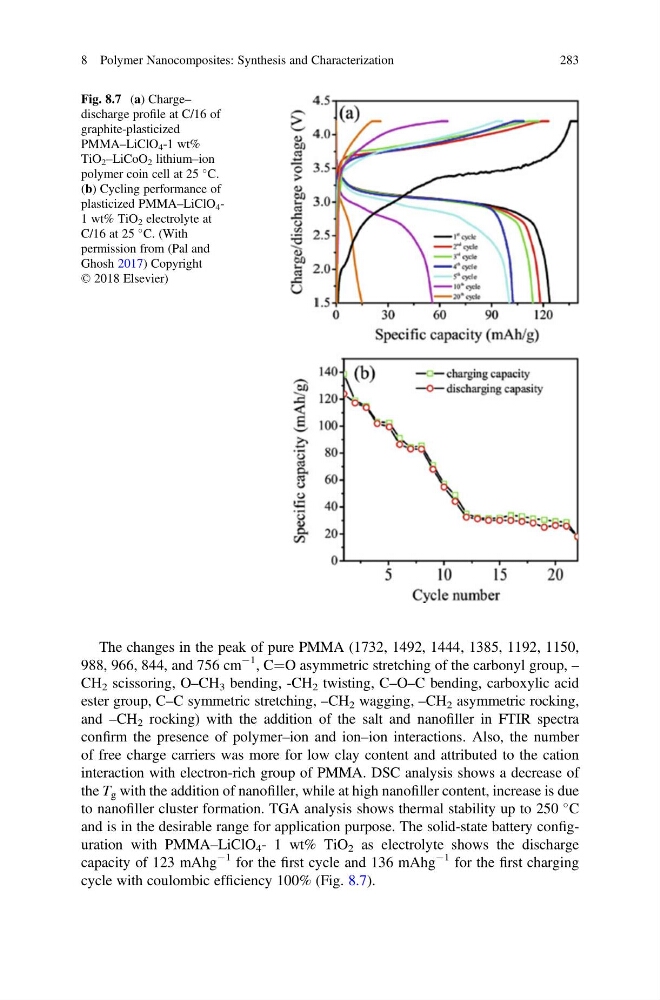
and is in the desirable range for application purpose. The solid-state battery configuration with PMMA–LiClO 4 - 1 wt% TiO 2 as electrolyte shows the discharge
capacity of 123 mAhg
À1 for the first cycle and 136 mAhg
À1 for the first charging
cycle with coulombic efficiency 100% (Fig. 8.7).
Fig. 8.7 (a) Charge–
discharge profile at C/16 of
graphite-plasticized
PMMA–LiClO 4 -1 wt%
TiO 2 –LiCoO 2 lithium–ion
polymer coin cell at 25
C.
(b) Cycling performance of
plasticized PMMA–LiClO 4 -
1 wt% TiO 2 electrolyte at
C/16 at 25
C. (With
permission from (Pal and
Ghosh 2017) Copyright
© 2018 Elsevier)
8 Polymer Nanocomposites: Synthesis and Characterization
283
988, 966, 844, and 756 cm
À1 , C¼O asymmetric stretching of the carbonyl group, –
CH 2 scissoring, O–CH 3 bending, -CH 2 twisting, C–O–C bending, carboxylic acid
ester group, C–C symmetric stretching, –CH 2 wagging, –CH 2 asymmetric rocking,
and –CH 2 rocking) with the addition of the salt and nanofiller in FTIR spectra
confirm the presence of polymer–ion and ion–ion interactions. Also, the number
of free charge carriers was more for low clay content and attributed to the cation
interaction with electron-rich group of PMMA. DSC analysis shows a decrease of
the T g with the addition of nanofiller, while at high nanofiller content, increase is due
to nanofiller cluster formation. TGA analysis shows thermal stability up to 250
C
and is in the desirable range for application purpose. The solid-state battery configuration with PMMA–LiClO 4 - 1 wt% TiO 2 as electrolyte shows the discharge
capacity of 123 mAhg
À1 for the first cycle and 136 mAhg
À1 for the first charging
cycle with coulombic efficiency 100% (Fig. 8.7).
Fig. 8.7 (a) Charge–
discharge profile at C/16 of
graphite-plasticized
PMMA–LiClO 4 -1 wt%
TiO 2 –LiCoO 2 lithium–ion
polymer coin cell at 25
C.
(b) Cycling performance of
plasticized PMMA–LiClO 4 -
1 wt% TiO 2 electrolyte at
C/16 at 25
C. (With
permission from (Pal and
Ghosh 2017) Copyright
© 2018 Elsevier)
8 Polymer Nanocomposites: Synthesis and Characterization
283