

retention for in situ synthesis (120 mAhg
À1 at 90
C and 100 mAhg
À1 at 60
C) as
compared to ex situ (65 mAhg
À1 ), while for ceramic-free, it was 50 mAhg
À1 . For in
situ cycle, stability was achieved, and after 80 cycles, capacity delivered was
105 mAhg
À1
. After 80 cycles, a decrease was observed due to the poor interface
stability, and dendrite growth may occur.
Pal et al. (Pal and Ghosh 2017) reported the PMMA–LiClO 4 -based polymer
nanocomposite electrolyte with TiO 2 as nanofiller using solution cast technique.
XRD diffractograms depict complete dissociation of salt, and PMMA peak broadens
with the addition of nanofiller. The addition of 1 wt. % TiO 2 evidences the optimum
enhancement of the amorphous content. Further, TEM analysis evidences the
nonuniform distribution and clustering, with no effect on particle size with nanofiller
loading.
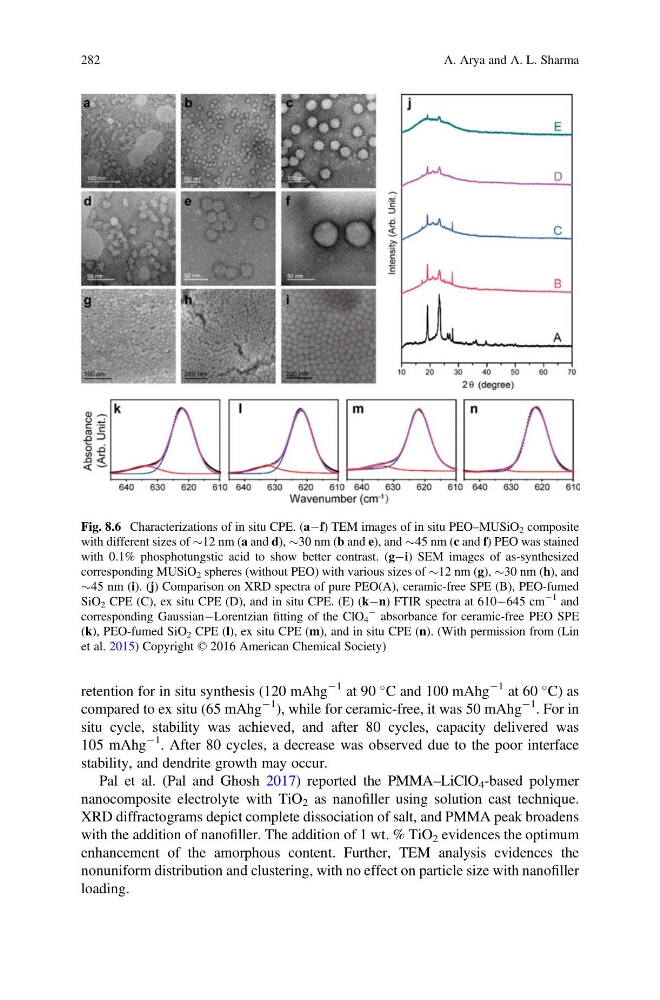
Fig. 8.6 Characterizations of in situ CPE. (aÀf) TEM images of in situ PEO–MUSiO 2 composite
with different sizes of $12 nm (a and d), $30 nm (b and e), and $45 nm (c and f) PEO was stained
with 0.1% phosphotungstic acid to show better contrast. (gÀi) SEM images of as-synthesized
corresponding MUSiO 2 spheres (without PEO) with various sizes of $12 nm (g), $30 nm (h), and
$45 nm (i). (j) Comparison on XRD spectra of pure PEO(A), ceramic-free SPE (B), PEO-fumed
SiO 2 CPE (C), ex situ CPE (D), and in situ CPE. (E) (kÀn) FTIR spectra at 610À645 cm
À1 and
corresponding GaussianÀLorentzian fitting of the ClO 4
À absorbance for ceramic-free PEO SPE
(k), PEO-fumed SiO 2 CPE (l), ex situ CPE (m), and in situ CPE (n). (With permission from (Lin
et al. 2015) Copyright © 2016 American Chemical Society)
282
A. Arya and A. L. Sharma
À1 at 90
C and 100 mAhg
À1 at 60
C) as
compared to ex situ (65 mAhg
À1 ), while for ceramic-free, it was 50 mAhg
À1 . For in
situ cycle, stability was achieved, and after 80 cycles, capacity delivered was
105 mAhg
À1
. After 80 cycles, a decrease was observed due to the poor interface
stability, and dendrite growth may occur.
Pal et al. (Pal and Ghosh 2017) reported the PMMA–LiClO 4 -based polymer
nanocomposite electrolyte with TiO 2 as nanofiller using solution cast technique.
XRD diffractograms depict complete dissociation of salt, and PMMA peak broadens
with the addition of nanofiller. The addition of 1 wt. % TiO 2 evidences the optimum
enhancement of the amorphous content. Further, TEM analysis evidences the
nonuniform distribution and clustering, with no effect on particle size with nanofiller
loading.
Fig. 8.6 Characterizations of in situ CPE. (aÀf) TEM images of in situ PEO–MUSiO 2 composite
with different sizes of $12 nm (a and d), $30 nm (b and e), and $45 nm (c and f) PEO was stained
with 0.1% phosphotungstic acid to show better contrast. (gÀi) SEM images of as-synthesized
corresponding MUSiO 2 spheres (without PEO) with various sizes of $12 nm (g), $30 nm (h), and
$45 nm (i). (j) Comparison on XRD spectra of pure PEO(A), ceramic-free SPE (B), PEO-fumed
SiO 2 CPE (C), ex situ CPE (D), and in situ CPE. (E) (kÀn) FTIR spectra at 610À645 cm
À1 and
corresponding GaussianÀLorentzian fitting of the ClO 4
À absorbance for ceramic-free PEO SPE
(k), PEO-fumed SiO 2 CPE (l), ex situ CPE (m), and in situ CPE (n). (With permission from (Lin
et al. 2015) Copyright © 2016 American Chemical Society)
282
A. Arya and A. L. Sharma