

As a lot of reports are available by the addition of nonporous inorganic nanofiller,
mesoporous nanoparticle may be a vital alternative and may fulfill the dream of
single-ion conductor. So, the suppression of crystallinity along with immobilization
of anion is simultaneously resolved by introducing the bulky imide group. Liang
et al. (2015) prepared the PEO–PMMA-based polymer nanocomposites with two
salts (LiClO 4 or LiTFSI), and nano-Al 2 O 3 was used as nanofiller by solution cast
technique. FESEM analysis showed the more uniform dispersion for PEO–PMMA–
LiTFSIAl 2 O 3 and a more even surface morphology which evidences the lowering of
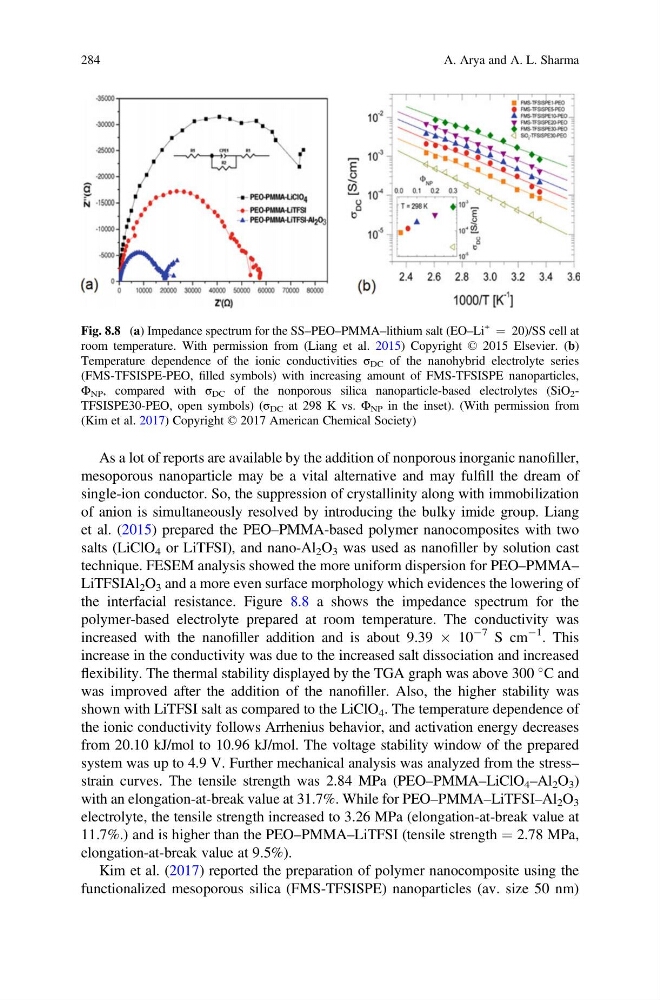
the interfacial resistance. Figure 8.8 a shows the impedance spectrum for the
polymer-based electrolyte prepared at room temperature. The conductivity was
increased with the nanofiller addition and is about 9.39 Â 10
À7 S cm
À1 . This
increase in the conductivity was due to the increased salt dissociation and increased
flexibility. The thermal stability displayed by the TGA graph was above 300
C and
was improved after the addition of the nanofiller. Also, the higher stability was
shown with LiTFSI salt as compared to the LiClO 4 . The temperature dependence of
the ionic conductivity follows Arrhenius behavior, and activation energy decreases
from 20.10 kJ/mol to 10.96 kJ/mol. The voltage stability window of the prepared
system was up to 4.9 V. Further mechanical analysis was analyzed from the stress–
strain curves. The tensile strength was 2.84 MPa (PEO–PMMA–LiClO 4 –Al 2 O 3 )
with an elongation-at-break value at 31.7%. While for PEO–PMMA–LiTFSI–Al 2 O 3
electrolyte, the tensile strength increased to 3.26 MPa (elongation-at-break value at
11.7%.) and is higher than the PEO–PMMA–LiTFSI (tensile strength ¼ 2.78 MPa,
elongation-at-break value at 9.5%).
Kim et al. (2017) reported the preparation of polymer nanocomposite using the
functionalized mesoporous silica (FMS-TFSISPE) nanoparticles (av. size 50 nm)
Fig. 8.8 (a) Impedance spectrum for the SS–PEO–PMMA–lithium salt (EO–Li
+ ¼ 20)/SS cell at
room temperature. With permission from (Liang et al. 2015) Copyright © 2015 Elsevier. (b)
Temperature dependence of the ionic conductivities σ DC of the nanohybrid electrolyte series
(FMS-TFSISPE-PEO, filled symbols) with increasing amount of FMS-TFSISPE nanoparticles,
Φ NP , compared with σ DC of the nonporous silica nanoparticle-based electrolytes (SiO 2 -
TFSISPE30-PEO, open symbols) (σ DC at 298 K vs. Φ NP in the inset). (With permission from
(Kim et al. 2017) Copyright © 2017 American Chemical Society)
284
A. Arya and A. L. Sharma
mesoporous nanoparticle may be a vital alternative and may fulfill the dream of
single-ion conductor. So, the suppression of crystallinity along with immobilization
of anion is simultaneously resolved by introducing the bulky imide group. Liang
et al. (2015) prepared the PEO–PMMA-based polymer nanocomposites with two
salts (LiClO 4 or LiTFSI), and nano-Al 2 O 3 was used as nanofiller by solution cast
technique. FESEM analysis showed the more uniform dispersion for PEO–PMMA–
LiTFSIAl 2 O 3 and a more even surface morphology which evidences the lowering of
the interfacial resistance. Figure 8.8 a shows the impedance spectrum for the
polymer-based electrolyte prepared at room temperature. The conductivity was
increased with the nanofiller addition and is about 9.39 Â 10
À7 S cm
À1 . This
increase in the conductivity was due to the increased salt dissociation and increased
flexibility. The thermal stability displayed by the TGA graph was above 300
C and
was improved after the addition of the nanofiller. Also, the higher stability was
shown with LiTFSI salt as compared to the LiClO 4 . The temperature dependence of
the ionic conductivity follows Arrhenius behavior, and activation energy decreases
from 20.10 kJ/mol to 10.96 kJ/mol. The voltage stability window of the prepared
system was up to 4.9 V. Further mechanical analysis was analyzed from the stress–
strain curves. The tensile strength was 2.84 MPa (PEO–PMMA–LiClO 4 –Al 2 O 3 )
with an elongation-at-break value at 31.7%. While for PEO–PMMA–LiTFSI–Al 2 O 3
electrolyte, the tensile strength increased to 3.26 MPa (elongation-at-break value at
11.7%.) and is higher than the PEO–PMMA–LiTFSI (tensile strength ¼ 2.78 MPa,
elongation-at-break value at 9.5%).
Kim et al. (2017) reported the preparation of polymer nanocomposite using the
functionalized mesoporous silica (FMS-TFSISPE) nanoparticles (av. size 50 nm)
Fig. 8.8 (a) Impedance spectrum for the SS–PEO–PMMA–lithium salt (EO–Li
+ ¼ 20)/SS cell at
room temperature. With permission from (Liang et al. 2015) Copyright © 2015 Elsevier. (b)
Temperature dependence of the ionic conductivities σ DC of the nanohybrid electrolyte series
(FMS-TFSISPE-PEO, filled symbols) with increasing amount of FMS-TFSISPE nanoparticles,
Φ NP , compared with σ DC of the nonporous silica nanoparticle-based electrolytes (SiO 2 -
TFSISPE30-PEO, open symbols) (σ DC at 298 K vs. Φ NP in the inset). (With permission from
(Kim et al. 2017) Copyright © 2017 American Chemical Society)
284
A. Arya and A. L. Sharma