

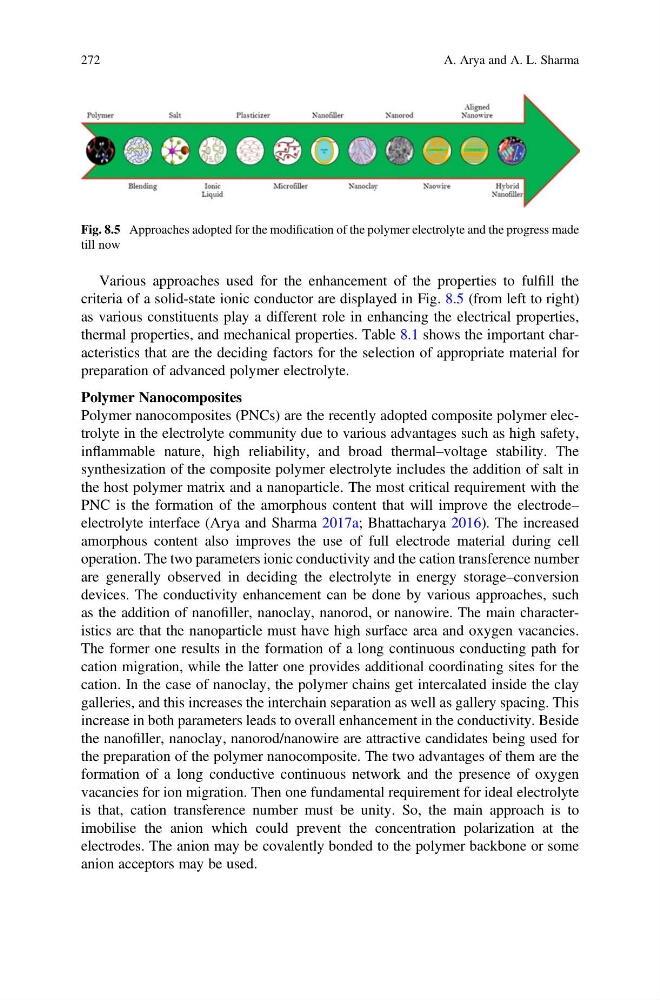
Various approaches used for the enhancement of the properties to fulfill the
criteria of a solid-state ionic conductor are displayed in Fig. 8.5 (from left to right)
as various constituents play a different role in enhancing the electrical properties,
thermal properties, and mechanical properties. Table 8.1 shows the important characteristics that are the deciding factors for the selection of appropriate material for
preparation of advanced polymer electrolyte.
Polymer Nanocomposites
Polymer nanocomposites (PNCs) are the recently adopted composite polymer electrolyte in the electrolyte community due to various advantages such as high safety,
inflammable nature, high reliability, and broad thermal–voltage stability. The
synthesization of the composite polymer electrolyte includes the addition of salt in
the host polymer matrix and a nanoparticle. The most critical requirement with the
PNC is the formation of the amorphous content that will improve the electrode–
electrolyte interface (Arya and Sharma 2017a; Bhattacharya 2016). The increased
amorphous content also improves the use of full electrode material during cell
operation. The two parameters ionic conductivity and the cation transference number
are generally observed in deciding the electrolyte in energy storage–conversion
devices. The conductivity enhancement can be done by various approaches, such
as the addition of nanofiller, nanoclay, nanorod, or nanowire. The main characteristics are that the nanoparticle must have high surface area and oxygen vacancies.
The former one results in the formation of a long continuous conducting path for
cation migration, while the latter one provides additional coordinating sites for the
cation. In the case of nanoclay, the polymer chains get intercalated inside the clay
galleries, and this increases the interchain separation as well as gallery spacing. This
increase in both parameters leads to overall enhancement in the conductivity. Beside
the nanofiller, nanoclay, nanorod/nanowire are attractive candidates being used for
the preparation of the polymer nanocomposite. The two advantages of them are the
formation of a long conductive continuous network and the presence of oxygen
vacancies for ion migration. Then one fundamental requirement for ideal electrolyte
is that, cation transference number must be unity. So, the main approach is to
imobilise the anion which could prevent the concentration polarization at the
electrodes. The anion may be covalently bonded to the polymer backbone or some
anion acceptors may be used.
Fig. 8.5 Approaches adopted for the modification of the polymer electrolyte and the progress made
till now
272
A. Arya and A. L. Sharma
criteria of a solid-state ionic conductor are displayed in Fig. 8.5 (from left to right)
as various constituents play a different role in enhancing the electrical properties,
thermal properties, and mechanical properties. Table 8.1 shows the important characteristics that are the deciding factors for the selection of appropriate material for
preparation of advanced polymer electrolyte.
Polymer Nanocomposites
Polymer nanocomposites (PNCs) are the recently adopted composite polymer electrolyte in the electrolyte community due to various advantages such as high safety,
inflammable nature, high reliability, and broad thermal–voltage stability. The
synthesization of the composite polymer electrolyte includes the addition of salt in
the host polymer matrix and a nanoparticle. The most critical requirement with the
PNC is the formation of the amorphous content that will improve the electrode–
electrolyte interface (Arya and Sharma 2017a; Bhattacharya 2016). The increased
amorphous content also improves the use of full electrode material during cell
operation. The two parameters ionic conductivity and the cation transference number
are generally observed in deciding the electrolyte in energy storage–conversion
devices. The conductivity enhancement can be done by various approaches, such
as the addition of nanofiller, nanoclay, nanorod, or nanowire. The main characteristics are that the nanoparticle must have high surface area and oxygen vacancies.
The former one results in the formation of a long continuous conducting path for
cation migration, while the latter one provides additional coordinating sites for the
cation. In the case of nanoclay, the polymer chains get intercalated inside the clay
galleries, and this increases the interchain separation as well as gallery spacing. This
increase in both parameters leads to overall enhancement in the conductivity. Beside
the nanofiller, nanoclay, nanorod/nanowire are attractive candidates being used for
the preparation of the polymer nanocomposite. The two advantages of them are the
formation of a long conductive continuous network and the presence of oxygen
vacancies for ion migration. Then one fundamental requirement for ideal electrolyte
is that, cation transference number must be unity. So, the main approach is to
imobilise the anion which could prevent the concentration polarization at the
electrodes. The anion may be covalently bonded to the polymer backbone or some
anion acceptors may be used.
Fig. 8.5 Approaches adopted for the modification of the polymer electrolyte and the progress made
till now
272
A. Arya and A. L. Sharma