

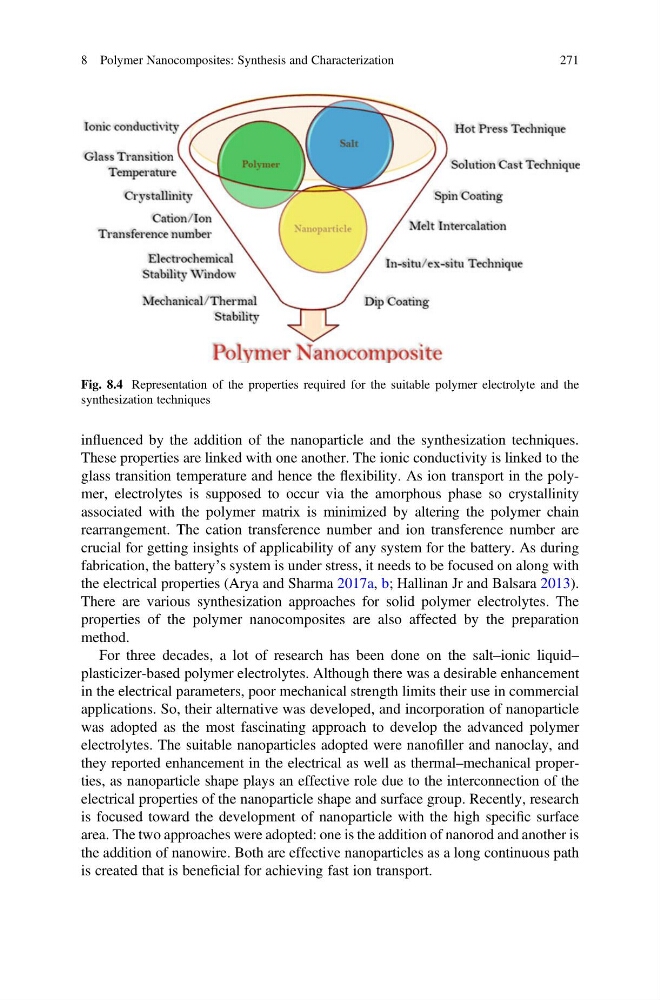
influenced by the addition of the nanoparticle and the synthesization techniques.
These properties are linked with one another. The ionic conductivity is linked to the
glass transition temperature and hence the flexibility. As ion transport in the polymer, electrolytes is supposed to occur via the amorphous phase so crystallinity
associated with the polymer matrix is minimized by altering the polymer chain
rearrangement. The cation transference number and ion transference number are
crucial for getting insights of applicability of any system for the battery. As during
fabrication, the battery’s system is under stress, it needs to be focused on along with
the electrical properties (Arya and Sharma 2017a, b; Hallinan Jr and Balsara 2013).
There are various synthesization approaches for solid polymer electrolytes. The
properties of the polymer nanocomposites are also affected by the preparation
method.
For three decades, a lot of research has been done on the salt–ionic liquid–
plasticizer-based polymer electrolytes. Although there was a desirable enhancement
in the electrical parameters, poor mechanical strength limits their use in commercial
applications. So, their alternative was developed, and incorporation of nanoparticle
was adopted as the most fascinating approach to develop the advanced polymer
electrolytes. The suitable nanoparticles adopted were nanofiller and nanoclay, and
they reported enhancement in the electrical as well as thermal–mechanical properties, as nanoparticle shape plays an effective role due to the interconnection of the
electrical properties of the nanoparticle shape and surface group. Recently, research
is focused toward the development of nanoparticle with the high specific surface
area. The two approaches were adopted: one is the addition of nanorod and another is
the addition of nanowire. Both are effective nanoparticles as a long continuous path
is created that is beneficial for achieving fast ion transport.
Fig. 8.4 Representation of the properties required for the suitable polymer electrolyte and the
synthesization techniques
8 Polymer Nanocomposites: Synthesis and Characterization
271
These properties are linked with one another. The ionic conductivity is linked to the
glass transition temperature and hence the flexibility. As ion transport in the polymer, electrolytes is supposed to occur via the amorphous phase so crystallinity
associated with the polymer matrix is minimized by altering the polymer chain
rearrangement. The cation transference number and ion transference number are
crucial for getting insights of applicability of any system for the battery. As during
fabrication, the battery’s system is under stress, it needs to be focused on along with
the electrical properties (Arya and Sharma 2017a, b; Hallinan Jr and Balsara 2013).
There are various synthesization approaches for solid polymer electrolytes. The
properties of the polymer nanocomposites are also affected by the preparation
method.
For three decades, a lot of research has been done on the salt–ionic liquid–
plasticizer-based polymer electrolytes. Although there was a desirable enhancement
in the electrical parameters, poor mechanical strength limits their use in commercial
applications. So, their alternative was developed, and incorporation of nanoparticle
was adopted as the most fascinating approach to develop the advanced polymer
electrolytes. The suitable nanoparticles adopted were nanofiller and nanoclay, and
they reported enhancement in the electrical as well as thermal–mechanical properties, as nanoparticle shape plays an effective role due to the interconnection of the
electrical properties of the nanoparticle shape and surface group. Recently, research
is focused toward the development of nanoparticle with the high specific surface
area. The two approaches were adopted: one is the addition of nanorod and another is
the addition of nanowire. Both are effective nanoparticles as a long continuous path
is created that is beneficial for achieving fast ion transport.
Fig. 8.4 Representation of the properties required for the suitable polymer electrolyte and the
synthesization techniques
8 Polymer Nanocomposites: Synthesis and Characterization
271