

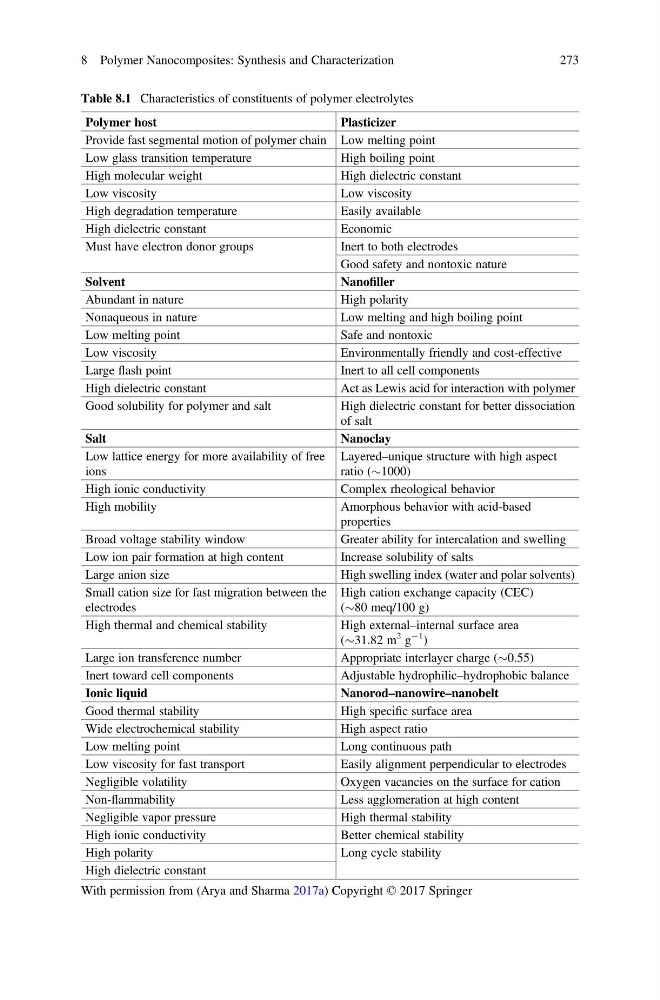
Table 8.1 Characteristics of constituents of polymer electrolytes
Polymer host
Plasticizer
Provide fast segmental motion of polymer chain Low melting point
Low glass transition temperature
High boiling point
High molecular weight
High dielectric constant
Low viscosity
Low viscosity
High degradation temperature
Easily available
High dielectric constant
Economic
Must have electron donor groups
Inert to both electrodes
Good safety and nontoxic nature
Solvent
Nanofiller
Abundant in nature
High polarity
Nonaqueous in nature
Low melting and high boiling point
Low melting point
Safe and nontoxic
Low viscosity
Environmentally friendly and cost-effective
Large flash point
Inert to all cell components
High dielectric constant
Act as Lewis acid for interaction with polymer
Good solubility for polymer and salt
High dielectric constant for better dissociation
of salt
Salt
Nanoclay
Low lattice energy for more availability of free
ions
Layered–unique structure with high aspect
ratio ($1000)
High ionic conductivity
Complex rheological behavior
High mobility
Amorphous behavior with acid-based
properties
Broad voltage stability window
Greater ability for intercalation and swelling
Low ion pair formation at high content
Increase solubility of salts
Large anion size
High swelling index (water and polar solvents)
Small cation size for fast migration between the
electrodes
High cation exchange capacity (CEC)
($80 meq/100 g)
High thermal and chemical stability
High external–internal surface area
($31.82 m
2 g
À1
)
Large ion transference number
Appropriate interlayer charge ($0.55)
Inert toward cell components
Adjustable hydrophilic–hydrophobic balance
Ionic liquid
Nanorod–nanowire–nanobelt
Good thermal stability
High specific surface area
Wide electrochemical stability
High aspect ratio
Low melting point
Long continuous path
Low viscosity for fast transport
Easily alignment perpendicular to electrodes
Negligible volatility
Oxygen vacancies on the surface for cation
Non-flammability
Less agglomeration at high content
Negligible vapor pressure
High thermal stability
High ionic conductivity
Better chemical stability
High polarity
Long cycle stability
High dielectric constant
With permission from (Arya and Sharma 2017a) Copyright © 2017 Springer
8 Polymer Nanocomposites: Synthesis and Characterization
273
Polymer host
Plasticizer
Provide fast segmental motion of polymer chain Low melting point
Low glass transition temperature
High boiling point
High molecular weight
High dielectric constant
Low viscosity
Low viscosity
High degradation temperature
Easily available
High dielectric constant
Economic
Must have electron donor groups
Inert to both electrodes
Good safety and nontoxic nature
Solvent
Nanofiller
Abundant in nature
High polarity
Nonaqueous in nature
Low melting and high boiling point
Low melting point
Safe and nontoxic
Low viscosity
Environmentally friendly and cost-effective
Large flash point
Inert to all cell components
High dielectric constant
Act as Lewis acid for interaction with polymer
Good solubility for polymer and salt
High dielectric constant for better dissociation
of salt
Salt
Nanoclay
Low lattice energy for more availability of free
ions
Layered–unique structure with high aspect
ratio ($1000)
High ionic conductivity
Complex rheological behavior
High mobility
Amorphous behavior with acid-based
properties
Broad voltage stability window
Greater ability for intercalation and swelling
Low ion pair formation at high content
Increase solubility of salts
Large anion size
High swelling index (water and polar solvents)
Small cation size for fast migration between the
electrodes
High cation exchange capacity (CEC)
($80 meq/100 g)
High thermal and chemical stability
High external–internal surface area
($31.82 m
2 g
À1
)
Large ion transference number
Appropriate interlayer charge ($0.55)
Inert toward cell components
Adjustable hydrophilic–hydrophobic balance
Ionic liquid
Nanorod–nanowire–nanobelt
Good thermal stability
High specific surface area
Wide electrochemical stability
High aspect ratio
Low melting point
Long continuous path
Low viscosity for fast transport
Easily alignment perpendicular to electrodes
Negligible volatility
Oxygen vacancies on the surface for cation
Non-flammability
Less agglomeration at high content
Negligible vapor pressure
High thermal stability
High ionic conductivity
Better chemical stability
High polarity
Long cycle stability
High dielectric constant
With permission from (Arya and Sharma 2017a) Copyright © 2017 Springer
8 Polymer Nanocomposites: Synthesis and Characterization
273