

from the cathode to the anode (reduction of the cathode; a gain of electrons)
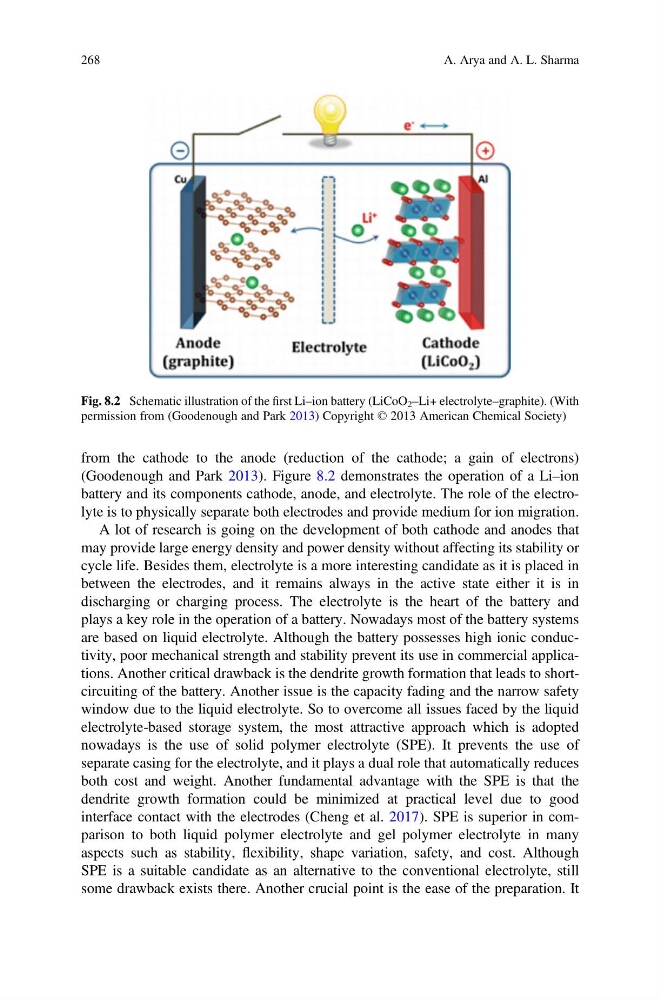
(Goodenough and Park 2013). Figure 8.2 demonstrates the operation of a Li–ion
battery and its components cathode, anode, and electrolyte. The role of the electrolyte is to physically separate both electrodes and provide medium for ion migration.
A lot of research is going on the development of both cathode and anodes that
may provide large energy density and power density without affecting its stability or
cycle life. Besides them, electrolyte is a more interesting candidate as it is placed in
between the electrodes, and it remains always in the active state either it is in
discharging or charging process. The electrolyte is the heart of the battery and
plays a key role in the operation of a battery. Nowadays most of the battery systems
are based on liquid electrolyte. Although the battery possesses high ionic conductivity, poor mechanical strength and stability prevent its use in commercial applications. Another critical drawback is the dendrite growth formation that leads to shortcircuiting of the battery. Another issue is the capacity fading and the narrow safety
window due to the liquid electrolyte. So to overcome all issues faced by the liquid
electrolyte-based storage system, the most attractive approach which is adopted
nowadays is the use of solid polymer electrolyte (SPE). It prevents the use of
separate casing for the electrolyte, and it plays a dual role that automatically reduces
both cost and weight. Another fundamental advantage with the SPE is that the
dendrite growth formation could be minimized at practical level due to good
interface contact with the electrodes (Cheng et al. 2017). SPE is superior in comparison to both liquid polymer electrolyte and gel polymer electrolyte in many
aspects such as stability, flexibility, shape variation, safety, and cost. Although
SPE is a suitable candidate as an alternative to the conventional electrolyte, still
some drawback exists there. Another crucial point is the ease of the preparation. It
Fig. 8.2 Schematic illustration of the first Li–ion battery (LiCoO 2 –Li+ electrolyte–graphite). (With
permission from (Goodenough and Park 2013) Copyright © 2013 American Chemical Society)
268
A. Arya and A. L. Sharma
(Goodenough and Park 2013). Figure 8.2 demonstrates the operation of a Li–ion
battery and its components cathode, anode, and electrolyte. The role of the electrolyte is to physically separate both electrodes and provide medium for ion migration.
A lot of research is going on the development of both cathode and anodes that
may provide large energy density and power density without affecting its stability or
cycle life. Besides them, electrolyte is a more interesting candidate as it is placed in
between the electrodes, and it remains always in the active state either it is in
discharging or charging process. The electrolyte is the heart of the battery and
plays a key role in the operation of a battery. Nowadays most of the battery systems
are based on liquid electrolyte. Although the battery possesses high ionic conductivity, poor mechanical strength and stability prevent its use in commercial applications. Another critical drawback is the dendrite growth formation that leads to shortcircuiting of the battery. Another issue is the capacity fading and the narrow safety
window due to the liquid electrolyte. So to overcome all issues faced by the liquid
electrolyte-based storage system, the most attractive approach which is adopted
nowadays is the use of solid polymer electrolyte (SPE). It prevents the use of
separate casing for the electrolyte, and it plays a dual role that automatically reduces
both cost and weight. Another fundamental advantage with the SPE is that the
dendrite growth formation could be minimized at practical level due to good
interface contact with the electrodes (Cheng et al. 2017). SPE is superior in comparison to both liquid polymer electrolyte and gel polymer electrolyte in many
aspects such as stability, flexibility, shape variation, safety, and cost. Although
SPE is a suitable candidate as an alternative to the conventional electrolyte, still
some drawback exists there. Another crucial point is the ease of the preparation. It
Fig. 8.2 Schematic illustration of the first Li–ion battery (LiCoO 2 –Li+ electrolyte–graphite). (With
permission from (Goodenough and Park 2013) Copyright © 2013 American Chemical Society)
268
A. Arya and A. L. Sharma