

(SPE) involves the dissolution of host polymer having an electron-rich group (polar
group), and the salt with bulky anion dissolves in the solvent. The host polymer
provides the coordinating sites that favor the fast ion migration and further supported
by the segmental motion of the polymer chains. The segmental motion of the
polymer chain is linked with the flexibility of the polymer chain, as it pushes the
ion from one site to the next and mobility is enhanced. The most important one is the
low ionic conductivity as compared to the desire for the practical applications, and
the other one is the mechanical stability. So, a new type of solid-state advanced
material needs to be developed which can provide us the desirable conductivity
value for practical applications (~10
À3 S cm
À1 ) (Arya and Sharma 2017a, 2018).
Nowadays, due to increased demand for Li–ion batteries globally, it becomes
important to develop new technologies which can provide safe and advanced energy
storage system, as the nanoparticles (nanofiller, nanorod, nanowire) are attractive
candidates for developing all components of the battery. One important point to be
noticed here is that the nanomaterial has possibilities to fulfill the dream of the
energy storage system with high-energy density and power density, as it is well
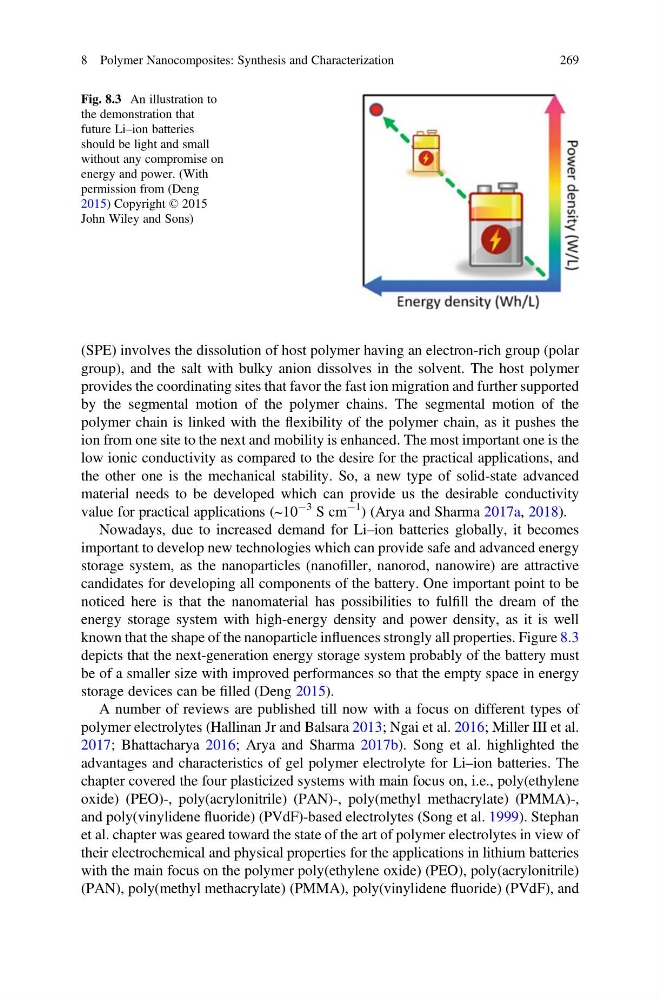
known that the shape of the nanoparticle influences strongly all properties. Figure 8.3
depicts that the next-generation energy storage system probably of the battery must
be of a smaller size with improved performances so that the empty space in energy
storage devices can be filled (Deng 2015).
A number of reviews are published till now with a focus on different types of
polymer electrolytes (Hallinan Jr and Balsara 2013; Ngai et al. 2016; Miller III et al.
2017; Bhattacharya 2016; Arya and Sharma 2017b). Song et al. highlighted the
advantages and characteristics of gel polymer electrolyte for Li–ion batteries. The
chapter covered the four plasticized systems with main focus on, i.e., poly(ethylene
oxide) (PEO)-, poly(acrylonitrile) (PAN)-, poly(methyl methacrylate) (PMMA)-,
and poly(vinylidene fluoride) (PVdF)-based electrolytes (Song et al. 1999). Stephan
et al. chapter was geared toward the state of the art of polymer electrolytes in view of
their electrochemical and physical properties for the applications in lithium batteries
with the main focus on the polymer poly(ethylene oxide) (PEO), poly(acrylonitrile)
(PAN), poly(methyl methacrylate) (PMMA), poly(vinylidene fluoride) (PVdF), and
Fig. 8.3 An illustration to
the demonstration that
future Li–ion batteries
should be light and small
without any compromise on
energy and power. (With
permission from (Deng
2015) Copyright © 2015
John Wiley and Sons)
8 Polymer Nanocomposites: Synthesis and Characterization
269
group), and the salt with bulky anion dissolves in the solvent. The host polymer
provides the coordinating sites that favor the fast ion migration and further supported
by the segmental motion of the polymer chains. The segmental motion of the
polymer chain is linked with the flexibility of the polymer chain, as it pushes the
ion from one site to the next and mobility is enhanced. The most important one is the
low ionic conductivity as compared to the desire for the practical applications, and
the other one is the mechanical stability. So, a new type of solid-state advanced
material needs to be developed which can provide us the desirable conductivity
value for practical applications (~10
À3 S cm
À1 ) (Arya and Sharma 2017a, 2018).
Nowadays, due to increased demand for Li–ion batteries globally, it becomes
important to develop new technologies which can provide safe and advanced energy
storage system, as the nanoparticles (nanofiller, nanorod, nanowire) are attractive
candidates for developing all components of the battery. One important point to be
noticed here is that the nanomaterial has possibilities to fulfill the dream of the
energy storage system with high-energy density and power density, as it is well
known that the shape of the nanoparticle influences strongly all properties. Figure 8.3
depicts that the next-generation energy storage system probably of the battery must
be of a smaller size with improved performances so that the empty space in energy
storage devices can be filled (Deng 2015).
A number of reviews are published till now with a focus on different types of
polymer electrolytes (Hallinan Jr and Balsara 2013; Ngai et al. 2016; Miller III et al.
2017; Bhattacharya 2016; Arya and Sharma 2017b). Song et al. highlighted the
advantages and characteristics of gel polymer electrolyte for Li–ion batteries. The
chapter covered the four plasticized systems with main focus on, i.e., poly(ethylene
oxide) (PEO)-, poly(acrylonitrile) (PAN)-, poly(methyl methacrylate) (PMMA)-,
and poly(vinylidene fluoride) (PVdF)-based electrolytes (Song et al. 1999). Stephan
et al. chapter was geared toward the state of the art of polymer electrolytes in view of
their electrochemical and physical properties for the applications in lithium batteries
with the main focus on the polymer poly(ethylene oxide) (PEO), poly(acrylonitrile)
(PAN), poly(methyl methacrylate) (PMMA), poly(vinylidene fluoride) (PVdF), and
Fig. 8.3 An illustration to
the demonstration that
future Li–ion batteries
should be light and small
without any compromise on
energy and power. (With
permission from (Deng
2015) Copyright © 2015
John Wiley and Sons)
8 Polymer Nanocomposites: Synthesis and Characterization
269