

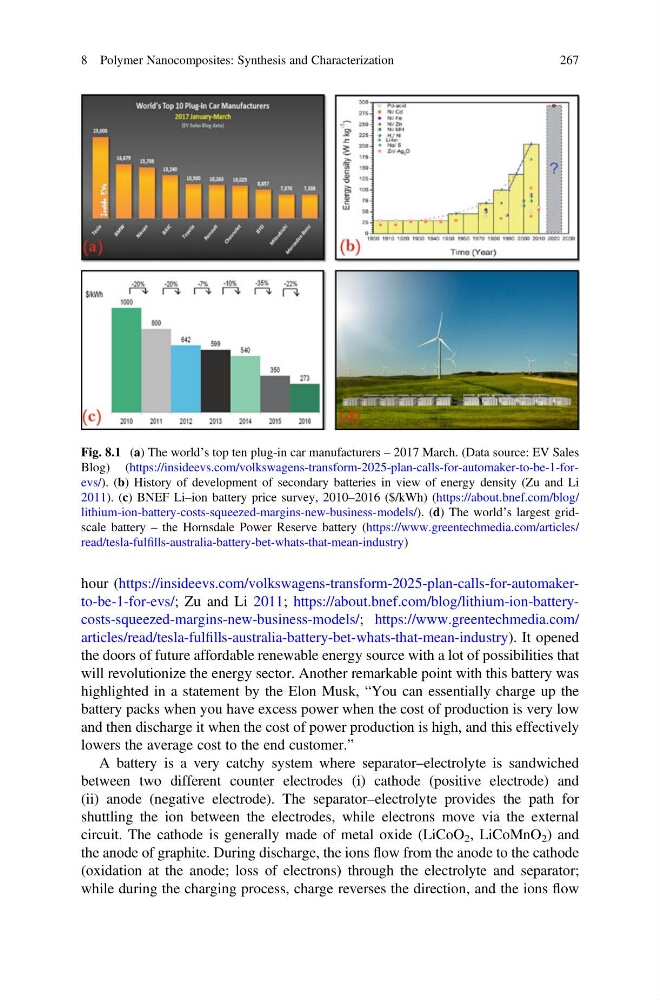
hour (https://insideevs.com/volkswagens-transform-2025-plan-calls-for-automakerto-be-1-for-evs/; Zu and Li 2011; https://about.bnef.com/blog/lithium-ion-batterycosts-squeezed-margins-new-business-models/; https://www.greentechmedia.com/
articles/read/tesla-fulfills-australia-battery-bet-whats-that-mean-industry). It opened
the doors of future affordable renewable energy source with a lot of possibilities that
will revolutionize the energy sector. Another remarkable point with this battery was
highlighted in a statement by the Elon Musk, “You can essentially charge up the
battery packs when you have excess power when the cost of production is very low
and then discharge it when the cost of power production is high, and this effectively
lowers the average cost to the end customer.”
A battery is a very catchy system where separator–electrolyte is sandwiched
between two different counter electrodes (i) cathode (positive electrode) and
(ii) anode (negative electrode). The separator–electrolyte provides the path for
shuttling the ion between the electrodes, while electrons move via the external
circuit. The cathode is generally made of metal oxide (LiCoO 2 , LiCoMnO 2 ) and
the anode of graphite. During discharge, the ions flow from the anode to the cathode
(oxidation at the anode; loss of electrons) through the electrolyte and separator;
while during the charging process, charge reverses the direction, and the ions flow
Fig. 8.1 (a) The world’s top ten plug-in car manufacturers – 2017 March. (Data source: EV Sales
Blog) (https://insideevs.com/volkswagens-transform-2025-plan-calls-for-automaker-to-be-1-forevs/). (b) History of development of secondary batteries in view of energy density (Zu and Li
2011). (c) BNEF Li–ion battery price survey, 2010–2016 ($/kWh) (https://about.bnef.com/blog/
lithium-ion-battery-costs-squeezed-margins-new-business-models/). (d) The world’s largest gridscale battery – the Hornsdale Power Reserve battery (https://www.greentechmedia.com/articles/
read/tesla-fulfills-australia-battery-bet-whats-that-mean-industry)
8 Polymer Nanocomposites: Synthesis and Characterization
267
articles/read/tesla-fulfills-australia-battery-bet-whats-that-mean-industry). It opened
the doors of future affordable renewable energy source with a lot of possibilities that
will revolutionize the energy sector. Another remarkable point with this battery was
highlighted in a statement by the Elon Musk, “You can essentially charge up the
battery packs when you have excess power when the cost of production is very low
and then discharge it when the cost of power production is high, and this effectively
lowers the average cost to the end customer.”
A battery is a very catchy system where separator–electrolyte is sandwiched
between two different counter electrodes (i) cathode (positive electrode) and
(ii) anode (negative electrode). The separator–electrolyte provides the path for
shuttling the ion between the electrodes, while electrons move via the external
circuit. The cathode is generally made of metal oxide (LiCoO 2 , LiCoMnO 2 ) and
the anode of graphite. During discharge, the ions flow from the anode to the cathode
(oxidation at the anode; loss of electrons) through the electrolyte and separator;
while during the charging process, charge reverses the direction, and the ions flow
Fig. 8.1 (a) The world’s top ten plug-in car manufacturers – 2017 March. (Data source: EV Sales
Blog) (https://insideevs.com/volkswagens-transform-2025-plan-calls-for-automaker-to-be-1-forevs/). (b) History of development of secondary batteries in view of energy density (Zu and Li
2011). (c) BNEF Li–ion battery price survey, 2010–2016 ($/kWh) (https://about.bnef.com/blog/
lithium-ion-battery-costs-squeezed-margins-new-business-models/). (d) The world’s largest gridscale battery – the Hornsdale Power Reserve battery (https://www.greentechmedia.com/articles/
read/tesla-fulfills-australia-battery-bet-whats-that-mean-industry)
8 Polymer Nanocomposites: Synthesis and Characterization
267