

is still able to react with a positive hole, producing a proton and formaldehyde with
the latter capable of generating hydrated compounds by the addition of water.
CH 2 OH
ð Þ 2 ! CO 2 þ H 2 O major decarboxylation
ð7:15Þ
CH 3 OH $ CH 2 O þ H 2 O ! CO 2 þ H 2 O decarboxylation
ð7:16Þ
Miwa et al. proposed a mechanism for the organic oxidation (Miwa et al. 2010):
CH 3 OH þ h
þ
! ÁCH 2 OH þ H
þ
ð7:17Þ
ÁCH 2 OH þ h
þ
! CH 2 O þ H
þ
ð7:18Þ
CH 2 O þ h
þ
þ ÁOH ! HCOOH þ H
þ
ð7:19Þ
HCOOH ! HCOO
À
þ H
þ
ð7:20Þ
HCOO
À
þ 2h
þ
! CO 2 þ H
þ
ð7:21Þ
Nanoparticles of Pt, Au, Ir, and Pd introduced in TiO 2 and (CNT-TiO 2 ) ox by an
incipient wetness method have shown an efficient activity for H 2 production from
methanol- and saccharide-containing solution (Silva et al. 2015). Compared with the
reference TiO 2 , composite catalysts presented the highest activity of 485 μmol of H 2
(Pt-loaded composite produced by the one-pot synthesis method being generated
after 2 h of irradiation), which contrast with the quantity of 205 μmol of H 2 obtained
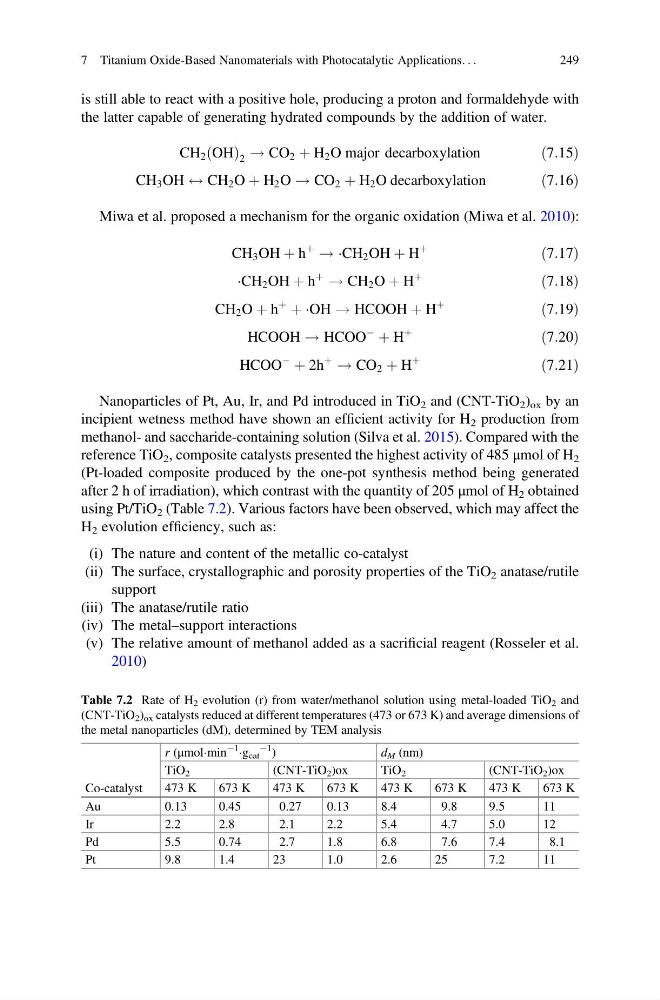
using Pt/TiO 2 (Table 7.2). Various factors have been observed, which may affect the
H 2 evolution efficiency, such as:
(i) The nature and content of the metallic co-catalyst
(ii) The surface, crystallographic and porosity properties of the TiO 2 anatase/rutile
support
(iii) The anatase/rutile ratio
(iv) The metal–support interactions
(v) The relative amount of methanol added as a sacrificial reagent (Rosseler et al.
2010)
Table 7.2 Rate of H 2 evolution (r) from water/methanol solution using metal-loaded TiO 2 and
(CNT-TiO 2 ) ox catalysts reduced at different temperatures (473 or 673 K) and average dimensions of
the metal nanoparticles (dM), determined by TEM analysis
Co-catalyst
r (μmolÁmin
À1
Ág cat
À1
)
d M (nm)
TiO 2
(CNT-TiO 2 )ox
TiO 2
(CNT-TiO 2 )ox
473 K
673 K
473 K
673 K
473 K
673 K
473 K
673 K
Au
0.13
0.45
0.27
0.13
8.4
9.8
9.5
11
Ir
2.2
2.8
2.1
2.2
5.4
4.7
5.0
12
Pd
5.5
0.74
2.7
1.8
6.8
7.6
7.4
8.1
Pt
9.8
1.4
23
1.0
2.6
25
7.2
11
7 Titanium Oxide-Based Nanomaterials with Photocatalytic Applications. . .
249
the latter capable of generating hydrated compounds by the addition of water.
CH 2 OH
ð Þ 2 ! CO 2 þ H 2 O major decarboxylation
ð7:15Þ
CH 3 OH $ CH 2 O þ H 2 O ! CO 2 þ H 2 O decarboxylation
ð7:16Þ
Miwa et al. proposed a mechanism for the organic oxidation (Miwa et al. 2010):
CH 3 OH þ h
þ
! ÁCH 2 OH þ H
þ
ð7:17Þ
ÁCH 2 OH þ h
þ
! CH 2 O þ H
þ
ð7:18Þ
CH 2 O þ h
þ
þ ÁOH ! HCOOH þ H
þ
ð7:19Þ
HCOOH ! HCOO
À
þ H
þ
ð7:20Þ
HCOO
À
þ 2h
þ
! CO 2 þ H
þ
ð7:21Þ
Nanoparticles of Pt, Au, Ir, and Pd introduced in TiO 2 and (CNT-TiO 2 ) ox by an
incipient wetness method have shown an efficient activity for H 2 production from
methanol- and saccharide-containing solution (Silva et al. 2015). Compared with the
reference TiO 2 , composite catalysts presented the highest activity of 485 μmol of H 2
(Pt-loaded composite produced by the one-pot synthesis method being generated
after 2 h of irradiation), which contrast with the quantity of 205 μmol of H 2 obtained
using Pt/TiO 2 (Table 7.2). Various factors have been observed, which may affect the
H 2 evolution efficiency, such as:
(i) The nature and content of the metallic co-catalyst
(ii) The surface, crystallographic and porosity properties of the TiO 2 anatase/rutile
support
(iii) The anatase/rutile ratio
(iv) The metal–support interactions
(v) The relative amount of methanol added as a sacrificial reagent (Rosseler et al.
2010)
Table 7.2 Rate of H 2 evolution (r) from water/methanol solution using metal-loaded TiO 2 and
(CNT-TiO 2 ) ox catalysts reduced at different temperatures (473 or 673 K) and average dimensions of
the metal nanoparticles (dM), determined by TEM analysis
Co-catalyst
r (μmolÁmin
À1
Ág cat
À1
)
d M (nm)
TiO 2
(CNT-TiO 2 )ox
TiO 2
(CNT-TiO 2 )ox
473 K
673 K
473 K
673 K
473 K
673 K
473 K
673 K
Au
0.13
0.45
0.27
0.13
8.4
9.8
9.5
11
Ir
2.2
2.8
2.1
2.2
5.4
4.7
5.0
12
Pd
5.5
0.74
2.7
1.8
6.8
7.6
7.4
8.1
Pt
9.8
1.4
23
1.0
2.6
25
7.2
11
7 Titanium Oxide-Based Nanomaterials with Photocatalytic Applications. . .
249