

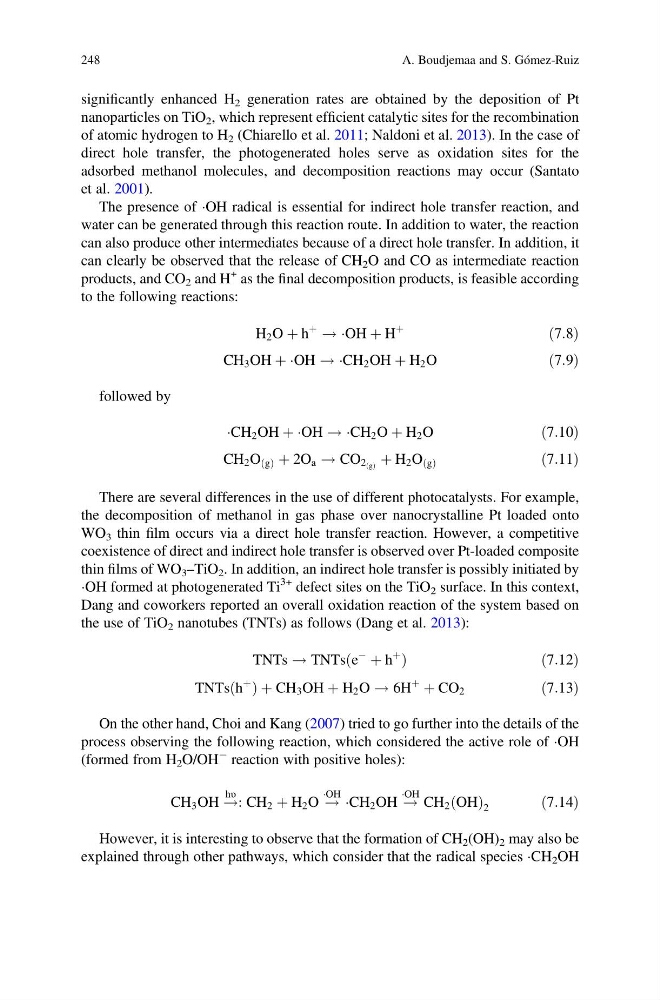
significantly enhanced H 2 generation rates are obtained by the deposition of Pt
nanoparticles on TiO 2 , which represent efficient catalytic sites for the recombination
of atomic hydrogen to H 2 (Chiarello et al. 2011; Naldoni et al. 2013). In the case of
direct hole transfer, the photogenerated holes serve as oxidation sites for the
adsorbed methanol molecules, and decomposition reactions may occur (Santato
et al. 2001).
The presence of ÁOH radical is essential for indirect hole transfer reaction, and
water can be generated through this reaction route. In addition to water, the reaction
can also produce other intermediates because of a direct hole transfer. In addition, it
can clearly be observed that the release of CH 2 O and CO as intermediate reaction
products, and CO 2 and H
+ as the final decomposition products, is feasible according
to the following reactions:
H 2 O þ h
þ
! ÁOH þ H
þ
ð7:8Þ
CH 3 OH þ ÁOH ! ÁCH 2 OH þ H 2 O
ð7:9Þ
followed by
ÁCH 2 OH þ ÁOH ! ÁCH 2 O þ H 2 O
ð7:10Þ
CH 2 O ðgÞ þ 2O a ! CO 2 ðgÞ þ H 2 O ðgÞ
ð7:11Þ
There are several differences in the use of different photocatalysts. For example,
the decomposition of methanol in gas phase over nanocrystalline Pt loaded onto
WO 3 thin film occurs via a direct hole transfer reaction. However, a competitive
coexistence of direct and indirect hole transfer is observed over Pt-loaded composite
thin films of WO 3 –TiO 2 . In addition, an indirect hole transfer is possibly initiated by
ÁOH formed at photogenerated Ti
3+ defect sites on the TiO 2 surface. In this context,
Dang and coworkers reported an overall oxidation reaction of the system based on
the use of TiO 2 nanotubes (TNTs) as follows (Dang et al. 2013):
TNTs ! TNTs e
À
þ h
þ
ð
Þ
ð 7:12Þ
TNTs h
þ
ð Þ þ CH 3 OH þ H 2 O ! 6H
þ
þ CO 2
ð7:13Þ
On the other hand, Choi and Kang (2007) tried to go further into the details of the
process observing the following reaction, which considered the active role of ÁOH
(formed from H 2 O/OH
À reaction with positive holes):
CH 3 OH !
hυ : CH 2 þ H 2 O !
ÁOH ÁCH 2 OH !
ÁOH CH 2 OH
ð Þ 2
ð7:14Þ
However, it is interesting to observe that the formation of CH 2 (OH) 2 may also be
explained through other pathways, which consider that the radical species ÁCH 2 OH
248
A. Boudjemaa and S. Gómez-Ruiz
nanoparticles on TiO 2 , which represent efficient catalytic sites for the recombination
of atomic hydrogen to H 2 (Chiarello et al. 2011; Naldoni et al. 2013). In the case of
direct hole transfer, the photogenerated holes serve as oxidation sites for the
adsorbed methanol molecules, and decomposition reactions may occur (Santato
et al. 2001).
The presence of ÁOH radical is essential for indirect hole transfer reaction, and
water can be generated through this reaction route. In addition to water, the reaction
can also produce other intermediates because of a direct hole transfer. In addition, it
can clearly be observed that the release of CH 2 O and CO as intermediate reaction
products, and CO 2 and H
+ as the final decomposition products, is feasible according
to the following reactions:
H 2 O þ h
þ
! ÁOH þ H
þ
ð7:8Þ
CH 3 OH þ ÁOH ! ÁCH 2 OH þ H 2 O
ð7:9Þ
followed by
ÁCH 2 OH þ ÁOH ! ÁCH 2 O þ H 2 O
ð7:10Þ
CH 2 O ðgÞ þ 2O a ! CO 2 ðgÞ þ H 2 O ðgÞ
ð7:11Þ
There are several differences in the use of different photocatalysts. For example,
the decomposition of methanol in gas phase over nanocrystalline Pt loaded onto
WO 3 thin film occurs via a direct hole transfer reaction. However, a competitive
coexistence of direct and indirect hole transfer is observed over Pt-loaded composite
thin films of WO 3 –TiO 2 . In addition, an indirect hole transfer is possibly initiated by
ÁOH formed at photogenerated Ti
3+ defect sites on the TiO 2 surface. In this context,
Dang and coworkers reported an overall oxidation reaction of the system based on
the use of TiO 2 nanotubes (TNTs) as follows (Dang et al. 2013):
TNTs ! TNTs e
À
þ h
þ
ð
Þ
ð 7:12Þ
TNTs h
þ
ð Þ þ CH 3 OH þ H 2 O ! 6H
þ
þ CO 2
ð7:13Þ
On the other hand, Choi and Kang (2007) tried to go further into the details of the
process observing the following reaction, which considered the active role of ÁOH
(formed from H 2 O/OH
À reaction with positive holes):
CH 3 OH !
hυ : CH 2 þ H 2 O !
ÁOH ÁCH 2 OH !
ÁOH CH 2 OH
ð Þ 2
ð7:14Þ
However, it is interesting to observe that the formation of CH 2 (OH) 2 may also be
explained through other pathways, which consider that the radical species ÁCH 2 OH
248
A. Boudjemaa and S. Gómez-Ruiz