

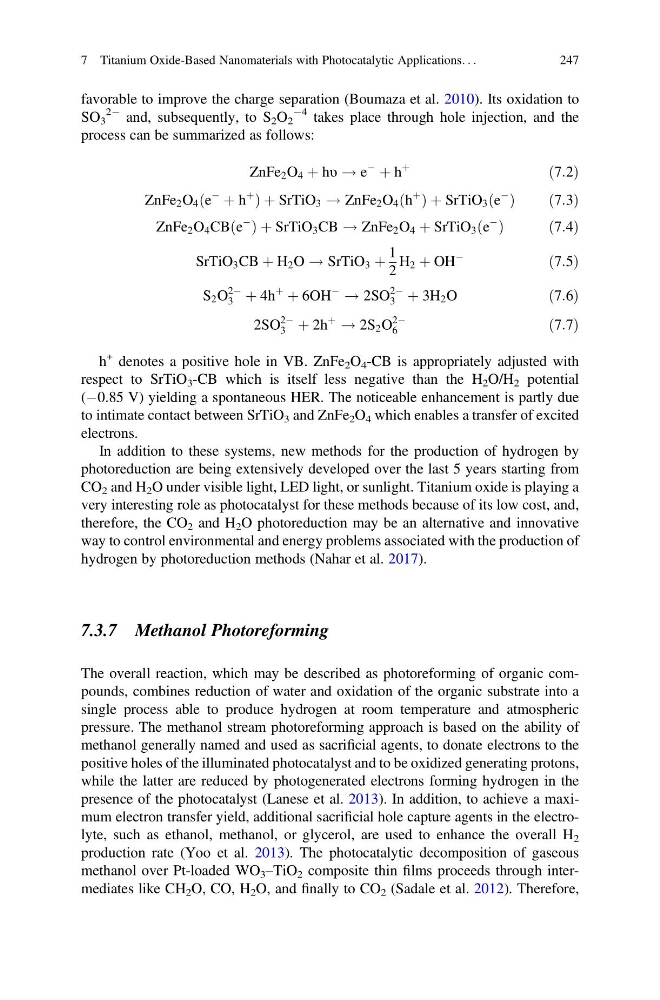
favorable to improve the charge separation (Boumaza et al. 2010). Its oxidation to
SO 3
2À and, subsequently, to S 2 O 2
À4 takes place through hole injection, and the
process can be summarized as follows:
ZnFe 2 O 4 þ hυ ! e
À
þ h
þ
ð7:2Þ
ZnFe 2 O 4 e
À
þ h
þ
ð
ÞþSrTiO 3 ! ZnFe 2 O 4 h
þ
ð Þ þ SrTiO 3 e
À
ð Þ
ð7:3Þ
ZnFe 2 O 4 CB e
À
ð Þ þ SrTiO 3 CB ! ZnFe 2 O 4 þ SrTiO 3 e
À
ð Þ
ð7:4Þ
SrTiO 3 CB þ H 2 O ! SrTiO 3 þ
1
2
H 2 þ OH
À
ð7:5Þ
S 2 O
2À
3 þ 4h
þ
þ 6OH
À
! 2SO
2À
3 þ 3H 2 O
ð7:6Þ
2SO
2À
3 þ 2h
þ
! 2S 2 O
2À
6
ð7:7Þ
h
+ denotes a positive hole in VB. ZnFe 2 O 4 -CB is appropriately adjusted with
respect to SrTiO 3 -CB which is itself less negative than the H 2 O/H 2 potential
(À0.85 V) yielding a spontaneous HER. The noticeable enhancement is partly due
to intimate contact between SrTiO 3 and ZnFe 2 O 4 which enables a transfer of excited
electrons.
In addition to these systems, new methods for the production of hydrogen by
photoreduction are being extensively developed over the last 5 years starting from
CO 2 and H 2 O under visible light, LED light, or sunlight. Titanium oxide is playing a
very interesting role as photocatalyst for these methods because of its low cost, and,
therefore, the CO 2 and H 2 O photoreduction may be an alternative and innovative
way to control environmental and energy problems associated with the production of
hydrogen by photoreduction methods (Nahar et al. 2017).
7.3.7 Methanol Photoreforming
The overall reaction, which may be described as photoreforming of organic compounds, combines reduction of water and oxidation of the organic substrate into a
single process able to produce hydrogen at room temperature and atmospheric
pressure. The methanol stream photoreforming approach is based on the ability of
methanol generally named and used as sacrificial agents, to donate electrons to the
positive holes of the illuminated photocatalyst and to be oxidized generating protons,
while the latter are reduced by photogenerated electrons forming hydrogen in the
presence of the photocatalyst (Lanese et al. 2013). In addition, to achieve a maximum electron transfer yield, additional sacrificial hole capture agents in the electrolyte, such as ethanol, methanol, or glycerol, are used to enhance the overall H 2
production rate (Yoo et al. 2013). The photocatalytic decomposition of gaseous
methanol over Pt-loaded WO 3 –TiO 2 composite thin films proceeds through intermediates like CH 2 O, CO, H 2 O, and finally to CO 2 (Sadale et al. 2012). Therefore,
7 Titanium Oxide-Based Nanomaterials with Photocatalytic Applications. . .
247
SO 3
2À and, subsequently, to S 2 O 2
À4 takes place through hole injection, and the
process can be summarized as follows:
ZnFe 2 O 4 þ hυ ! e
À
þ h
þ
ð7:2Þ
ZnFe 2 O 4 e
À
þ h
þ
ð
ÞþSrTiO 3 ! ZnFe 2 O 4 h
þ
ð Þ þ SrTiO 3 e
À
ð Þ
ð7:3Þ
ZnFe 2 O 4 CB e
À
ð Þ þ SrTiO 3 CB ! ZnFe 2 O 4 þ SrTiO 3 e
À
ð Þ
ð7:4Þ
SrTiO 3 CB þ H 2 O ! SrTiO 3 þ
1
2
H 2 þ OH
À
ð7:5Þ
S 2 O
2À
3 þ 4h
þ
þ 6OH
À
! 2SO
2À
3 þ 3H 2 O
ð7:6Þ
2SO
2À
3 þ 2h
þ
! 2S 2 O
2À
6
ð7:7Þ
h
+ denotes a positive hole in VB. ZnFe 2 O 4 -CB is appropriately adjusted with
respect to SrTiO 3 -CB which is itself less negative than the H 2 O/H 2 potential
(À0.85 V) yielding a spontaneous HER. The noticeable enhancement is partly due
to intimate contact between SrTiO 3 and ZnFe 2 O 4 which enables a transfer of excited
electrons.
In addition to these systems, new methods for the production of hydrogen by
photoreduction are being extensively developed over the last 5 years starting from
CO 2 and H 2 O under visible light, LED light, or sunlight. Titanium oxide is playing a
very interesting role as photocatalyst for these methods because of its low cost, and,
therefore, the CO 2 and H 2 O photoreduction may be an alternative and innovative
way to control environmental and energy problems associated with the production of
hydrogen by photoreduction methods (Nahar et al. 2017).
7.3.7 Methanol Photoreforming
The overall reaction, which may be described as photoreforming of organic compounds, combines reduction of water and oxidation of the organic substrate into a
single process able to produce hydrogen at room temperature and atmospheric
pressure. The methanol stream photoreforming approach is based on the ability of
methanol generally named and used as sacrificial agents, to donate electrons to the
positive holes of the illuminated photocatalyst and to be oxidized generating protons,
while the latter are reduced by photogenerated electrons forming hydrogen in the
presence of the photocatalyst (Lanese et al. 2013). In addition, to achieve a maximum electron transfer yield, additional sacrificial hole capture agents in the electrolyte, such as ethanol, methanol, or glycerol, are used to enhance the overall H 2
production rate (Yoo et al. 2013). The photocatalytic decomposition of gaseous
methanol over Pt-loaded WO 3 –TiO 2 composite thin films proceeds through intermediates like CH 2 O, CO, H 2 O, and finally to CO 2 (Sadale et al. 2012). Therefore,
7 Titanium Oxide-Based Nanomaterials with Photocatalytic Applications. . .
247