

field covering most of the novel materials and current alternative for
photoelectrochemical hydrogen production by using a wide variety of semiconductors including titanium oxide has been published and should be useful for the rational
design of new materials which may be of interest for the development of this
hydrogen production technology (Joy et al. 2018).
7.3.6 Water Photoreduction
Photocatalytic H 2 production via water photoreduction is different to water splitting.
With this process, absorption of energetic photons by semiconductor generates (e
À
/
h
+
) pairs; the electrons migrate to the interface to reduce water into gaseous
hydrogen, whereas the holes move into the bulk to react with hole scavenger in
the electrolyte preventing the formation of oxygen.
Most of the materials investigated for the water photodecomposition are chemically stable but are of a limited practical use as they have either an unsuitable flat
band potential (V fb ) or a wide band-gap which inhibits the utilization of the visible
region. Moreover, the O 2
À : 2p orbital, which constitutes the valence band (VB), lies
too far (~2 eV) above the O 2 /H 2 O level. Accordingly, the CB is positioned at a
non-negative enough potential to liberate hydrogen with efficient rates.
One of the methods to increase the photocatalytic performance of the catalyst in
heterogeneous photocatalysis is the use of materials as heterojunctions (Wang et al.
2012c). In addition, the combination of ferrites with TiO 2 photocatalysts showed a
synergistic effect that produces enhanced photocatalytic activity (Kezzim et al.
2011). Moreover, combining two photocatalysts with different band-gap
(Eg) positions effectively causes a greater separation of (e
À
/h
+
) pairs. When the
semiconductor is irradiated with light energy, an electron from the VB is excited to
the CB of the photocatalyst, leaving a photogenerated hole. Kezzim and coworkers
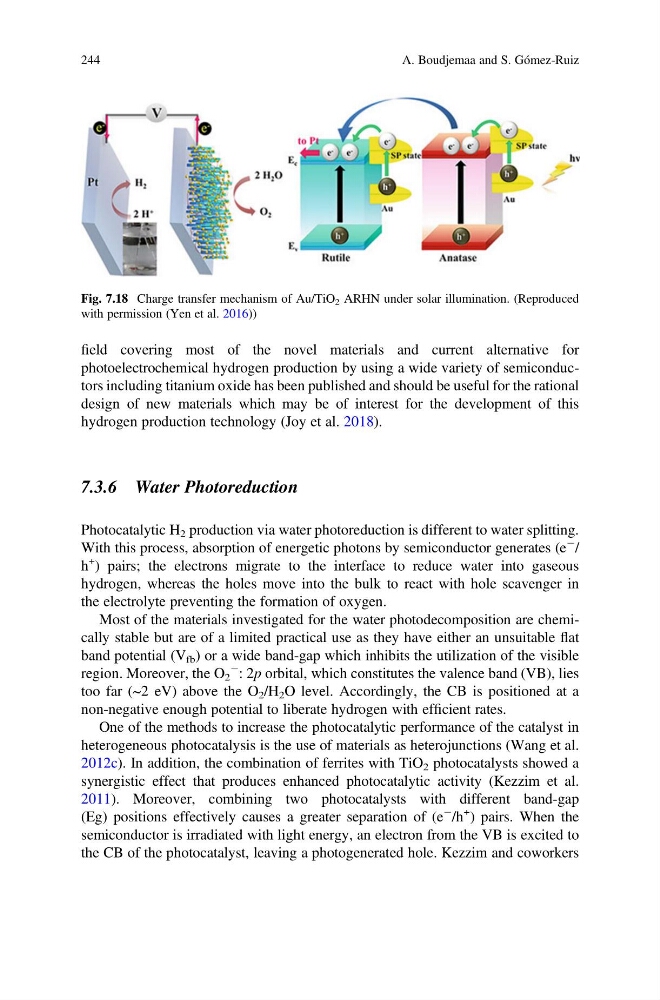
Fig. 7.18 Charge transfer mechanism of Au/TiO 2 ARHN under solar illumination. (Reproduced
with permission (Yen et al. 2016))
244
A. Boudjemaa and S. Gómez-Ruiz
photoelectrochemical hydrogen production by using a wide variety of semiconductors including titanium oxide has been published and should be useful for the rational
design of new materials which may be of interest for the development of this
hydrogen production technology (Joy et al. 2018).
7.3.6 Water Photoreduction
Photocatalytic H 2 production via water photoreduction is different to water splitting.
With this process, absorption of energetic photons by semiconductor generates (e
À
/
h
+
) pairs; the electrons migrate to the interface to reduce water into gaseous
hydrogen, whereas the holes move into the bulk to react with hole scavenger in
the electrolyte preventing the formation of oxygen.
Most of the materials investigated for the water photodecomposition are chemically stable but are of a limited practical use as they have either an unsuitable flat
band potential (V fb ) or a wide band-gap which inhibits the utilization of the visible
region. Moreover, the O 2
À : 2p orbital, which constitutes the valence band (VB), lies
too far (~2 eV) above the O 2 /H 2 O level. Accordingly, the CB is positioned at a
non-negative enough potential to liberate hydrogen with efficient rates.
One of the methods to increase the photocatalytic performance of the catalyst in
heterogeneous photocatalysis is the use of materials as heterojunctions (Wang et al.
2012c). In addition, the combination of ferrites with TiO 2 photocatalysts showed a
synergistic effect that produces enhanced photocatalytic activity (Kezzim et al.
2011). Moreover, combining two photocatalysts with different band-gap
(Eg) positions effectively causes a greater separation of (e
À
/h
+
) pairs. When the
semiconductor is irradiated with light energy, an electron from the VB is excited to
the CB of the photocatalyst, leaving a photogenerated hole. Kezzim and coworkers
Fig. 7.18 Charge transfer mechanism of Au/TiO 2 ARHN under solar illumination. (Reproduced
with permission (Yen et al. 2016))
244
A. Boudjemaa and S. Gómez-Ruiz