

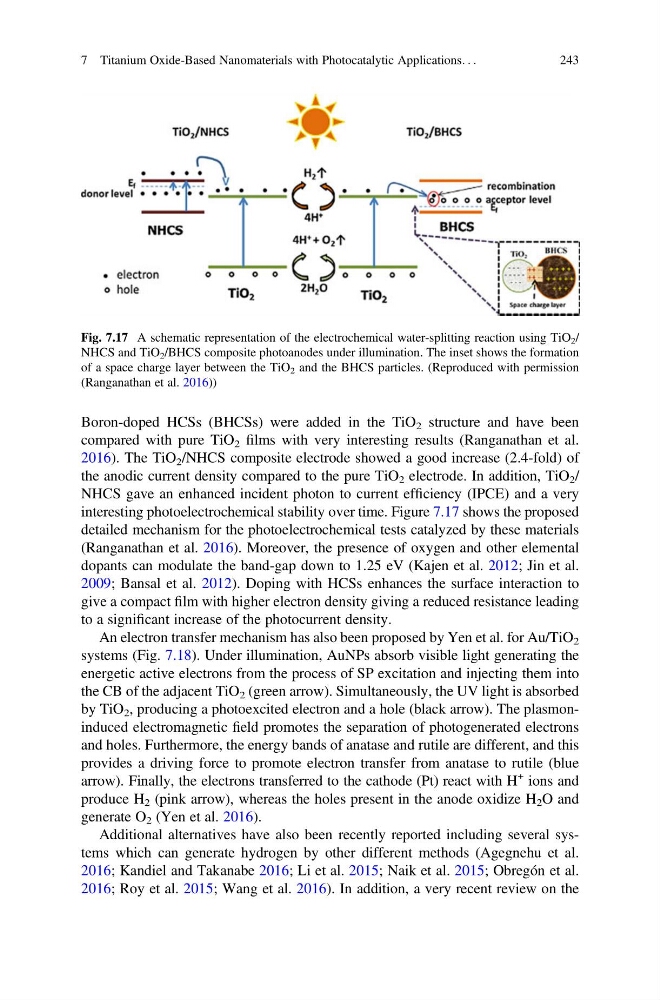
Boron-doped HCSs (BHCSs) were added in the TiO 2 structure and have been
compared with pure TiO 2 films with very interesting results (Ranganathan et al.
2016). The TiO 2 /NHCS composite electrode showed a good increase (2.4-fold) of
the anodic current density compared to the pure TiO 2 electrode. In addition, TiO 2 /
NHCS gave an enhanced incident photon to current efficiency (IPCE) and a very
interesting photoelectrochemical stability over time. Figure 7.17 shows the proposed
detailed mechanism for the photoelectrochemical tests catalyzed by these materials
(Ranganathan et al. 2016). Moreover, the presence of oxygen and other elemental
dopants can modulate the band-gap down to 1.25 eV (Kajen et al. 2012; Jin et al.
2009; Bansal et al. 2012). Doping with HCSs enhances the surface interaction to
give a compact film with higher electron density giving a reduced resistance leading
to a significant increase of the photocurrent density.
An electron transfer mechanism has also been proposed by Yen et al. for Au/TiO 2
systems (Fig. 7.18). Under illumination, AuNPs absorb visible light generating the
energetic active electrons from the process of SP excitation and injecting them into
the CB of the adjacent TiO 2 (green arrow). Simultaneously, the UV light is absorbed
by TiO 2 , producing a photoexcited electron and a hole (black arrow). The plasmoninduced electromagnetic field promotes the separation of photogenerated electrons
and holes. Furthermore, the energy bands of anatase and rutile are different, and this
provides a driving force to promote electron transfer from anatase to rutile (blue
arrow). Finally, the electrons transferred to the cathode (Pt) react with H
+ ions and
produce H 2 (pink arrow), whereas the holes present in the anode oxidize H 2 O and
generate O 2 (Yen et al. 2016).
Additional alternatives have also been recently reported including several systems which can generate hydrogen by other different methods (Agegnehu et al.
2016; Kandiel and Takanabe 2016; Li et al. 2015; Naik et al. 2015; Obregón et al.
2016; Roy et al. 2015; Wang et al. 2016). In addition, a very recent review on the
Fig. 7.17 A schematic representation of the electrochemical water-splitting reaction using TiO 2 /
NHCS and TiO 2 /BHCS composite photoanodes under illumination. The inset shows the formation
of a space charge layer between the TiO 2 and the BHCS particles. (Reproduced with permission
(Ranganathan et al. 2016))
7 Titanium Oxide-Based Nanomaterials with Photocatalytic Applications. . .
243
compared with pure TiO 2 films with very interesting results (Ranganathan et al.
2016). The TiO 2 /NHCS composite electrode showed a good increase (2.4-fold) of
the anodic current density compared to the pure TiO 2 electrode. In addition, TiO 2 /
NHCS gave an enhanced incident photon to current efficiency (IPCE) and a very
interesting photoelectrochemical stability over time. Figure 7.17 shows the proposed
detailed mechanism for the photoelectrochemical tests catalyzed by these materials
(Ranganathan et al. 2016). Moreover, the presence of oxygen and other elemental
dopants can modulate the band-gap down to 1.25 eV (Kajen et al. 2012; Jin et al.
2009; Bansal et al. 2012). Doping with HCSs enhances the surface interaction to
give a compact film with higher electron density giving a reduced resistance leading
to a significant increase of the photocurrent density.
An electron transfer mechanism has also been proposed by Yen et al. for Au/TiO 2
systems (Fig. 7.18). Under illumination, AuNPs absorb visible light generating the
energetic active electrons from the process of SP excitation and injecting them into
the CB of the adjacent TiO 2 (green arrow). Simultaneously, the UV light is absorbed
by TiO 2 , producing a photoexcited electron and a hole (black arrow). The plasmoninduced electromagnetic field promotes the separation of photogenerated electrons
and holes. Furthermore, the energy bands of anatase and rutile are different, and this
provides a driving force to promote electron transfer from anatase to rutile (blue
arrow). Finally, the electrons transferred to the cathode (Pt) react with H
+ ions and
produce H 2 (pink arrow), whereas the holes present in the anode oxidize H 2 O and
generate O 2 (Yen et al. 2016).
Additional alternatives have also been recently reported including several systems which can generate hydrogen by other different methods (Agegnehu et al.
2016; Kandiel and Takanabe 2016; Li et al. 2015; Naik et al. 2015; Obregón et al.
2016; Roy et al. 2015; Wang et al. 2016). In addition, a very recent review on the
Fig. 7.17 A schematic representation of the electrochemical water-splitting reaction using TiO 2 /
NHCS and TiO 2 /BHCS composite photoanodes under illumination. The inset shows the formation
of a space charge layer between the TiO 2 and the BHCS particles. (Reproduced with permission
(Ranganathan et al. 2016))
7 Titanium Oxide-Based Nanomaterials with Photocatalytic Applications. . .
243