

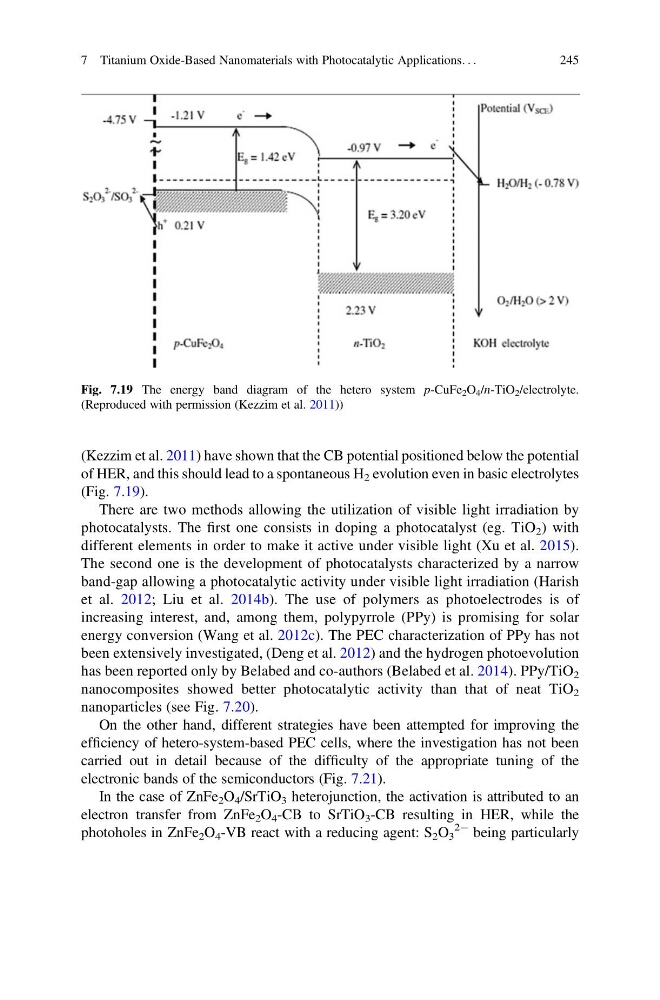
(Kezzim et al. 2011) have shown that the CB potential positioned below the potential
of HER, and this should lead to a spontaneous H 2 evolution even in basic electrolytes
(Fig. 7.19).
There are two methods allowing the utilization of visible light irradiation by
photocatalysts. The first one consists in doping a photocatalyst (eg. TiO 2 ) with
different elements in order to make it active under visible light (Xu et al. 2015).
The second one is the development of photocatalysts characterized by a narrow
band-gap allowing a photocatalytic activity under visible light irradiation (Harish
et al. 2012; Liu et al. 2014b). The use of polymers as photoelectrodes is of
increasing interest, and, among them, polypyrrole (PPy) is promising for solar
energy conversion (Wang et al. 2012c). The PEC characterization of PPy has not
been extensively investigated, (Deng et al. 2012) and the hydrogen photoevolution
has been reported only by Belabed and co-authors (Belabed et al. 2014). PPy/TiO 2
nanocomposites showed better photocatalytic activity than that of neat TiO 2
nanoparticles (see Fig. 7.20).
On the other hand, different strategies have been attempted for improving the
efficiency of hetero-system-based PEC cells, where the investigation has not been
carried out in detail because of the difficulty of the appropriate tuning of the
electronic bands of the semiconductors (Fig. 7.21).
In the case of ZnFe 2 O 4 /SrTiO 3 heterojunction, the activation is attributed to an
electron transfer from ZnFe 2 O 4 -CB to SrTiO 3 -CB resulting in HER, while the
photoholes in ZnFe 2 O 4 -VB react with a reducing agent: S 2 O 3
2À being particularly
Fig. 7.19 The energy band diagram of the hetero system p-CuFe 2 O 4 /n-TiO 2 /electrolyte.
(Reproduced with permission (Kezzim et al. 2011))
7 Titanium Oxide-Based Nanomaterials with Photocatalytic Applications. . .
245
of HER, and this should lead to a spontaneous H 2 evolution even in basic electrolytes
(Fig. 7.19).
There are two methods allowing the utilization of visible light irradiation by
photocatalysts. The first one consists in doping a photocatalyst (eg. TiO 2 ) with
different elements in order to make it active under visible light (Xu et al. 2015).
The second one is the development of photocatalysts characterized by a narrow
band-gap allowing a photocatalytic activity under visible light irradiation (Harish
et al. 2012; Liu et al. 2014b). The use of polymers as photoelectrodes is of
increasing interest, and, among them, polypyrrole (PPy) is promising for solar
energy conversion (Wang et al. 2012c). The PEC characterization of PPy has not
been extensively investigated, (Deng et al. 2012) and the hydrogen photoevolution
has been reported only by Belabed and co-authors (Belabed et al. 2014). PPy/TiO 2
nanocomposites showed better photocatalytic activity than that of neat TiO 2
nanoparticles (see Fig. 7.20).
On the other hand, different strategies have been attempted for improving the
efficiency of hetero-system-based PEC cells, where the investigation has not been
carried out in detail because of the difficulty of the appropriate tuning of the
electronic bands of the semiconductors (Fig. 7.21).
In the case of ZnFe 2 O 4 /SrTiO 3 heterojunction, the activation is attributed to an
electron transfer from ZnFe 2 O 4 -CB to SrTiO 3 -CB resulting in HER, while the
photoholes in ZnFe 2 O 4 -VB react with a reducing agent: S 2 O 3
2À being particularly
Fig. 7.19 The energy band diagram of the hetero system p-CuFe 2 O 4 /n-TiO 2 /electrolyte.
(Reproduced with permission (Kezzim et al. 2011))
7 Titanium Oxide-Based Nanomaterials with Photocatalytic Applications. . .
245